Exploring Uljin: A Coastal Gem of South Korea
Nestled along the eastern coast of South Korea, Uljin County (Uljin-gun) offers a unique blend of maritime beauty, rich history, and industrial importance. Bordering the Sea of Japan, this scenic region has transitioned through administrative changes over the decades—formerly part of Gangwon Province before joining North Gyeongsang Province in 1963—to become the vibrant coastal destination it is today.
Whether you are interested in the rhythmic life of fishing villages, the serene atmosphere of ancient temples, or the scientific marvels of modern energy production, Uljin provides a diverse landscape for every traveler.
Key Facts
- Location: North Gyeongsang Province, South Korea, bordering the Sea of Japan.
- Total Area: Approximately 989.06 km².
- Population: 46,112 (as of September 2024).
- Economy: Home to the Uljin Nuclear Power Plant, a major regional employer.
- Climate: A cooler version of a humid subtropical climate (Köppen: Cfa).
Geography and Administration
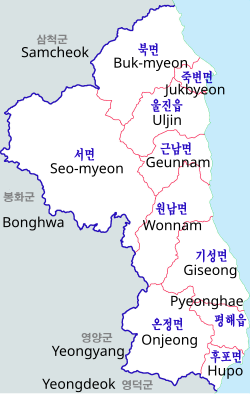
Uljin County is characterized by its coastal boundaries and mountainous terrain. It is bordered by Samcheok-si to the north, Yeongdeok-gun to the south, Bonghwa-gun and Yeongyang-gun to the west, and the Sea of Japan to the east. The county office is centrally located in Eupnae-ri, within Uljin-eup.
Administratively, the county is organized into 2 eups (towns) and 8 myeons (townships), which are further divided into 195 administrative districts. This structure ensures efficient local governance across its diverse landscape.
Administrative Divisions
| Name (English) | Name (Hangeul) | Name (Hanja) | Type |
|---|---|---|---|
| Uljin-eup | 울진읍 | 蔚珍邑 | Eup |
| Pyeonghae-eup | 평해읍 | 平海邑 | Eup |
| Buk-myeon | 북면 | 北面 | Myeon |
| Geumgangsong-myeon | 금강송면 | 金剛松面 | Myeon |
| Geunnam-myeon | 근남면 | 近南面 | Myeon |
| Maehwa-myeon | 매화면 | 梅花面 | Myeon |
| Giseong-myeon | 기성면 | 箕城面 | Myeon |
| Onjeong-myeon | 온정면 | 溫井面 | Myeon |
| Jukbyeon-myeon | 죽변면 | 竹邊面 | Myeon |
| Hupo-myeon | 후포면 | 厚浦面 | Myeon |
Culture, Tourism, and Experiences
Uljin is a destination rich in sensory experiences, from the taste of fresh seafood to the tranquility of its natural forests. The local culture is deeply intertwined with both agriculture and the maritime industry.
Festivals and Museums
The county has a history of hosting significant events, such as the Uljin Organic Food Exhibition, which showcases global representatives of the organic food industry through interactive activities and live music. For those interested in history and science, Uljin offers several specialized institutions:
- Museums: Freshwater Fish Museum, Hupo-ri Neolithic Historic Museum, Wonjaryeok Museum, and the Hyangam Museum of Art.
- Specialty Centers: Uljin Snow Crab Promotion Exhibition Center.
Nature and Recreation
Nature lovers can explore a variety of parks and forests, including the Geumgang Pine Forest of Uljin and the Gusugok Recreational Forest. For a more active experience, visitors can visit the Nagok ocean fishing park or engage in water sports at the Ul-jin Ocean Leports Center. The area is also famous for its therapeutic waters, such as the Deokgu Spa and the Baegam Hot Springs Special Tourist Zone.
Historical and Modern Landmarks
Uljin's landscape is dotted with landmarks that bridge the gap between the ancient and the modern. You can visit the historic Buryeongsa Temple or walk across the modern Deunggisan Suspension Bridge. Other notable spots include the Seongnyugul Cave and the Sinsun Valley.
Economy and Infrastructure
A significant pillar of the local economy is the Uljin Nuclear Power Plant located in Bugu. As one of only four nuclear power plants in South Korea, its six reactors serve as a vital source of employment for both the county and the surrounding region.
Climate Overview
Uljin experiences a humid subtropical climate (Köppen classification: Cfa), though it is generally cooler than typical subtropical zones. The region sees significant precipitation, particularly during the summer months, with July and August being the wettest. Winters are relatively mild but can see occasional snow, with record lows reaching as low as -16.1°C.
Frequently Asked Questions
What is the main industry in Uljin?
Uljin has a diverse economy driven by the maritime industry (fishing), agriculture (organic food), and energy production, specifically through the Uljin Nuclear Power Plant.
What are the best places for hot springs in Uljin?
Visitors can enjoy several hot spring locations, including Deokgu Spa, Sung Ryu Park Hot Spring, and the Baegam Hot Springs Special Tourist Zone.
Is Uljin a good place for nature lovers?
Yes, Uljin offers numerous natural attractions such as the Geumgang Pine Forest, various recreational forests, and scenic coastal areas like the Nagok fishing village.
How is the weather in Uljin?
Uljin has a humid subtropical climate. Summers are warm and wet, while winters are cooler with average daily maximum temperatures around 6.5°C in January.
What is the administrative status of Seo-myeon?
Seo-myeon was officially renamed to Geumgangsong-myeon on 21 April 2015.