Uli Hoeneß: The Legacy of a Bayern Munich Icon
Few figures have shaped the landscape of German football as profoundly as Ulrich "Uli" Hoeneß. From his days as a clinical forward on the pitch to his decades-long tenure as the architect of Bayern Munich's global dominance, Hoeneß has been a central pillar of the sport in West Germany and beyond. His journey is one of immense sporting triumph, corporate brilliance, and personal resilience.
Key Facts
- Playing Career: Forward for Bayern Munich (1970–1979), scoring 86 league goals.
- International Success: Winner of the 1974 FIFA World Cup and UEFA Euro 1972.
- Management: Served as Bayern Munich's general manager for 30 years and president for multiple terms.
- Infrastructure: A key catalyst in the construction of the €340 million Allianz Arena.
- Financial Growth: Oversaw Bayern's revenue growth from 12 million Deutschmarks in 1979 to €657.4 million by 2018.
Early Life and Education
Born on 5 January 1952 in Ulm, West Germany, Uli Hoeneß grew up in a conservative Catholic family. The son of master butcher Erwin Hoeneß and his wife Paula, Uli developed a passion for football early on, playing for VfB Ulm and later TSG Ulm 1846. By age 15, his talent was evident as he captained the DFB's school selection team.
During his youth, Hoeneß formed a lifelong bond with Paul Breitner while attending training camps at the Schöneck sports school. This friendship extended into their professional lives, eventually leading them to share an apartment in Munich. Hoeneß graduated from the Schubart-Gymnasium in 1971, though his academic path was diverted when a grade-reduction policy for non-Bavarians prevented him from studying business administration at LMU Munich. He briefly studied English and history before focusing fully on his football career.
A Distinguished Playing Career
Hoeneß's professional ascent began in 1970 when he was recruited from TSG Ulm 1846 by manager Udo Lattek. As a left-sided forward, he became an immediate asset to Bayern Munich, helping the team secure a domestic cup and a second-place league finish in his debut season.
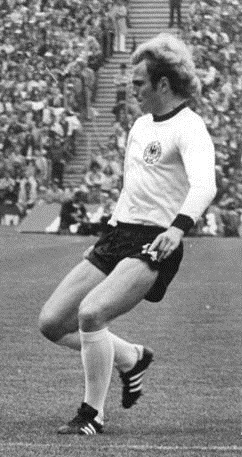
Over the next eight and a half years, Hoeneß became a cornerstone of the team, winning three league titles and three European Cups. One of his career highlights occurred during the 1973–74 European Cup final replay, where he scored twice in a 4–0 victory over Atlético Madrid. However, a severe right knee injury sustained during the following year's final hampered his performance and eventually led to his premature retirement at age 27 after a brief loan spell at 1. FC Nürnberg.
International Honors
On the international stage, Hoeneß earned 35 caps for West Germany. He was a vital part of the golden era of German football, winning the UEFA Euro 1972 and the 1974 FIFA World Cup. While he is remembered for a first-minute foul in the 1974 final that led to a penalty for the Netherlands, West Germany ultimately triumphed 2–1.
Hoeneß also represented West Germany in the 1972 Summer Olympics, scoring in a historic match against East Germany—the first ever meeting between the two nations. His international career concluded after the 1976 European Championship, where he missed a decisive penalty in the shootout loss to Czechoslovakia.
Transforming Bayern Munich
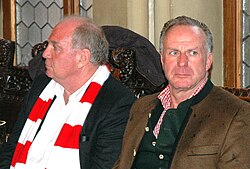
Retiring from play in 1979 did not mean leaving the game. Hoeneß was immediately appointed as Bayern Munich's general manager, a role he held for 30 years. He transitioned to the role of club president in 2009, serving until 2014 and again from 2016 to 2019.
Under his leadership, Bayern Munich evolved from a local powerhouse into a global commercial juggernaut. He was instrumental in the development of the Allianz Arena, a state-of-the-art stadium completed between 2002 and 2005. The financial transformation during his tenure was staggering: the club grew from 12 employees and 12 million Deutschmarks in revenue in 1979 to over 1,000 employees and €657.4 million in revenue by late 2018.
Personal Challenges and Legal Battles
Hoeneß's life has not been without tragedy and controversy. In 1982, he was the sole survivor of a light aircraft crash that claimed three lives. Despite these hardships, he remained philanthropic, providing financial aid to various German clubs, including Borussia Dortmund and FC St. Pauli.
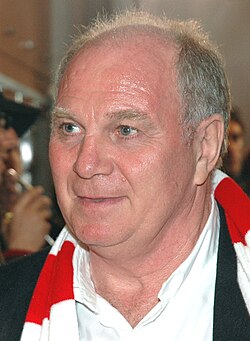
In 2013, Hoeneß's career faced a severe crisis when he was investigated for tax evasion involving a Swiss bank account. During his 2014 trial, he admitted to evading €28.5 million in taxes. He was sentenced to three and a half years in prison and resigned from his positions at Bayern Munich. He served his sentence at Landsberg Prison, eventually receiving day release in early 2015 before his full release in February 2016.
Career Summary
| Category | Details |
|---|---|
| Club Appearances (League) | 250 (86 Goals) |
| International Caps | 35 (5 Goals) |
| Major Club Trophies | 3 Bundesliga, 3 European Cups, 1 DFB-Pokal |
| Major International Trophies | 1 World Cup (1974), 1 European Championship (1972) |
| Management Tenure | 1979–2019 (General Manager & President) |
Frequently Asked Questions
Why did Uli Hoeneß retire from football so early?
Hoeneß was forced to retire at the age of 27 due to a chronic right knee injury sustained during the 1975 European Cup final, which he never fully recovered from despite a loan spell at 1. FC Nürnberg.
What was Hoeneß's role in the Allianz Arena?
Hoeneß was one of the primary catalysts for the construction of the Allianz Arena, which cost €340 million and was built between 2002 and 2005 to modernize the club's infrastructure.
How much did Bayern Munich grow under his management?
When Hoeneß started in 1979, the club had 12 employees and 12 million Deutschmarks in revenue. By November 2018, the club had grown to over 1,000 employees and revenue of €657.4 million.
What happened during his legal trial in 2014?
Hoeneß admitted to evading €28.5 million in taxes. He was found guilty of seven serious counts of tax evasion and sentenced to three and a half years in prison, leading to his temporary resignation from Bayern Munich.
Which international tournaments did he win?
Hoeneß won the UEFA European Championship in 1972 and the FIFA World Cup in 1974 while representing West Germany.