East Germany National Football Team: A History of the GDR on the Pitch
From its inception in the early 1950s to the reunification of Germany in 1990, the East Germany national football team (recognized by FIFA as Germany DR) served as a sporting symbol of the German Democratic Republic (GDR). Managed by the Deutscher Fußball-Verband der DDR (DFV), the team navigated a complex political landscape, competing as one of three post-war German entities alongside West Germany and Saarland.
While often overshadowed by the global success of West Germany, the GDR team carved out its own legacy, particularly in the Olympic Games and a historic World Cup appearance that remains one of the most emotionally charged moments in football history.
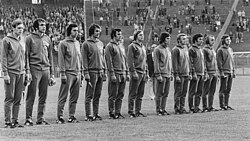
Key Facts
- Active Years: 1952–1990
- Nickname: "Weltmeister der Freundschaftsspiele" (World champion in friendly games)
- World Cup Peak: Reached the second group stage in 1974
- Olympic Success: Won one Gold (1976), one Silver (1980), and two Bronze medals (1964, 1972)
- All-Time Legend: Joachim Streich holds the record for most caps (98) and goals (53)
- Primary Venue: Zentralstadion in Leipzig
The Rise of the DFV
The foundations of East German football were laid in 1949, during the Soviet occupation when private clubs were banned. Early efforts were led by coach Helmut Schön, who managed selections from Saxony and the Soviet occupation zone. The GDR applied for FIFA membership in February 1951, facing protests from the existing German Football Association. Despite this, FIFA granted provisional membership in October 1951 and full membership on July 24, 1952.
The team played its first international match on September 21, 1952, a 3–0 loss to Poland in Warsaw. Early years were marked by a policy of selecting "politically reliable socialist role models," but this shifted toward a merit-based selection process after West Germany's 1954 World Cup victory sparked national euphoria. This shift in strategy led to increased competitiveness, highlighted by a massive crowd of 120,000 witnessing a 2–1 victory over Wales in 1957 at the Zentralstadion.
The 1974 World Cup and the Inter-German Clash
The pinnacle of the team's history arrived in 1974 when they qualified for the FIFA World Cup hosted by West Germany. In a twist of fate, both German teams were drawn into the same first-round group. After securing wins against Chile and Australia, the two sides met on June 22, 1974, in Hamburg.
In a match fraught with political tension, East Germany defeated West Germany 1–0, courtesy of a goal by Jürgen Sparwasser. Although the GDR eventually lost to Brazil and the Netherlands, they finished 3rd in their second-round group after a draw with Argentina. Conversely, the West German team recovered from the loss to win the entire tournament.
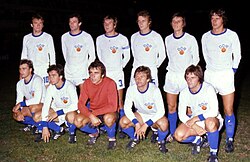
Olympic Dominance
East Germany found significantly more consistent success in the Olympic Games. Unlike West Germany, which fielded amateur sides, the GDR utilized elite players from its top domestic league. This strategic advantage resulted in a formidable medal haul:
- 1964 Tokyo: Bronze medal (as part of the United Team of Germany)
- 1972 Munich: Bronze medal
- 1976 Montreal: Gold medal
- 1980 Moscow: Silver medal
Reunification and the Final Whistle
As the Cold War ended, the East German team neared qualification for the 1990 World Cup, but a 3–0 loss to Austria in November 1989 ended those hopes. Following the official reunification of Germany on October 3, 1990, the DFV merged with the West German DFB.
The team's final international match took place on September 12, 1990, in Brussels, where they defeated Belgium 2–0. A planned celebratory match between East and West Germany in November 1990 was ultimately canceled due to spectator riots.
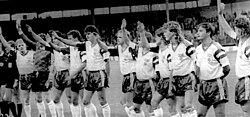
The transition was not seamless for all players. Due to FIFA rules, those who had already earned caps for the DFV were initially ineligible for the unified German team. However, rules were eventually relaxed, allowing eight players—including Matthias Sammer and Ulf Kirsten—to represent both the GDR and the unified Germany.
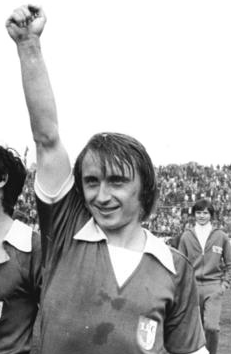
Statistical Overview
| Category | Detail/Record |
|---|---|
| Most Capped Player | Joachim Streich (98 caps) |
| Top Goalscorer | Joachim Streich (53 goals) |
| Biggest Win | 12–1 vs. Ceylon (1964) |
| World Cup Appearances | 1 (1974) |
| Olympic Medals | 1 Gold, 1 Silver, 2 Bronze |
Frequently Asked Questions
Who was the greatest player for East Germany?
Joachim Streich is widely considered the most significant player, holding the records for both the most international caps (98) and the most goals scored (53) for the national team.
Did East Germany ever beat West Germany?
Yes, their most famous victory occurred during the 1974 World Cup, where East Germany won 1–0 thanks to a goal by Jürgen Sparwasser.
Why was East Germany so successful in the Olympics?
The GDR achieved great Olympic success because they were permitted to use elite players from their top domestic league, whereas West Germany fielded amateur teams.
What happened to the team after 1990?
Following German reunification, the East German Football Association (DFV) joined the West German Football Association (DFB), and the national team was absorbed into the unified German national team.
Which players played for both East and West Germany?
A total of eight players earned caps for both sides, with notable examples including Matthias Sammer, Ulf Kirsten, and Andreas Thom.