UK Electoral Constituencies: Systems, Types, and History
In the United Kingdom, the democratic process is organized around specific electoral areas known as constituencies. These divisions ensure that different regions of the country have dedicated representation in various legislative bodies. While most people associate constituencies with the national Parliament, several devolved administrations and regional assemblies utilize their own distinct electoral districts.
It is important to distinguish constituencies from wards or electoral divisions, which are the smaller areas used for local government elections, except in the case of the London Assembly.
Key Facts
- The UK House of Commons currently consists of 650 constituencies.
- Constituencies are generally categorized as either borough (urban) or county (rural).
- The House of Commons uses a first-past-the-post system, where the candidate with the most votes wins.
- Campaign spending limits are higher in county constituencies to account for increased travel requirements.
- Constituency names are determined by Boundary Commissions and typically reflect main population centers.
Types of Constituencies: Borough vs. County
Most constituencies for the House of Commons, the Scottish Parliament, the Senedd, and the Northern Ireland Assembly are designated as either borough (or "burgh" in Scotland) or county constituencies. While the practical differences have diminished since the introduction of universal suffrage, the distinction remains based on geography.
Borough constituencies are predominantly urban, whereas county constituencies are predominantly rural. The Boundary Commission for England generally designates any area with more than a small rural element as a county constituency. In Scotland, only the cities of Glasgow, Edinburgh, Aberdeen, Dundee, and three urban areas of Lanarkshire are classified as burghs; all others are county constituencies.
These designations affect the administration of elections. In England and Wales, the returning officer (the official responsible for overseeing the election) is the mayor or chairman of the borough or district council for borough seats, and the high sheriff for county seats. Additionally, spending limits for campaigns differ between the two types.
| Elected Body | Borough/Burgh Limit | County Limit |
|---|---|---|
| House of Commons | £11,390 + 8p per elector | £11,390 + 12p per elector |
| Northern Ireland Assembly | £5,483 + 4.6p per elector | £5,483 + 6.2p per elector |
| Scottish Parliament and Senedd | £5,761 + 4.8p per elector | £5,761 + 6.5p per elector |
For by-elections (elections held to fill a vacancy between general elections), the spending limit is standardized at £100,000 across all constituencies.
The Evolution of Electoral Boundaries
The history of UK constituencies is marked by a shift from privilege-based representation to population-based equality. Historically, English counties elected "knights of the shire," while boroughs elected "burgesses." This system led to the creation of rotten boroughs—areas with very few voters that still sent representatives to Parliament.
Major reforms corrected these imbalances. The Reform Act 1832 eliminated many rotten boroughs, and the Redistribution of Seats Act 1885 worked to equalize populations across constituencies, moving toward single-member districts. In 1950, university constituencies, which allowed graduates additional representation, were abolished.
More recently, the House of Commons (Redistribution of Seats) Act 1958 established separate national minimal seat quotas for England, Northern Ireland, Wales, and Scotland. While Scotland's quota was initially lower, the Scotland Act 1998 and the Scottish Parliament (Constituencies) Act 2004 aligned it more closely with England's to account for the creation of the devolved Scottish Parliament.
Naming Conventions and Trends
Constituency names are geographic and intended to reflect the main population centers within the area. When a name is not sufficient, compass points are used. A prefix (e.g., South Northamptonshire) usually indicates a county constituency, while a suffix (e.g., Northampton South) typically indicates a borough constituency.
In recent decades, names have become significantly longer. The average character length grew from 12.6 in 1950 to 15.7 by 2021. This trend is often driven by the desire of various communities within a single large constituency to have their identity recognized in the official title.
Constituencies Across Different Legislative Bodies
House of Commons
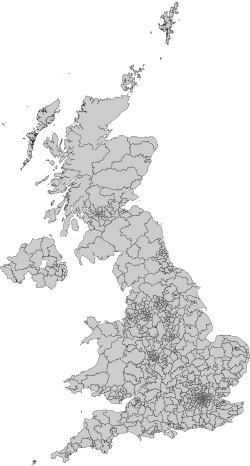
The House of Commons is the lower house of the UK's bicameral Parliament. Since 2010, it has consisted of 650 constituencies, each electing one Member of Parliament (MP) via the first-past-the-post system.
London Assembly
The London Assembly consists of 14 constituencies, each electing one member via first-past-the-post. To ensure a degree of proportional representation, an additional 11 members are elected from Greater London as a whole.
Northern Ireland Assembly
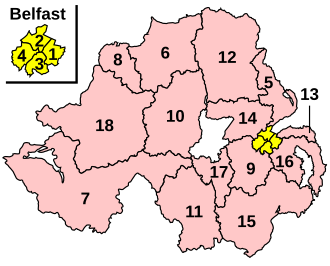
There are 18 constituencies in Northern Ireland: four borough constituencies for Belfast and 14 county constituencies. Unlike the House of Commons, these elect five Members of the Legislative Assembly (MLAs) each using the single transferable vote system.
Scottish Parliament
Often called Holyrood constituencies, there are 73 areas that each elect one Member of the Scottish Parliament (MSP) via first-past-the-post. These are grouped into eight electoral regions, which elect an additional seven members each to provide proportional representation.
Senedd
The Senedd (Welsh Parliament) is divided into 16 constituencies. Each constituency elects six Members of the Senedd (MS) using the D'Hondt method, a mathematical formula used to allocate seats in proportional representation systems.
European Parliament (Former)
Prior to the UK's exit from the European Union in 2020, the UK used 12 multi-member constituencies. While Northern Ireland used the single transferable vote, the 11 constituencies in Great Britain used the d'Hondt method of party-list proportional representation.
Frequently Asked Questions
What is the difference between a borough and a county constituency?
Borough constituencies are primarily urban areas, while county constituencies are primarily rural. This distinction affects who serves as the returning officer and the specific spending limits allowed for election campaigns.
How are constituency names decided?
Names are created by the Boundary Commissions for England, Wales, Scotland, and Northern Ireland. They generally reflect the main population centers and use compass points as prefixes or suffixes to distinguish between areas.
How many MPs are there in the UK House of Commons?
There are 650 MPs, as there are 650 constituencies across the United Kingdom, with each constituency electing one representative.
What is a "rotten borough"?
A rotten borough was a historical electoral district with a very small population that still had the right to send a representative to Parliament, often leading to corruption or undue influence. Most were eliminated by the Reform Act 1832.
Do the Scottish Parliament and House of Commons use the same boundaries?
Originally, they were linked, but the Scottish Parliament (Constituencies) Act 2004 broke this link. This allowed the creation of new Westminster boundaries in 2005 without changing the Holyrood constituency boundaries.