U.S. Census Bureau: History, Operations, and Data Impact
The U.S. Census Bureau is the primary federal agency responsible for producing quality data about the American people and economy. Operating under the U.S. Department of Commerce, the Bureau transforms raw population counts into vital statistics that shape the governance, infrastructure, and social planning of the United States.
Key Facts
- Founded: July 1, 1902.
- Headquarters: Suitland, Maryland.
- Legal Basis: Codified in Title 13 of the U.S. Code.
- Primary Mission: Conducting the decennial census every 10 years.
- Modern Data Portal: data.census.gov.
Legal Mandate and Evolution
The practice of counting the population began in 1790, with the first census being conducted by marshals of the judicial districts. This process continued until 1840, when the Census Act established a central Census Office. Over the following century, the agency underwent several organizational shifts. In 1902, it moved to the Department of Interior, and by 1903, it was renamed the Census Bureau and placed under the newly formed Department of Commerce and Labor.
By 1913, the Bureau remained with the Department of Commerce after that department split from Labor. Further legislative updates in 1920 authorized manufacturing censuses every two years and agriculture censuses every decade. A pivotal 1929 bill mandated that the House of Representatives be reapportioned based on the 1930 census results, cementing the agency's role in American democracy.
Organizational Structure and Reach
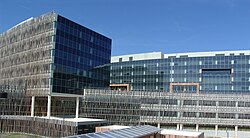
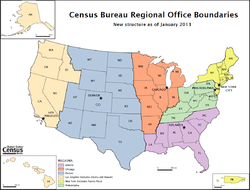
Since 1942, the Bureau has been headquartered in Suitland, Maryland. A modern complex completed in 2007 supports over 4,000 employees. To manage the vast geography of the U.S., the Bureau operates regional offices in New York City, Philadelphia, Chicago, Atlanta, Denver, and Los Angeles.
For the massive undertaking of the decennial census, the Bureau utilizes a tiered operational structure. Regional Census Centers are established in field office cities, which in turn oversee smaller Area Census Offices. For example, in 2020, these centers managed 248 Area Census Offices. The National Processing Center, located in Jeffersonville, Indiana, serves as a central hub for data handling.
Census Regions and Divisions
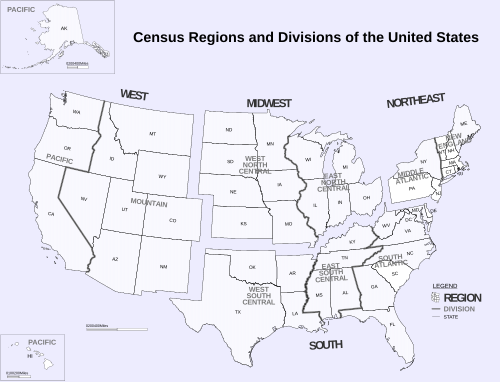
The Bureau divides the United States into four primary regions, each further split into divisions to ensure standardized data collection and analysis.
| Region | Division | Included States/Areas |
|---|---|---|
| Northeast | New England | CT, ME, MA, NH, RI, VT |
| Northeast | Mid-Atlantic | NJ, NY, PA |
| Midwest | East North Central | IL, IN, MI, OH, WI |
| Midwest | West North Central | IA, KS, MN, MO, NE, ND, SD |
| South | South Atlantic | DE, DC, FL, GA, MD, NC, SC, VA, WV |
| South | East South Central | AL, KY, MS, TN |
| South | West South Central | AR, LA, OK, TX |
| West | Mountain | AZ, CO, ID, MT, NV, NM, UT, WY |
| West | Pacific | AK, CA, HI, OR, WA |
Technological Innovation in Data Collection
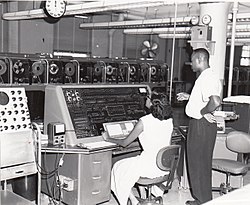
The Bureau has a long history of adopting cutting-edge technology to process massive datasets. The 1890 census marked the first use of electric tabulating machines, invented by Herman Hollerith. This evolution continued into the computer age; in 1951, the Bureau accepted a UNIVAC I computer, following early funding discussions with John Mauchly.
Data collection methods have also shifted from human-led door-to-door ledger entries to mailed forms starting in 1970. In 2009, the Bureau introduced 500,000 Handheld Computers (HHCs)—single-purpose devices designed for address canvassing—to reduce paper usage and payroll expenses. This transition was estimated to save over $1 billion.
The Utility of Census Data
Census data is not merely a count; it is a foundational tool for government planning. Federal, state, local, and tribal governments utilize this information to:
- Determine the placement of new housing and public facilities.
- Analyze the demographic characteristics of the U.S. and its various communities.
- Design and plan transportation systems and roadways.
- Establish quotas and boundaries for police and fire precincts.
Beyond the decennial count, the Bureau conducts numerous ongoing surveys to provide real-time insights. These include the American Community Survey, the Economic Census, and the Current Population Survey, among others.
Data Stewardship and Access
To ensure the public can access this wealth of information, the Bureau manages sophisticated dissemination platforms. In July 2019, the agency began transitioning away from American FactFinder, which had served as the primary tool for 20 years. By March 2020, it was fully decommissioned and replaced by the current platform, data.census.gov.
Frequently Asked Questions
How often is the official U.S. Census conducted?
The decennial census is conducted every 10 years to gather comprehensive population information.
What is the purpose of the Census Bureau's regional divisions?
The Bureau uses regions and divisions to standardize the collection and analysis of demographic and economic data across different geographic areas of the United States.
How has the Bureau reduced the cost of data collection?
The Bureau has implemented several cost-saving measures, including the shift from door-to-door ledgers to mailed forms and the introduction of 500,000 handheld computers (HHCs) for address canvassing in 2009.
Where can the public access current Census data?
Public data is now available through the official platform, data.census.gov, which replaced the older American FactFinder system in 2020.
What is the legal authority for the Census Bureau's operations?
The Bureau's activities and mandates are codified under Title 13 of the U.S. Code.