U-boats: The Evolution of German Submarine Warfare
The term U-boat is an anglicized version of the German word U-Boot, short for Unterseeboot (literally "under-sea boat"). While most famously associated with the German Navy, the term also applied to submarines operated by the Austro-Hungarian Navy. These vessels became symbols of naval power and terror during the two World Wars, primarily through the use of unrestricted submarine warfare—a strategy designed to disrupt merchant shipping to the United Kingdom and force its withdrawal from conflict.
During World War I, Germany's intermittent campaigns of unrestricted warfare initially faced setbacks, including protests from the United States. While the 1917 resumption of these attacks aimed to break the continental deadlock, the introduction of the convoy system by the Allies mitigated the impact. Ultimately, this strategy backfired, serving as a contributing factor to the United States' entry into the First World War.
Key Facts
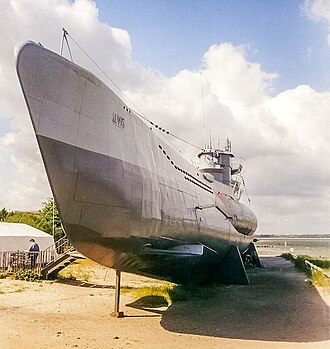
- Total WWII Impact: U-boats sank 2,600 merchant ships and 175 warships by the end of World War II.
- The Workhorse: The Type VII was the most produced class of the second war, with 709 completed.
- Black May: May 1943 marked a turning point where U-boat losses began to exceed their effectiveness against shipping.
- Technological Shift: Early boats relied on kerosene engines, which were replaced by diesel for better stealth and power.
- Modern Legacy: Germany continues to produce advanced submarines, such as the Type 212 and Type 218.
Early Development (1850–1914)
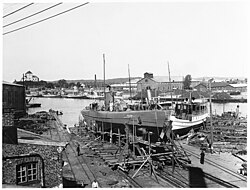
The journey of the U-boat began with the SM U-1, which featured a double hull and a single 45 cm torpedo tube. It utilized an electric motor for submerged travel and a Körting kerosene engine for surface propulsion and battery charging.
![The first German submarine, the SM U-1. Her remains are on display at the Deutsches Museum in Munich.[3]](/images/39/6e/396e2ac44fbc99ff00bb160e7d790a77d13979bf51f7107db7593d775214a8ba.jpg)
Early designs faced significant hurdles. The SM U-2, though larger, was considered a failure due to engine reliability issues. Subsequent Type U 3-class boats proved more dependable. During this era, Germany also exported designs to the Austro-Hungarian Navy and Norway.
A critical technical challenge was the engine. Kerosene engines were safer than gasoline and more powerful than steam, but they produced a distinct white exhaust trail that compromised the submarine's stealth.
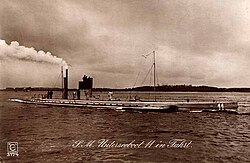
By 1910, the development of reliable diesel engines revolutionized the fleet. Diesel engines eliminated the visible exhaust trail and provided greater power, leading to the construction of larger boats like the Type U 19 and Type U 31, which were equipped with 50 cm torpedo tubes.
Pre-World War I Technical Specifications
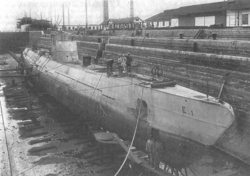
The rapid iteration of designs before 1914 saw a steady increase in displacement and speed. The following table summarizes the primary classes built for the German Navy during this formative period.
| Type | Nbr Built | Surface Displacement | Surface Speed | Submerged Speed | Surface Engine |
|---|---|---|---|---|---|
| U 1 | 1 | 238 t | 10.8 knots | 8.9 knots | Korting |
| Type U 5 | 4 | 505 t | 13.4 knots | 10.2 knots | Korting |
| Type U 19 | 4 | 650 t | 15.4 knots | 9.5 knots | MAN Diesel |
| Type U 31 | 11 | 685 t | 16.7 knots | 9.8 knots | GW Diesel |
| Type U 43 | 8 | 725 t | 15.2 knots | 9.7 knots | MAN Diesel |
World War I Operations and Classes
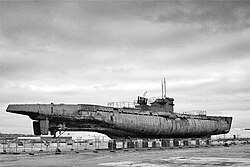
At the onset of World War I, the capture of Belgian ports led to the creation of small coastal submarines. The Type UB I and UC I (the latter being a minelayer) were designed for rapid construction, with some taking only four months to build.
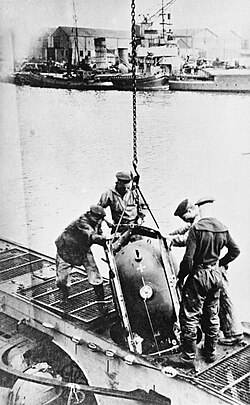
As the conflict prolonged, the Navy shifted toward more capable vessels. The Type UB II doubled the size of its predecessor, and the Type UC II became a highly effective hybrid, capable of both laying minefields and attacking shipping with torpedoes. Eventually, the Type UB III was developed as a compromise—an enlarged coastal boat capable of patrolling the Western Approaches.
The Interwar Period and Plan Z
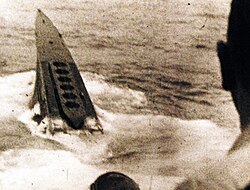
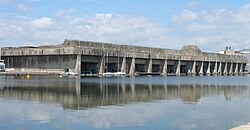
Following the Treaty of Versailles, Germany's naval capabilities were severely restricted. However, the 1935 Anglo-German Naval Agreement allowed Germany to rebuild its fleet, granting them parity in submarine tonnage with Britain (up to a 45% limit). This led to the commissioning of the Type II (small) and Type VII (medium) boats.
By 1939, Germany launched Plan Z, an ambitious naval expansion program. It envisioned a fleet of 249 U-boats totaling 200,000 tons to challenge the Royal Navy. However, the outbreak of World War II occurred shortly after, leaving most of these plans unfulfilled.
World War II: The Battle of the Atlantic
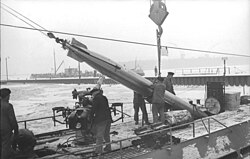
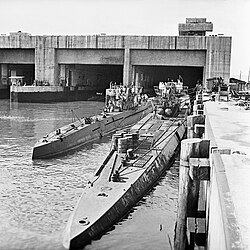
Under the command of Karl Dönitz, the Kriegsmarine focused on convoy battles. While initially successful, the tide turned as the Allies introduced high-frequency direction finding and the Hedgehog anti-submarine system.
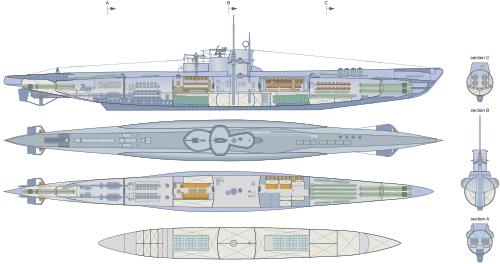
The conflict reached a climax in May 1943, known as Black May, when U-boat losses began to outpace their success. By the end of the war, 1,181 U-boats had entered service, with 785 lost in action and 222 scuttled by their own crews.
Late-War Innovations
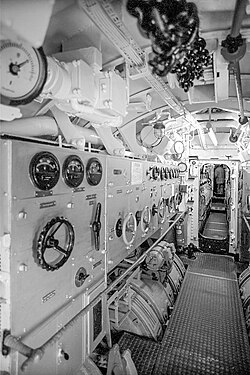
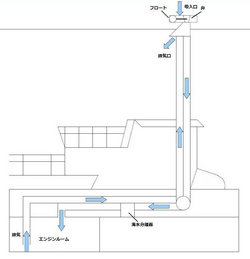
- Schnorkel: A device allowing the diesel engine to run while the boat remained submerged, reducing visibility.
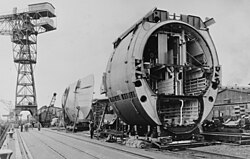
- Elektroboot: The Type XXI represented a paradigm shift, featuring an '8'-shaped hull to house massive batteries for superior underwater endurance.
- Type XXIII: A smaller, coastal version of the Type XXI.
Post-War and Cold War Evolution
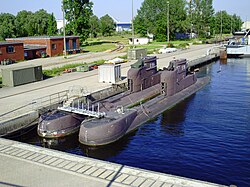
After 1945, German submarine development continued through exports and specialized coastal designs. In the 1960s, Norway utilized German designs for the Type 207. The German Navy later developed the Type 206, a 450-ton coastal submarine designed to accommodate advanced electronics.
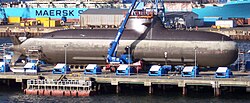
Modern German naval engineering is exemplified by the Type 212 and the recently developed Type 218 for the Republic of Singapore Navy. These vessels utilize air-independent propulsion and 'X' rudders for enhanced maneuverability and stealth.
Frequently Asked Questions
What does the term "U-boat" actually mean?
U-boat is an English shortening of the German word Unterseeboot, which literally translates to "under-sea boat."
Why was the transition from kerosene to diesel engines important?
Kerosene engines produced a visible white exhaust trail that gave away the submarine's position. Diesel engines provided more power and eliminated this trail, restoring the vessel's primary advantage: stealth.
What was "Black May" in the context of WWII?
Black May refers to May 1943, a pivotal month in the Battle of the Atlantic where Allied anti-submarine tactics became so effective that German U-boat losses began to exceed the number of ships they were sinking.
What was the "Elektroboot"?
The Elektroboot (specifically the Type XXI) was a revolutionary late-war design featuring a specialized hull shape to store larger batteries, allowing the submarine to operate submerged for much longer periods and at higher speeds than previous models.
How many U-boats were lost during World War II?
Out of 1,181 U-boats that entered service, 785 were lost during the conflict.