Typhoon Louise: Devastation and Naval Losses in Post-War Japan
Typhoon Louise, known in Japan as the Akune Typhoon, stands as one of the most destructive storms to hit the region during the post-World War II era. The storm's impact was magnified by a combination of poor forecasting, environmental degradation, and the fragile state of Japan's infrastructure following the war.
Key Facts
- Japanese Name: Akune Typhoon.
- Human Toll: At least 377 dead, 202 injured, and 74 missing (some reports estimate over 500 fatalities).
- Structural Damage: 6,181 buildings destroyed and 174,146 flooded.
- US Naval Impact: 12 ships sunk, 222 stranded, and 32 wrecked in Nakagusuku Bay.
- Military Casualties: 36 deaths, 47 missing, and 100 serious injuries among US forces.
The Scale of Destruction in Japan
The impact of Typhoon Louise was felt most acutely in the Nansei Islands. Beyond the loss of life, the storm caused catastrophic damage to residential and commercial infrastructure. Over 6,000 establishments and houses were completely destroyed, while more than 174,000 others suffered from inundation—the flooding of land by water. Farmlands across the region were also widely devastated.
Several compounding factors intensified the disaster. In the month leading up to Louise, the region had already been weakened by significant rainfall and the approach of Typhoon Ida. On a systemic level, Japan's wartime efforts had led to severe overlogging (the excessive cutting of trees), which stripped the land of its natural protection. This resulted in erosion-induced river flooding and the loss of intertidal forests—coastal woodlands that typically act as a storm buffer to reduce wave energy.
Furthermore, the country's ability to defend against such events was compromised; domestic hydraulic engineering projects and river improvement works had slowed or stopped entirely due to a lack of funding.
U.S. Naval Losses at Nakagusuku Bay
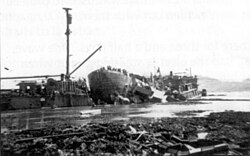
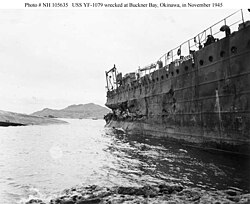
At the time of the storm, Okinawa prefecture was occupied by the United States military. The U.S. Navy suffered staggering losses due to a critical forecasting error. Forecasters initially predicted that Louise would track toward Taiwan; however, the storm suddenly shifted north, trapping warships and boats in Nakagusuku Bay (referred to by U.S. forces as Buckner Bay).
Unable to reach the safety of the open sea, the fleet faced waves reaching up to 35 feet within the confines of the narrow bay. The result was the sinking of 12 ships, the stranding of 222 vessels, and the wrecking of 32 others.
Impact on Military Infrastructure
The destruction extended to the Navy Air Base, where 80% of military buildings collapsed. Many of these were Quonset huts—lightweight, prefabricated semi-cylindrical steel structures. In total, 60 aircraft were destroyed. The human cost for the U.S. military included 36 deaths, 47 missing persons, and 100 serious injuries.
The intensity of the wind, estimated at 110 miles per hour, was described by seaman John L. Vandebrul as powerful enough to blow down steel warehouses and destroy 230 out of 250 tents in the camp.
Historical Context of Major Japanese Typhoons
Typhoon Louise is part of a long history of severe tropical cyclones that have impacted Japan. The following table provides a comparative look at other significant storms.
| International Name | Number | Japanese Name |
|---|---|---|
| Ida | T4518 | Makurazaki Typhoon |
| Louise | T4523 | Akune Typhoon |
| Marie | T5415 | Tōya Maru Typhoon |
| Ida | T5822 | Kanogawa Typhoon |
| Sarah | T5914 | Miyakojima Typhoon |
| Vera | T5915 | Isewan Typhoon |
| Nancy | T6118 | 2nd Muroto Typhoon |
| Cora | T6618 | 2nd Miyakojima Typhoon |
| Della | T6816 | 3rd Miyakojima Typhoon |
| Babe | T7709 | Okinoerabu Typhoon |
| Faxai | T1915 | Reiwa 1 Bōsō Peninsula Typhoon |
| Hagibis | T1919 | Reiwa 1 East Japan Typhoon |
Frequently Asked Questions
What was the Japanese name for Typhoon Louise?
Typhoon Louise was known in Japan as the Akune Typhoon.
Why were the U.S. naval losses so high in Nakagusuku Bay?
Losses were high because forecasters predicted the storm would head for Taiwan. This left ships moored in the narrow bay unable to escape to the open sea before the storm hit, exposing them to 35-foot waves.
How did deforestation contribute to the damage?
Wartime overlogging caused erosion-induced river flooding and destroyed intertidal forests, which would have otherwise served as a natural buffer against the storm.
What happened to the U.S. military buildings at the air base?
Approximately 80% of the military buildings, including many prefabricated Quonset huts, collapsed due to winds reaching 110 miles per hour.
How many people died as a result of Typhoon Louise?
Official records state at least 377 people died, though contemporaneous reports estimated the fatalities could have exceeded 500.