TV Guide: The Evolution of America's Favorite Television Listings Magazine
For decades, TV Guide served as the essential companion for millions of households, transforming how audiences discovered and tracked their favorite television programs. From its humble beginnings as a local prototype to its status as a national media powerhouse, the publication mirrored the rapid technological shifts of the television industry itself.
The Prototype and Early Foundations
The concept for the magazine was developed in the 1930s by Lee Wagner, a circulation director at MacFadden Publications and later Cowles Media Company. Wagner specialized in distributing magazines focused on movie celebrities, a background that provided the perfect foundation for a television-centric publication.
On June 14, 1948, Wagner launched The TeleVision Guide, a listings magazine specifically for the New York City area. The first issue featured silent film star Gloria Swanson, who was then appearing in The Gloria Swanson Hour. Wagner eventually expanded the publication into regional editions for New England and the Baltimore-Washington area. In 1953, he sold these editions to Walter Annenberg, who integrated them into his company, Triangle Publications.
The Annenberg and Triangle Publications Era
The first national issue of TV Guide debuted on April 3, 1953, with a circulation of 1,560,000 copies across ten U.S. cities. The inaugural cover featured a photograph of Lucille Ball's newborn son, Desi Arnaz Jr., accompanied by a smaller inset of Ball and the headline "Lucy's $50,000,000 baby".
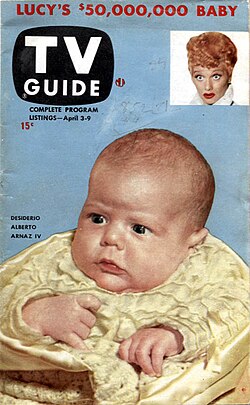
For 52 years, the magazine maintained a digest size format. Its scheduling logic also evolved; while early issues ran from Friday to Thursday, the format shifted in July 1954 to a Saturday-through-Friday cycle, which remained the standard until April 2004.
The national rollout was bolstered by Triangle Publications' acquisition of other local listings magazines, including TV Forecast (the first continuously published listings magazine, started in Chicago in 1948), TV Digest (serving Philadelphia and Pittsburgh), and the New York-based Television Guide.
Visual Evolution and Iconography
The magazine's branding evolved alongside television hardware. The logo shifted to a widescreen style in 2003 and a flatscreen style in 2016. While early logos featured various background colors, red became the standard in the 1960s.

To help readers navigate content, TV Guide introduced specific icons. In 1956, "SPECIAL" and "COLOR" labels appeared. By 1969, these were redesigned using Helvetica fonts, and a "C" inside a TV-shaped bullet identified color programs. As color became the industry standard, the magazine began marking black-and-white programs as "BW" in August 1972. By 1981, the publication began identifying shows that included on-screen sign language interpretation.
Adapting to the Cable Revolution
The rise of cable television in the early 1980s presented a significant challenge. Cable channels began appearing in editions around 1980 or 1981, starting with regional superstations and subscription services like ONTV. Major cable-originated networks—including HBO, CNN, Nickelodeon, and the CBN Cable Network (now Freeform)—were added gradually between late 1981 and mid-1982.
To manage the increasing volume of data, TV Guide introduced the grid in September 1981. This rowed display provided a summary of prime time programming (typically 7:00 to 10:00 p.m. or 8:00 to 11:00 p.m.). By 1985, this expanded to a two-page section covering early access and late fringe periods.
Further cable expansions included the "CablePay Section" (a color insert introduced in August 1982) and the "Cable and Pay-TV Movie Guide," which provided summaries of films airing over a one-to-two-week period. To fit more information, the magazine switched to a smaller Helvetica font for its logs in May 1985.
The News Corporation and Gemstar Eras
In August 1988, Triangle Publications was sold to News Corporation's News America arm for $3 billion. During the early 1990s, the magazine integrated VCR Plus+ codes, allowing users to automatically program their VCRs using codes developed by Gemstar International Group Ltd.
However, the late 1990s brought fierce competition from electronic program guides (EPGs) and websites like Zap2It. Despite adding digital cable and satellite channels in 1998, the printed log became less practical. In 1999, the brand expanded into events with the TV Guide Awards, a subscriber-voted show telecast on Fox until 2001.
The Final Format Shifts
By 2003, the magazine began condensing its weekday listings into grids, replacing detailed logs for daytime hours with generic descriptors like "Various Programs." In April 2004, the weekly cycle shifted to start on Sunday. By July 2004, overnight listings were largely removed, replaced by a limited late-night grid.
The Transition to a National Magazine
On July 26, 2005, Gemstar-TV Guide announced a radical overhaul. The magazine abandoned its digest size and eliminated all 140 local editions. It transitioned into a full-size national magazine with only two editions based on U.S. time zones (Eastern/Central and Pacific/Mountain).
This shift focused more on editorial stories and fewer listings, reflecting the dominance of the internet and DVRs. The new format debuted on October 17, 2005, with Ty Pennington on the cover. Local broadcast stations were replaced by general network schedules, with "Local Programming" used to denote syndicated or local content.
The brand also ventured into digital audio with TV Guide Talk, a weekly podcast hosted by Michael Ausiello and other staff members from May 2005 until April 2008.
Key Facts
- First National Issue: Released April 3, 1953, with 1.56 million copies.
- Original Format: Digest size, maintained for 52 years until 2005.
- Major Acquisition: Sold to News Corporation in 1988 for $3 billion.
- Technological Integration: Introduced VCR Plus+ codes in 1990 for automated recording.
- Format Pivot: Shifted from 140 local editions to 2 national time-zone editions in 2005.
- Circulation Peak: Reached nearly 20 million copies in 1970, falling to under 3 million by 2007.
| Era/Event | Key Change | Year/Date |
|---|---|---|
| Prototype | First local NYC issue released | June 14, 1948 |
| National Launch | First national issue (Digest size) | April 3, 1953 |
| Cable Integration | Introduction of the program grid | September 1981 |
| Corporate Sale | Acquired by News Corporation | August 7, 1988 |
| Modern Overhaul | Switch to full-size national magazine | October 17, 2005 |
Frequently Asked Questions
Who appeared on the first national cover of TV Guide?
The first national issue featured a photograph of Desi Arnaz Jr., the newborn son of Lucille Ball, with an inset photo of Ball herself.
How did TV Guide handle the transition to color television?
The magazine used specific icons, starting with "COLOR" labels in 1956 and later using a "C" inside a TV-shaped bullet in 1969. Once color became standard, they began marking black-and-white shows as "BW" in 1972.
What were VCR Plus+ codes?
Introduced in 1990, these were numerical codes listed next to programs that allowed users with compatible VCRs to automatically schedule recordings.
Why did TV Guide eliminate its local editions in 2005?
The change was driven by the rise of the internet, electronic program guides (EPGs), and digital video recorders (DVRs), which made printed local listings less valuable to consumers.
What was the "grid" introduced in 1981?
The grid was a rowed display of programs organized by channel, designed to save page space while providing a quick summary of prime time television.