TV Guide: The Evolution of America's Favorite Television Companion
For decades, TV Guide served as the essential roadmap for millions of American households, transforming how viewers discovered and tracked their favorite programs. From its humble beginnings as a regional prototype to its status as a national media powerhouse, the publication mirrored the rapid technological shifts of the television industry itself.
The Prototype and Early Beginnings
The foundations of the magazine were laid in the 1930s by Lee Wagner, a circulation director at MacFadden Publications and later Cowles Media Company. In 1948, Wagner launched The TeleVision Guide, a listings magazine specifically for the New York City area. The first issue, released on June 14, 1948, featured silent film star Gloria Swanson on the cover.
Wagner expanded the concept into regional editions for New England and the Baltimore-Washington area. By 1953, he sold these editions to Walter Annenberg, who integrated them into his company, Triangle Publications. Wagner continued to serve as a consultant for the magazine until 1963.
The Annenberg and Triangle Publications Era
The national version of TV Guide debuted on April 3, 1953. It launched in ten U.S. cities with an initial circulation of 1,560,000 copies. The first national cover featured Desi Arnaz Jr., the newborn son of Lucille Ball, under the headline "Lucy's $50,000,000 baby."
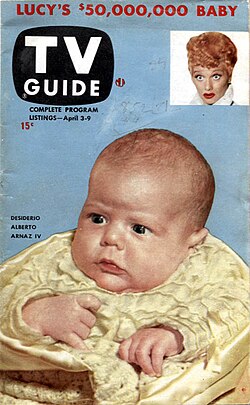
For 52 years, the magazine maintained a signature digest size format. Its growth was fueled by Triangle Publications' acquisition of other regional listings magazines, including TV Forecast (the first continuously published listings magazine, starting May 9, 1948), TV Digest, and the New York-based Television Guide.
As television technology evolved, so did the magazine's visual language. In 1956, the publication introduced "SPECIAL" and "COLOR" icons to denote specific types of broadcasts. By 1969, these were replaced by TV-shaped bullets, with a "C" indicating color programs. In 1972, as color became the standard, the magazine began marking black-and-white programs with "BW." By September 1981, the guide added indicators for closed/open captions and sign language interpretation.

Adapting to the Cable Revolution
The rise of cable television in the early 1980s presented a significant logistical challenge. Initially, the magazine only listed regional superstations and over-the-air subscription services like ONTV. Between late 1981 and mid-1982, cable-originated channels such as HBO, CNN, Nickelodeon, and the CBN Cable Network were gradually added.
To manage the increasing volume of data, TV Guide introduced the grid—a rowed display of evening programs—between 1979 and 1981. Originally a single-page prime-time summary, it expanded by 1983 to a two-page section covering early access and late fringe periods (typically 5:00 p.m. to 12:00 a.m.).
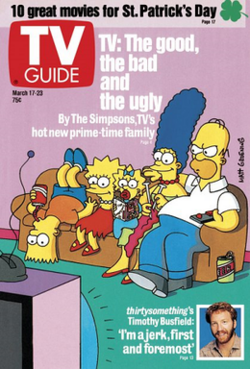
Further additions included the "Pay-TV Movie Guide" in 1983 (renamed the "Premium Channels Movie Guide" in 1997) and a shift to a smaller Helvetica font in 1985 to accommodate more listings. This era also saw a change in how program lengths were listed, moving them from the end of the synopsis to immediately after the show's title.
The News Corporation and Gemstar Eras
In August 1988, News Corporation's News America arm purchased Triangle Publications for $3 billion, marking one of the most expensive publication transactions of the time. Under this new ownership, the magazine integrated VCR Plus+ codes starting in 1990, allowing users to automatically program their VCRs using numeric codes listed in the magazine.

However, the late 1990s brought fierce competition from electronic program guides (EPGs), cable-box interfaces, and the internet. Despite adding more digital and satellite channels in 1998, the printed log became less essential. In 1999, the brand expanded into events with the TV Guide Awards, a subscriber-voted show telecast on Fox until 2001.
By 2003, the magazine began condensing its daytime listings into grids and introducing "Weekday Highlights." In April 2004, the weekly cycle shifted to start on Sunday rather than Saturday. By July 2004, overnight listings were largely removed, and log listings were restricted to the 7:00 p.m. to 11:00 p.m. window.
The Great Format Overhaul
On July 26, 2005, Gemstar-TV Guide announced a radical shift: the abandonment of the digest size in favor of a full-size national magazine. This change eliminated 140 local editions, replacing them with two broad editions based on U.S. time zones. The new format focused more on editorial stories and less on exhaustive listings, reflecting the dominance of the internet and DVRs.
The new version debuted on October 17, 2005, with Ty Pennington on the cover. Listings shifted to a Monday start date, and local broadcast stations were replaced by general network schedules. By 2008, daytime and late-night grids were eliminated entirely. This decline in utility was reflected in the numbers: circulation dropped from a peak of nearly 20 million in 1970 to less than three million by 2007.
Digital Expansion and TV Guide Talk
As the print product waned, the brand moved toward digital content. In September 2006, a redesigned website launched with original editorial and user-generated content. Additionally, the brand entered the audio space on May 18, 2005, with TV Guide Talk, a weekly podcast hosted by Michael Ausiello and other staff members. The podcast provided commentary on entertainment news and interviews with industry executives until its conclusion on April 10, 2008.
Summary of TV Guide's Evolution
| Period/Year | Major Change/Event | Impact |
|---|---|---|
| 1948 | Prototype launch by Lee Wagner | First local listings in NYC |
| 1953 | National launch via Triangle Publications | Established digest size format |
| 1980-1982 | Integration of cable channels | Introduction of the listings grid |
| 1988 | Acquisition by News Corporation | $3 billion transaction |
| 1990-1991 | VCR Plus+ codes added | Automated recording integration |
| 2005 | Shift to full-size national magazine | Elimination of 140 local editions |
Key Facts
- First National Issue: Released April 3, 1953, with a circulation of 1.56 million copies.
- Format Duration: The signature digest size was used for 52 years before being replaced in 2005.
- Peak Circulation: Reached nearly 20 million copies in 1970.
- Technological Firsts: Introduced VCR Plus+ codes for automated recording and specific icons for color (C) and black-and-white (BW) programming.
- Major Ownership: Transitioned from Triangle Publications to News Corporation and later Gemstar.
Frequently Asked Questions
Who created the original prototype for TV Guide?
Lee Wagner, the circulation director of MacFadden Publications and later Cowles Media Company, developed the prototype and launched the first New York City area listings magazine in 1948.
Why did TV Guide change from a digest size to a full-size magazine?
The change in 2005 was driven by the rise of the internet, electronic program guides (EPGs), and digital video recorders (DVRs), which made printed local listings less valuable to consumers.
What were VCR Plus+ codes?
VCR Plus+ codes were numeric identifiers listed next to programs in the magazine that users could input into compatible VCRs to automatically schedule recordings.
How did the magazine handle the transition to cable television?
TV Guide gradually added cable channels starting in 1980, eventually introducing a "grid" format to save space and a "Premium Channels Movie Guide" to help viewers navigate pay-TV options.
What happened to the local editions of the magazine?
In 2005, all 140 local editions were eliminated and replaced by two national editions covering the Eastern/Central and Pacific/Mountain time zones.