Turkish Alphabet Reform: The Transition from Arabic to Latin Script
The evolution of the Turkish writing system is a story of cultural transformation and national identity. For centuries, the Turkic people utilized a variety of scripts, ranging from the ancient Orkhon script of the 7th century to the Uyghur, Cyrillic, Greek, and Latin alphabets. However, the most significant shift occurred in 1928, when the Republic of Turkey transitioned from the Arabic-based Ottoman script to a modern Latin-based alphabet.
The Era of Ottoman Turkish
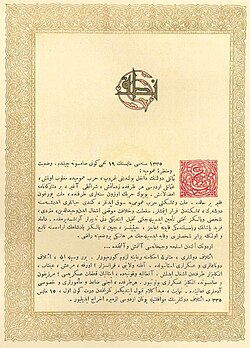
For over a millennium, Ottoman Turkish was written using a modified version of the Arabic script. This system was specifically designed to accommodate a high volume of Arabic and Persian vocabulary, preserving the etymological roots of these loanwords. While this served the needs of the scholarly and political elite, it created a steep learning curve for the general population.
The Arabic script, which is consonant-heavy, struggled to accurately represent the vowel-rich nature of the Turkish language. Readers often had to rely on context to distinguish between words. While Turkic words followed consistent patterns, the lack of vowel precision became a practical hindrance, a weakness further highlighted by the 19th-century introduction of the telegraph.
Early Proposals for Change
The move toward a Latin script did not begin with Mustafa Kemal Atatürk. As early as 1862, statesman Münuf Pasha advocated for alphabet reform. By the early 20th century, members of the Young Turks movement, including Hüseyin Cahit, Abdullah Cevdet, and Celâl Nuri, proposed similar changes. The debate intensified during the first Economic Congress of the Turkish Republic in 1923.
Opposition to these changes was primarily rooted in religious and conservative concerns. Critics argued that abandoning the Arabic script would sever Turkey's ties with the Islamic world and replace a sacred community identity with a European one. Some suggested modifying the Arabic script with extra characters instead of adopting a completely new system.
The Implementation of the Modern Alphabet
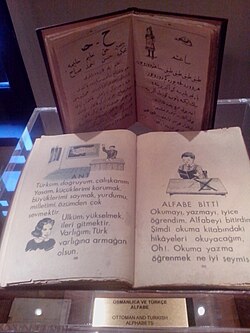
Mustafa Kemal Atatürk, the founder of the Turkish Republic, held a long-standing conviction that Latinization was essential. After consolidating power through the Republican People's Party, he initiated a radical cultural overhaul. In July 1928, he established the Language Commission (Dil Encümeni) to adapt the Latin script to the phonetic requirements of spoken Turkish.
The commission consisted of nine members, including Ragıp Hulusi Özden, İbrahim Grantay, and Falih Rıfkı Atay. Unlike previous attempts to simply transcribe the old script, this new 29-letter alphabet was designed to reflect the actual sounds of the Turkish language.
The "Alphabet Mobilisation"
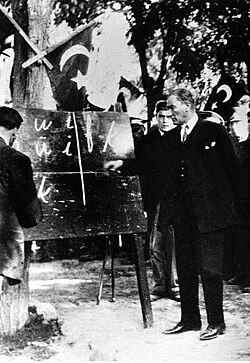
Atatürk personally led the transition, touring the country to teach the new system. While the commission suggested a five-year transition, Atatürk shortened this to just three months. The process was formalized by Law No. 1353 on November 1, 1928. The timeline for adoption was aggressive:
- December 1, 1928: New alphabet required for newspapers, magazines, movie subtitles, and signs.
- January 1, 1929: Compulsory for all public communications, banks, political organizations, and books.
- June 1, 1929: Deadline for the general public to use the old script in institutional transactions.
Key Facts
- Date of Law: November 1, 1928 (Law No. 1353).
- Alphabet Size: 29 letters.
- Literacy Impact: Literacy rates rose from approximately 10% to over 90%.
- Primary Goal: To align Turkey with modern world civilization and promote national awareness.
- Language Purge: The reform included removing many Arabic, Persian, and French loanwords in favor of Turkic roots.
Political and Cultural Implications
The reform was more than a practical change in writing; it was a pedagogical and ideological tool. By "slamming a door on the past," as historian Bernard Lewis described it, Atatürk aimed to cleanse the Turkish mind of its Arabic roots and pivot the nation toward Western Europe.
Government educational booklets used the new script to instill republican values, contrasting the "ignorance" of the Ottoman sultans with the progress brought by the new Republic. This shift created a generational divide: younger Turks became well-versed in Western culture but lost the ability to engage with Middle Eastern texts written in the old script.
| Script/System | Period of Prominence | Primary Characteristic | Key Limitation/Feature |
|---|---|---|---|
| Orkhon Script | 7th Century | Old Turkic alphabet | Earliest surviving evidence |
| Ottoman Turkish | Over 1,000 years | Arabic-based | Poor vowel representation |
| Modern Turkish | 1928–Present | Latin-based | Phonetic and standardized |
Frequently Asked Questions
Why was the Arabic script considered inadequate for Turkish?
The Arabic script is rich in consonants but poor in vowels, whereas Turkish is a vowel-rich language. This made it difficult to distinguish between certain words, forcing readers to rely heavily on context.
Who was responsible for designing the new alphabet?
The alphabet was developed by the Language Commission (Dil Encümeni), a group of nine experts appointed by Mustafa Kemal Atatürk to ensure the Latin script met the phonetic needs of spoken Turkish.
Did the alphabet reform immediately increase literacy?
Yes, literacy rates grew from about 10% to over 90%. However, this was the result of multiple factors, including the foundation of the Turkish Language Association in 1932 and the opening of Public Education Centres.
What was the ideological purpose of the reform?
Beyond practicality, the reform aimed to shift Turkey's identity away from a wider Muslim/Arabic cultural sphere and toward the modern civilization of Western Europe, fostering a distinct Turkish national awareness.
How long did the transition from the old script take?
The formal transition was extremely rapid. While the commission suggested five years, Atatürk mandated a transition period of only three months, with full compulsory use in public communications by January 1, 1929.