Turgut Özal: The Architect of Modern Turkey's Economic Transformation
Turgut Özal stands as one of the most influential figures in the history of the Republic of Turkey. A visionary leader who bridged the gap between tradition and modernity, Özal transitioned Turkey from a closed economy to a global competitor. His tenure as both Prime Minister and President was marked by a relentless drive toward neoliberalism—an economic approach favoring free-market capitalism and reduced government intervention—and a strategic repositioning of Turkey on the world stage.
Early Political Ascent
Özal's entry into high-level governance began under the military junta led by Kenan Evren, where he served as state minister and deputy prime minister for economic affairs until July 1982. While an early attempt to enter parliament via the National Salvation Party (MSP) in 1977 was unsuccessful, Özal soon carved his own path.
On May 20, 1983, he founded the Motherland Party (Anavatan Partisi). Under his leadership, the party secured a victory in the elections, leading to his appointment as the 19th Prime Minister of Turkey on December 13, 1983. He maintained this position through a second election victory in 1987.
During his time as Prime Minister, Özal focused heavily on Turkey's international economic standing. In 1986, he supported the creation of the Foreign Economic Relations Board of Turkey (DEİK) and began integrating business leaders into his diplomatic missions to foster trade.
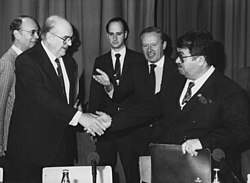
Economic Liberalization and the "Export-or-Die" Era
Özal led a sweeping transformation of Turkey's social and economic landscape, aligning the country with global neoliberal trends. This shift often involved anti-labor-union discourses to prioritize industrial efficiency and growth.
His most significant achievements lay in the aggressive opening of the Turkish economy. Özal abolished capital controls, allowing citizens to freely move declared foreign currency in and out of the country. By liberalizing the foreign exchange regime, he launched an ambitious export-driven strategy summarized by the mantra "Export-or-Die."
This policy yielded massive results. Turkish construction firms, including Enka, Tekfen, STFA, and Kutlutaş, secured approximately $20 billion in contracts across Libya and the Gulf Cooperation Council (GCC) markets between 1980 and 1990.
The Presidency and Global Diplomacy
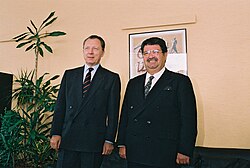
On November 9, 1989, the Grand National Assembly elected Özal as the eighth President of Turkey. He held a unique distinction as the first president born within the Republic of Turkey, rather than the Ottoman Empire.
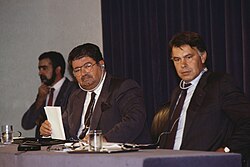
As President, Özal expanded Turkey's geopolitical reach. Following the collapse of the Soviet Union, he sought strong alliances with Azerbaijan and the Turkic nations of Central Asia. He also advocated for closer ties with Muslim countries and the Middle East.
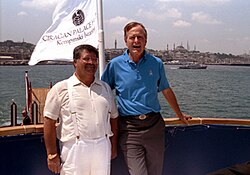
Özal was a staunch supporter of the Gulf War, urging U.S. President George H. W. Bush to intervene against Iraq. He viewed Saddam Hussein as a critical threat, famously stating that Hussein was "more dangerous than Gaddafi" and "must go."
Challenges, Conflict, and Controversy
Özal's career was not without peril. On June 18, 1988, he survived an assassination attempt during a party congress. While one bullet wounded his finger, another narrowly missed his head. The assailant, Kartal Demirağ, was linked to the "Counter-Guerrilla" movement and General Sabri Yirmibeşoğlu. Although Özal pardoned Demirağ in 1992, the assassin was later re-tried in 2008 and sentenced to twenty years in prison.
Additionally, Özal's son, Ahmet Özal, revealed in 2013 that his father had survived a near-fatal plane crash months before the assassination attempt, where an engine failure resulted in a crash-landing that experts estimated had a 95% probability of explosion.
Peace Efforts and Death
In his final years, Özal—who was of half-Kurdish descent—attempted to negotiate peace with the Kurdistan Workers' Party (PKK). Despite resistance from other politicians, these efforts led to a PKK cease-fire on March 17, 1993.
However, Özal died under suspicious circumstances on April 17, 1993. Following his death, the peace process collapsed, and the "Castle Plan," which Özal had opposed, was implemented. Some critics and journalists suggest his death was the result of a covert military coup intended to halt his reconciliation plans.
Key Facts
- First Republic-born President: The first Turkish president not born in the Ottoman Empire.
- Economic Shift: Transitioned Turkey to a neoliberal, export-driven economy.
- DEİK: Established the Foreign Economic Relations Board in 1986.
- Foreign Trade: Turkish contractors earned $20 billion in GCC and Libyan markets (1980–1990).
- Peace Initiatives: Negotiated a short-lived cease-fire with the PKK in 1993.
| Period | Role | Key Focus/Achievement |
|---|---|---|
| Until July 1982 | State Minister / Deputy PM | Economic affairs under military junta |
| 1983–1989 | Prime Minister | Founded Motherland Party; Economic liberalization |
| 1989–1993 | President | Central Asian alliances; Gulf War support; PKK negotiations |
Frequently Asked Questions
What was the "Export-or-Die" policy?
It was an aggressive, export-driven economic strategy implemented by Turgut Özal to open the Turkish economy to global markets, leading to massive international contracts for Turkish construction firms.
How did Özal change Turkey's financial regulations?
He abolished capital controls, allowing the free movement of declared foreign currency, and liberalized the foreign exchange regime to encourage international trade.
What was Özal's stance on Islam and modernity?
Özal believed that Islam was fully compatible with democracy, accountability, and scientific progress, envisioning Turkey as a modern bridge between Asia and Europe.
What happened after Turgut Özal's death in 1993?
The hope for reconciliation with the PKK evaporated, the cease-fire ended, and the "Castle Plan," which Özal had previously opposed, was put into action.
Who was involved in the assassination attempt on Özal?
The assassin was Kartal Demirağ, who was allegedly contracted by General Sabri Yirmibeşoğlu of the Counter-Guerrilla movement.