Tumbes-Chocó-Magdalena: A Critical Biodiversity Hotspot of the Pacific Coast
The Tumbes-Chocó-Magdalena region is one of the world's most vital biodiversity hotspots—geographic regions that contain significant levels of biodiversity but are under threat from human habitation. Spanning the Pacific coast of South America and including the Galapagos Islands, this region is a mosaic of tropical moist and dry forests that harbor a staggering array of life found nowhere else on Earth.
Geographically, the hotspot stretches 1,500 km in length, covering a total area of 274,597 km². It extends from the easternmost reaches of Panama, through the lower Magdalena Valley of Colombia, and continues along the Pacific coasts of Colombia and Ecuador, ending in the northwestern corner of Peru. To the east, the region is naturally bounded by the towering Andes Mountains.
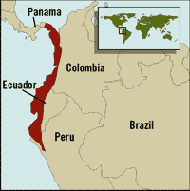
Key Facts
- Total Area: 274,597 km² over a 1,500 km span.
- Endemic Plants: 2,750 species unique to the region.
- Critical Status: Coastal Ecuador has lost approximately 98% of its native forest.
- Boundaries: Extends from Panama to Peru, bounded east by the Andes.
- Threats: Deforestation, farming encroachment, illegal crops, and population growth.
Diverse Habitats and Ecoregions
The Tumbes-Chocó-Magdalena hotspot is characterized by its extreme environmental variety. It encompasses everything from rocky shorelines and sandy beaches to mangroves and coastal wilderness. Notably, the Colombian Chocó contains some of the wettest rain forests on the planet.
The region is divided into several distinct ecoregions, each supporting unique biological communities:
- Moist Forests: Including the Chocó–Darién moist forests (Panama, Colombia, Ecuador), Magdalena–Urabá moist forests (Colombia), and Western Ecuador moist forests (Colombia, Ecuador).
- Dry Forests: Including the Ecuadorian dry forests (Ecuador) and Tumbes–Piura dry forests (Ecuador, Peru).
- Mangroves and Wetlands: Including the Gulf of Guayaquil–Tumbes mangroves (Ecuador, Peru), Manabí mangroves (Ecuador), Piura mangroves (Peru), and the Guayaquil flooded grasslands (Ecuador).
- Specialized Zones: The Galápagos Islands xeric scrub (Ecuador) and the Magdalena Valley montane forests (Colombia).
Conservation Challenges and Endemism
While the portions of the hotspot located in Panama and Colombia remain relatively intact, the situation in Ecuador is dire. With roughly 98% of its native coastal forests cleared, it is considered the most threatened tropical forest in the world. This loss is driven primarily by population growth, the expansion of farming, and the cultivation of illegal crops.
The urgency of protecting this region is highlighted by its high level of endemism—species that are native to a single defined geographic location and found nowhere else. The region supports thousands of unique plants and several threatened animal species.
| Category | Number of Species |
|---|---|
| Endemic Plant Species | 2,750 |
| Endemic Threatened Birds | 21 |
| Endemic Threatened Mammals | 7 |
| Endemic Threatened Amphibians | 8 |
With a human population density of 51 people per km², the pressure on these fragile ecosystems continues to mount, making international conservation efforts essential for the survival of these unique species.
Frequently Asked Questions
What is the Tumbes-Chocó-Magdalena hotspot?
It is a biodiversity hotspot encompassing the tropical moist and dry forests of the Pacific coast of South America, including the Galapagos Islands, stretching from Panama to northwestern Peru.
Which part of the hotspot is most threatened?
Coastal Ecuador is the most threatened area, having lost approximately 98% of its native forest, making it the most threatened tropical forest globally.
What are the primary threats to this region?
The main threats include deforestation, encroachment by farming, the growth of illegal crops, and increasing human population growth.
What makes the Colombian Chocó unique?
The Colombian Chocó is home to some of the wettest rain forests in the entire world.
How many endemic plant species are found here?
There are 2,750 endemic plant species unique to the Tumbes-Chocó-Magdalena hotspot.