U.S. Department of the Interior: Managing America's Natural Resources and Heritage
The United States Department of the Interior (DOI) is a cornerstone of the U.S. federal government, tasked with the immense responsibility of managing and conserving the majority of the nation's federal lands and natural resources. From the towering peaks of national parks to the complex administration of Native American affairs, the DOI ensures the sustainable use and preservation of America's diverse landscapes.
Often humorously referred to as "the Department of Everything Else" due to its wide-ranging mandate, the DOI differs significantly from interior ministries in other countries, which typically handle internal security and policing. In the U.S., those roles are managed by the Department of Homeland Security and the Department of Justice.

Key Facts
- Established: March 3, 1849.
- Headquarters: Main Interior Building, Washington, D.C.
- Current Leadership: Secretary Doug Burgum (sworn in February 1, 2025).
- Land Management: Manages approximately 75% of all federal public land.
- Budget: $18.0 billion for 2025.
- Workforce: 67,026 employees.
Organizational Scope and Impact
The scale of the DOI's operations is vast. As of mid-2004, the department managed 507 million acres of surface land, representing roughly one-fifth of the total land area of the United States. This management is executed through several specialized agencies.
Land and Resource Management
The Bureau of Land Management (BLM) is the department's largest land management agency, overseeing about one-eighth of the U.S. landmass. Other critical infrastructure and conservation efforts include:
- National Park Service: Manages 433 national parks, monuments, and historical sites.
- Fish and Wildlife Service: Oversees 544 national wildlife refuges.
- Bureau of Reclamation: Manages 476 dams and 348 reservoirs.
Native American and Insular Affairs
The DOI administers vital programs for Native Americans, Alaska Natives, and Native Hawaiians. The Bureau of Indian Affairs (BIA) and the Office of Special Trustee handle federal relations and trust accounting. Notably, Deb Haaland became the first American Indian to lead an executive department when she served as Secretary starting March 16, 2021.
Historical Evolution
The concept of a domestic affairs department was discussed as early as 1789, but these duties remained with the Department of State for decades. The momentum for a separate agency grew following the Mexican-American War (1846–48) as federal responsibilities expanded.
Robert J. Walker, then Secretary of the Treasury, championed the creation of the DOI to consolidate disparate offices, such as the General Land Office and the Indian Affairs office. The department was officially established on March 3, 1849, with Thomas Ewing serving as the first Secretary.
Over time, the DOI's scope shifted. The Bureau of Agriculture eventually became the separate Department of Agriculture, and water pollution control was transferred to the Environmental Protection Agency (EPA) upon its creation.
Challenges and Controversies
The department's long history has not been without conflict. High-profile scandals include the 1921 Teapot Dome scandal, which led to the conviction of Secretary Albert B. Fall for bribery regarding oil leases.
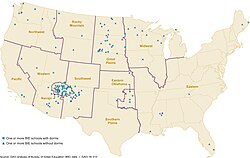
More recently, the department has faced scrutiny over its historical treatment of Native American children. The Federal Indian Boarding School Initiative, concluded in June 2024, revealed the systemic abuse and cultural disruption within boarding schools operating from the late 19th to mid-20th century, finding that 973 children died in these institutions.
Additionally, the department has dealt with significant maintenance backlogs and internal cultural critiques, as well as the dissolution of the Federal Consulting Group in March 2025 following advice from the Department of Government Efficiency (DOGE).
Departmental Structure and Administration
To streamline operations, the DOI established 12 organizational regions in 2018, replacing a fragmented system of 49 regions across eight different agencies.
| Agency/Office | Primary Responsibility | Key Asset/Metric |
|---|---|---|
| Bureau of Land Management | Public land management | ~1/8 of U.S. land |
| National Park Service | Parks and monuments | 433 sites |
| Fish and Wildlife Service | Wildlife conservation | 544 refuges |
| Bureau of Reclamation | Water and power | 476 dams |
| Bureau of Indian Affairs | Tribal relations | Federal-Tribal trust |
Operating Units
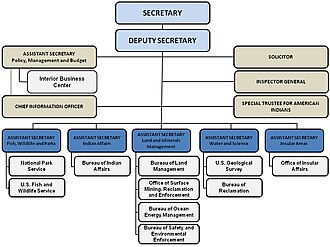
The DOI is organized into several assistant secretariats, including those for Fish, Wildlife and Parks, Indian Affairs, Land and Minerals Management, and Water and Science. These oversee specialized offices such as the U.S. Geological Survey and the Office of Insular Affairs.



Frequently Asked Questions
What is the primary role of the U.S. Department of the Interior?
The DOI is responsible for the management and conservation of most federal lands and natural resources, as well as administering programs for Native Americans, Alaska Natives, Native Hawaiians, and several U.S. insular areas.
How does the DOI differ from interior ministries in other countries?
Unlike many international counterparts that focus on internal security and policing, the U.S. DOI focuses on land, wildlife, and natural resource management. Security and immigration are handled by the Department of Homeland Security and the Department of Justice.
Who is the current Secretary of the Interior?
The current Secretary is Doug Burgum, who took office on February 1, 2025.
What percentage of federal land does the DOI manage?
The Department of the Interior manages approximately 75% of federal public land, with the majority of the remaining land managed by the Department of Agriculture's Forest Service.
What was the Federal Indian Boarding School Initiative?
It was a three-year investigation launched in 2021 to examine the trauma and systemic abuse inflicted on Native American children in federal boarding schools, concluding in 2024 with reports on cultural disruption and student deaths.