Tribune: A History of the Voice of the British Labour Left
Founded in the turbulent political climate of the 1930s, Tribune has served for decades as a critical intellectual hub for the left wing of the British Labour Party. From its origins as an anti-fascist front to its modern iteration as a quarterly analysis magazine, Tribune has mirrored the ideological shifts, internal conflicts, and evolving goals of democratic socialism in the United Kingdom.
Origins and the Anti-Fascist Front
Tribune was established in early 1937 by Sir Stafford Cripps and George Strauss, two wealthy Labour Party MPs. Their goal was to support the Unity Campaign, an effort to create a united front against fascism and appeasement. This coalition brought together the Labour Party and various socialist groups, including the Socialist League, the Independent Labour Party (ILP), and the Communist Party of Great Britain (CPGB).
The publication's early years were marked by internal ideological struggles. The first editor, William Mellor, was dismissed in 1938 after refusing to support a "popular front" that included non-socialist parties. He was replaced by H. J. Hartshorn, a secret member of the CPGB, leading the paper to become an appendage of the Left Book Club with an uncritical view of the Soviet Union.
The War Years and the Orwell Era
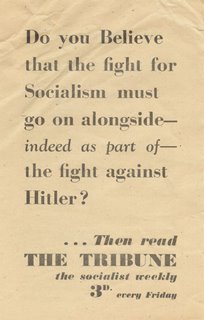
The outbreak of World War II in 1939 and the Molotov–Ribbentrop Pact (the non-aggression pact between Nazi Germany and the Soviet Union) triggered a pivot in the paper's direction. After the Soviet invasion of Finland, George Strauss fired Hartshorn and appointed Raymond Postgate. Under Postgate, Tribune purged its pro-Stalinist elements and became the voice of the pro-war democratic left.
In 1941, Aneurin Bevan took over as editor, with Jon Kimche managing daily operations. During this period, the paper campaigned for a second front against Adolf Hitler and advocated for a democratic socialist settlement in post-war Europe. One of the most significant appointments in the paper's history occurred in 1943, when George Orwell was hired as literary editor.
Orwell's tenure is legendary in the field of opinion journalism. His column, "As I Please," produced seminal essays such as "You and the Atom Bomb" and "Some Thoughts on the Common Toad." Although he left in 1945 to become a war correspondent for The Observer, he continued contributing until 1947.
Post-War Influence and Bevanism
Following the Labour landslide victory in 1945, Tribune reached its peak circulation of approximately 40,000. The paper became a focal point for the "Bevanite" left—followers of Aneurin Bevan—who pushed for a "third force" foreign policy where Europe acted independently of both the United States and the Soviet Union.
By the late 1940s, however, the paper shifted toward a strongly anti-communist stance following the Soviet takeover of Czechoslovakia. By the 1950s, it evolved into the primary organ for the Bevanite opposition within the Labour Party, opposing West German rearmament and nuclear weapons. It eventually became the "official weekly" of the Campaign for Nuclear Disarmament (CND).
Political Evolution: 1960s to 1990s
Throughout the 1960s and 1970s, Tribune aligned itself with workplace militancy and left-wing trade union leaders. While it initially welcomed Harold Wilson's 1964 government, it soon became a fierce critic of Wilson's policies on nationalisation, the Vietnam War, and the move to join the European Communities (EC). It played a central role in the "no" campaign during the 1975 EEC membership referendum.
The 1980s saw a period of instability. Under editor Chris Mullin, the paper supported Tony Benn, but later shifted toward the "soft left" under Nigel Williamson, supporting Neil Kinnock. By the 1990s, under Mark Seddon, Tribune returned to a more traditional left-wing stance, opposing Tony Blair's "New Labour" rebranding and the abandonment of Clause IV of the party constitution.
Financial Struggles and Modern Relaunch
The turn of the millennium brought significant financial hardship. Tribune transitioned from a newspaper to a magazine in 2001 and was saved from bankruptcy in 2004 by a consortium of trade unions, including Unison and Amicus. However, ownership continued to fluctuate, passing through various hands including Kevin McGrath and Owen Oyston, the latter of whom ceased publication in 2018.
In May 2018, the intellectual property was purchased by the American socialist magazine Jacobin. Relaunched as a high-quality bimonthly (and later quarterly) publication, the new Tribune focuses on long-form political analysis. By December 2020, it reported 15,000 subscribers. In 2025, the magazine was purchased by Mohamed Ali Harrath.
Key Facts
- Founded: 1937 by Sir Stafford Cripps and George Strauss.
- Peak Circulation: Approximately 40,000 in the post-WWII era.
- Notable Figures: George Orwell (Literary Editor), Aneurin Bevan (Editor), and Michael Foot.
- Political Alignment: Historically the voice of the Labour Party's left wing and the CND.
- Current Format: Quarterly magazine focusing on long-form analysis.
| Era | Key Influence/Owner | Primary Political Stance |
|---|---|---|
| 1937–1940 | Cripps/Strauss/CPGB | Anti-fascist / Popular Front |
| 1941–1950s | Aneurin Bevan | Democratic Socialism / Anti-Stalinism |
| 1960s–1970s | Parliamentary Left | Trade Unionism / Anti-EEC |
| 1980s–1990s | Bennites / Soft Left | Internal Labour Party disputes |
| 2018–Present | Jacobin / Mohamed Ali Harrath | Long-form Socialist Analysis |
Frequently Asked Questions
Who was the most famous writer for Tribune?
George Orwell is the most renowned contributor, serving as literary editor from 1943 to 1945 and writing the influential "As I Please" columns.
What is "Bevanism" in the context of Tribune?
Bevanism refers to the left-wing faction of the Labour Party led by Aneurin Bevan. Tribune served as the primary publication for this group, advocating for democratic socialist policies and opposing the party's right-wing leadership.
How did Tribune's view on the Soviet Union change?
Initially uncritical under CPGB influence, the paper pivoted to a strongly anti-Stalinist and anti-communist position in the 1940s, particularly after the Soviet invasion of Finland and the takeover of Czechoslovakia.
What is the current status of the publication?
Tribune is currently a quarterly magazine. After being relaunched by Jacobin in 2018, it was purchased by Mohamed Ali Harrath in 2025.
Did Tribune support the European Union?
The paper's stance fluctuated; it was a leading voice in the "no" campaign against the EEC in 1975 and remained anti-European under Mark Seddon, though it took a pro-European stance briefly under Paul Anderson.