Transitional Fossils and the Evidence of Evolutionary Change
In the study of life's history, transitional fossils serve as critical physical evidence of evolution. A transitional fossil is any fossilized remain of a life form that exhibits traits common to both an ancestral group and its derived descendant group. These fossils are particularly significant when the descendant group differs sharply in anatomy or lifestyle from its ancestors.
It is important to note that taxonomic divisions—the categories we use to classify animals—are human constructs imposed on a continuous spectrum of biological variation. Because the fossil record is inherently incomplete, scientists cannot always determine exactly how close a specific fossil is to the point of divergence. Consequently, while these fossils are often used as models for ancestors, they are not always the direct ancestors of more recent groups.
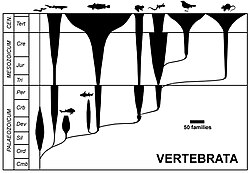
Key Facts
- Definition: Fossils showing traits of both ancestral and descendant groups.
- Purpose: They provide evidence for the continuum of variation between different taxonomic classes.
- Historical Context: Charles Darwin initially viewed the lack of these fossils as a major objection to his theory, citing the imperfection of the geological record.
- Major Transitions: Well-documented transitions include fish to tetrapods, dinosaurs to birds, and mammal-like reptiles to mammals.
The History of Evolutionary Evidence
The concept that species change over time existed as early as the 18th century, but Charles Darwin provided a firm scientific basis for this in his 1859 work, On the Origin of Species. Darwin acknowledged that the paleontological evidence of his time was limited, making the "transmutation" between higher biological categories difficult to visualize.
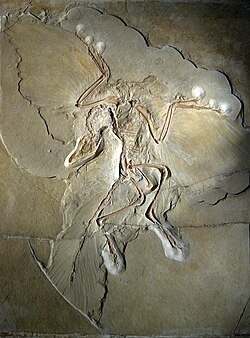
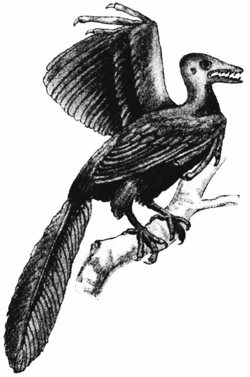
This changed dramatically in 1861 with the discovery of Archaeopteryx. This specimen provided the first tangible link between basal reptiles and the highly derived class of birds, validating Darwin's theory of descent with modification through natural selection.
Prominent Examples of Transitional Forms
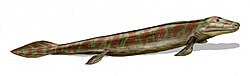
Tiktaalik roseae: The "Fishapod"
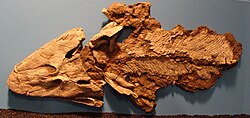
Living approximately 375 million years ago, Tiktaalik roseae represents the transition between non-tetrapod vertebrates (like Panderichthys) and early tetrapods (like Acanthostega and Ichthyostega). Neil Shubin, one of its discoverers, termed it a "fishapod" because it combined fish-like gills, scales, and fins with tetrapod-like rib bones, a mobile neck, lungs, and wrist bones that may have been weight-bearing.
Human and Animal Transitions
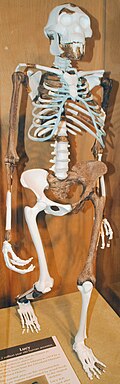
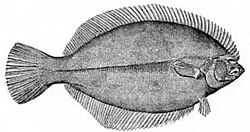
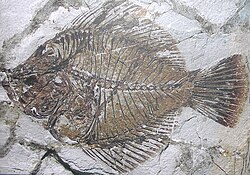
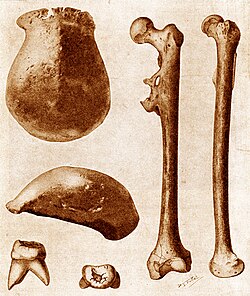
The fossil record also tracks the evolution of humans and other vertebrates. Australopithecus afarensis provides insight into the development of human walking posture, while "Java Man" (Homo erectus) was historically viewed as a "missing link." In the marine world, fossils like Amphistium show the transition toward the asymmetrical body plans seen in modern flatfish.
Plant Evolution
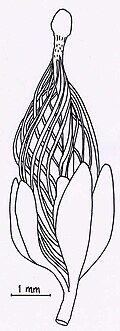
Transitions are not limited to animals. The Devonian fossil plant Runcaria is a precursor to seed plants; it resembles a seed but lacks a solid seed coat and the mechanisms required to guide pollen. Other early plants, such as Rhynia, further illustrate the rise of complex plant life.

The Nature of the Fossil Record
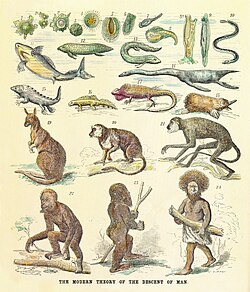
The term "missing link" is often used in popular media, but many scientists find it inappropriate. Modern research suggests that evolution often consists of diverse species branching out rather than a single, smooth line from one form to another.
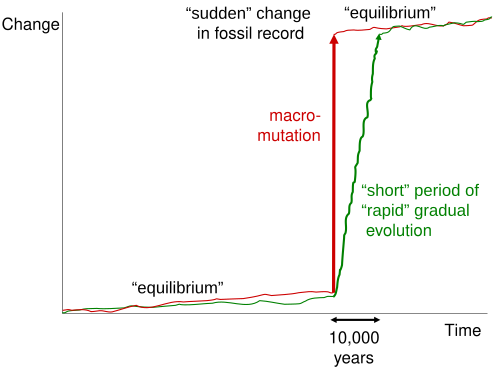
Some researchers point to punctuated equilibrium to explain sudden jumps or gaps in the fossil record. This theory suggests that evolution can occur in rapid episodes of natural selection or macromutation. Because a period of 10,000 years is barely detectable in geological time, these "jumps" may actually be episodes of relatively rapid gradual evolution.
Summary of Key Transitional Fossils
| Fossil Name | Transition Type | Key Characteristics |
|---|---|---|
| Archaeopteryx | Dinosaurs $\rightarrow$ Birds | Reptilian features combined with avian feathers. |
| Tiktaalik | Fish $\rightarrow$ Tetrapods | Gills and scales with wrist bones and a mobile neck. |
| A. afarensis | Hominids $\rightarrow$ Humans | Evidence of bipedal walking posture. |
| Runcaria | Early Plants $\rightarrow$ Seed Plants | Seed-like structure without a solid seed coat. |
| Amphistium | Symmetrical Fish $\rightarrow$ Flatfish | Intermediate eye placement on the head. |
Frequently Asked Questions
Are transitional fossils direct ancestors?
Not necessarily. While they are frequently used as models for ancestors, the incompleteness of the fossil record means we cannot always assume a specific transitional fossil is the direct progenitor of a more recent group.
What is a "fishapod"?
A "fishapod" is a term used to describe Tiktaalik roseae, a fossil that possesses a mixture of primitive fish characteristics (scales, gills) and derived tetrapod characteristics (wrist bones, lungs, and a mobile neck).
Why are there gaps in the fossil record?
Gaps occur because the geological record is imperfect. Additionally, the theory of punctuated equilibrium suggests that some evolutionary changes happen relatively quickly (e.g., over 10,000 years), which is too brief to be consistently captured in the fossil record.
Is the term "missing link" scientifically accurate?
Many scientists consider the term inappropriate because evolution is typically a branching process involving many diverse species, rather than a single linear chain connecting an ancestor to a descendant.