Trademarks: Protecting Brand Identity and Intellectual Property
In a crowded global marketplace, the ability to distinguish one company's offerings from another is essential for both businesses and consumers. A trademark is a specific type of intellectual property consisting of a word, phrase, symbol, design, or a combination of these elements. Its primary purpose is to identify the source of a product or service and ensure that consumers can distinguish it from competitors.
While many think of trademarks as simple logos, they extend to non-traditional marks. These include 3D shapes (such as unique product packaging), sounds, scents, specific colors, and drawings. For instance, while the name "Pepsi" is a registered trademark for soft drinks, the distinctive shape of the Coca-Cola bottle serves as a registered trademark protecting the brand's packaging design.

Key Facts
- Purpose: Trademarks identify the source of goods or services and prevent consumer confusion.
- Scope: They cover traditional elements (words, logos) and non-traditional elements (scents, sounds, 3D shapes).
- Registration: Legal protection is typically secured through agencies like the USPTO (USA) or EUIPO (European Union).
- Global Growth: In 2021, approximately 13.9 million trademark applications were filed worldwide, a 4% increase from 2020.
- Regional Dominance: Asian offices accounted for 69.7% of all trademark filings in 2021.
The Mechanics of Trademark Protection
The primary function of a trademark is to act as a badge of origin. By securing legal protection, owners gain exclusive rights to the mark and can seek legal remedies against unauthorized use. This protection is often signaled through specific symbols:
- ®: Used only for trademarks that have been officially registered.
- TM: Generally used for unregistered trademarks related to goods.
- SM: Used for unregistered trademarks related to services.

Brand vs. Trademark
While often used interchangeably, a brand is the overall perception and identity of a company, whereas a trademark is the legally protectable element of that brand. It is important to note that if a brand name becomes so common that the public uses it to refer to a general category of goods rather than a specific source—a process known as genericide—the company may lose its trademark status. Examples of terms that have suffered this fate include "escalator," "cellophane," and "laundromat."
Comparison with Other Intellectual Property
Trademarks differ significantly from patents and copyrights in what they protect and how they benefit the owner.
| Feature | Trademark | Patent | Copyright |
|---|---|---|---|
| Protects | Brand identifiers (e.g., Coca-Cola ®) | Inventions (e.g., a new hybrid engine) | Creative works (e.g., song lyrics) |
| Primary Goal | Source identification | Technical innovation | Original expression |
A History of Brand Protection
Modern trademark laws began to emerge in the late 19th century. France led the way with the "Manufacture and Goods Mark Act" in 1857. In the United Kingdom, the Merchandise Marks Act 1862 criminalized the imitation of trademarks with the intent to defraud, followed by the Trade Marks Registration Act 1875, which allowed formal registration starting January 1, 1876.
![Bass Brewery's logo became the first image to be registered as a trademark in the UK, in 1876.[60]](/images/15/d2/15d2bb4c93a5897e3afa2d182305d7350d1137b86da21ff70edb524243aa4e7f.jpg)
In the United States, the path to federal regulation was more complex. An initial 1870 statute was struck down by the Supreme Court as unconstitutional. Congress later passed a new act in 1881 based on Commerce Clause powers, which was revised in 1905. The primary federal law today is the Lanham Act of 1946.
![The COCA-COLA® trademark has been registered with the U.S. Patent and Trademark Office since 1893.[71]](/images/ae/70/ae70d8c39f31c6f1112e73eb120ea32bfc8971679b229d471837748857f4f5ad.webp)
Oldest Registered Trademarks
Determining the oldest trademark depends on the jurisdiction. In the U.S., the Averill Chemical Paint Company filed a design mark in 1870, but the law under which it was filed was later ruled unconstitutional. Consequently, the oldest U.S. registered trademark still in use is registration no. 11210, depicting Samson wrestling a lion, registered on May 27, 1884, by the J.P. Tolman Company (now Samson Rope Technologies, Inc.).
Global Trends and Registration
Trademark filing has seen consistent growth since the 2008 financial crisis. The Madrid System facilitates the international registration of marks, allowing applicants to seek protection in multiple countries through a single application.
![An estimated 13.9 million trademark applications were filed worldwide in 2021. This represents an increase of 4% compared to 2020. This was the twelfth consecutive year of growth following the end of the 2008 financial crisis.[83]](/images/3e/de/3edef8cd2a90d90a6a64ed460d42e783f5b604d6808d06d717dbcb9798ba6310.png)
Recent data shows a high volume of filings from major global corporations. For example, L'Oreal (France) and Novartis (Germany) consistently rank among the top applicants. Interestingly, the geographical distribution of filings is heavily skewed toward Asia.
![Offices in Asia accounted for 69.7% of all trademark filing in 2021.[83]](/images/6b/34/6b342aa1cc7646c399a101b9d060eacd2a35f17cd58c8450f3e159642d58fac1.png)
Enforcement and Legal Challenges
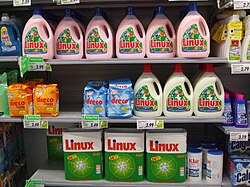
Owning a trademark requires active maintenance and enforcement. Owners must monitor for infringement—the unauthorized use of a mark that is likely to cause consumer confusion. However, trademarks are not absolute. A product may use a name like "Linux" without infringing on the trademark if it falls into a completely different product category.
Trademark Dilution
For "famous" marks, the law provides protection against dilution. This occurs when the uniqueness of a mark is weakened even if there is no consumer confusion. Dilution happens in two ways: blurring (chipping away at distinctiveness by using the mark on dissimilar products) and tarnishment (linking the mark to unsavory associations).
Frequently Asked Questions
What is the difference between TM and ®?
The ® symbol is reserved exclusively for trademarks that have been officially registered with a governmental agency. The TM symbol is typically used for unregistered trademarks to notify the public of a claim to the mark.
Can a trademark be lost over time?
Yes. A trademark can be lost through "genericide," where the mark becomes the common name for the product category itself. Additionally, in some jurisdictions like the EU, a mark may be revoked if it is not put to genuine use within a continuous five-year period.
What is the Madrid System?
The Madrid System is an international treaty that allows a trademark owner to protect their mark in multiple member countries by filing one application in one language and paying one set of fees.
What constitutes trademark dilution?
Dilution applies to famous marks and occurs when the mark's ability to uniquely distinguish goods is lessened. This happens through blurring (use on unrelated goods) or tarnishment (association with negative imagery), regardless of whether consumers are actually confused about the source.