Torneo Internacional Nocturno Rioplatense: A Legacy of Night Football
The Torneo Internacional Nocturno Rioplatense (Rioplatense Night International Tournament) was a prestigious friendly football competition that brought together the elite clubs of Argentina and Uruguay. Organized by the Argentine Football Association (AFA) and the Uruguayan Football Association (AUF), this non-confederative tournament took place during the summer recess of official league competitions between 1936 and 1944.
As part of a broader tradition of cross-border clashes—including the Tie Cup and Copa Aldao—the Internacional Nocturno served as a precursor to the later Argentine Torneos de Verano established in 1968. It provided a high-stakes environment where the fierce Rioplatense rivalry could flourish under the stadium lights.
Key Facts
- Active Years: 1936 to 1944.
- Participating Nations: Argentina and Uruguay.
- Format: Initially a single round-robin; transitioned to a group stage with a final in 1944.
- Most Successful Clubs: Independiente, Nacional, Newell's Old Boys, and River Plate (one title each).
- Largest Victory: Huracán 8–1 Peñarol (1943).
Tournament Format and Evolution
For most of its existence, the tournament utilized a round-robin system, where every participating team played each other once, and the club with the most points was crowned champion. However, the format evolved for the final edition in 1944.
In 1944, the ten participating teams were split into two groups of five. The winners of each group advanced to a final match to determine the overall champion. This shift added a knockout element to the competition, culminating in a victory for River Plate over Rosario Central.
Participating Clubs and Legendary Players
Despite its status as a friendly competition, the Torneo Internacional Nocturno was treated with immense seriousness. Clubs fielded their senior squads, meaning the tournament featured some of the greatest footballers of the era.
Regular participants included Independiente, Racing, San Lorenzo, Newell's Old Boys, Peñarol, and Nacional. Other clubs that appeared in various editions were Rosario Central, Boca Juniors, River Plate, Estudiantes (LP), and Huracán.
The rosters were star-studded, featuring icons such as Arsenio Erico and Vicente de la Mata (Independiente), José Manuel Moreno and Angel Labruna (River Plate), and Atilio García (Nacional). These players brought a level of quality and intensity that mirrored official international competitions.
The "Match of the Blooded Shirts"
The tournament is remembered not only for its skill but for the intense volatility of the Rioplatense rivalry. The most infamous encounter occurred on February 19, 1938, when Nacional faced Estudiantes de La Plata.
The match, attended by 20,000 spectators, descended into extreme violence. Reports from the time described a hostile atmosphere where the referee was nearly assaulted and armed individuals were allegedly present near the locker rooms during halftime. In a moment of defiance, Nacional captain Ricardo Faccio urged his team to win for their families.
Nacional eventually won 2–1. The match earned the nickname "the match of the blooded shirts" after Atilio García scored the winning goal while his jersey was stained with his own blood from an injury sustained during the game.
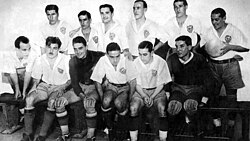
While violence marked some encounters, the tournament also saw displays of offensive dominance. On February 25, 1943, Huracán recorded the tournament's largest win, defeating Peñarol 8–1, highlighted by a hat-trick from Norberto "Tucho" Méndez.
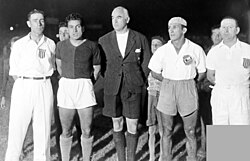
Tournament Summary
| Year | Champion | Runner-up | Final Score |
|---|---|---|---|
| 1936 | Independiente | San Lorenzo | N/A (Round-robin) |
| 1938 | Nacional | San Lorenzo | N/A (Round-robin) |
| 1943 | Newell's Old Boys | Boca Juniors | N/A (Round-robin) |
| 1944 | River Plate | Rosario Central | 2–0 |
Frequently Asked Questions
Was the Torneo Internacional Nocturno Rioplatense an official AFA tournament?
No. According to the Annual Reports and Balances published by the AFA, the association never included this competition among its official tournaments.
Which team won the most titles?
Four teams share the record for the most championships, with one title each: Independiente, Nacional, Newell's Old Boys, and River Plate.
What was the most significant match in the tournament's history?
The 1938 match between Nacional and Estudiantes de La Plata is the most notable due to its extreme violence and the resulting nickname, "the match of the blooded shirts."
How did the tournament format change over time?
From 1936 to 1943, the tournament used a single round-robin system. In 1944, it switched to a group stage format where the top team from each group played in a final.
Who was the top scorer in the 1938 edition?
Atilio García of Nacional was the top scorer of the 1938 tournament with 12 goals.