Tone in Linguistics: How Pitch Defines Meaning
In many languages, the meaning of a word is not determined solely by its consonants and vowels, but by the musicality of its delivery. In linguistics, this phenomenon is known as tone. While English uses pitch primarily to convey emotion or emphasis (a concept known as intonation), tonal languages use pitch to distinguish between different words or to change the grammatical function of a syllable.
Tone involves the use of pitch contour—the shape of the pitch movement—or pitch register, which refers to the relative height of the pitch. A tone might be held steady, slide upwards, drop downwards, or follow a complex pattern of both. In some linguistic contexts, scholars also include phonation, or specific changes in vocal cord vibrations, as part of the tonal system.
Key Facts
- Lexical Tone: Uses pitch to distinguish the fundamental meaning of words.
- Grammatical Tone: Uses pitch to indicate grammatical categories like number, aspect, or case.
- Pitch Contour: The movement of pitch (rising, falling, or level) within a syllable.
- Tonogenesis: The historical process by which a language develops tones.
- Tone Sandhi: The phenomenon where the tone of a word changes depending on the surrounding words.
Mechanics of Tonal Systems
Tonal systems vary significantly across different languages. Some languages use a small number of distinct tones, while others feature complex combinations of pitch height and movement.
Vietnamese Tones
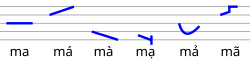
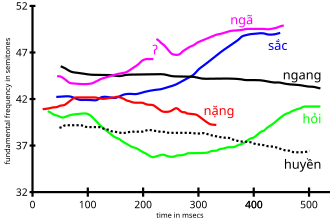
Vietnamese is a prominent example of a language with a complex tonal structure. It utilizes six distinct tones, each identified by specific diacritics (accent marks) in its writing system. These tones can vary slightly between Northern and Southern dialects.
| Tone Name | Description | Diacritic | Example |
|---|---|---|---|
| ngang | mid level | (none) | ma |
| huyền | low falling | ◌̀ | mà |
| sắc | mid rising | ◌́ | má |
| nặng | mid falling, glottalized | ◌̣ | mạ |
| hỏi | mid falling-rising | ◌̉ | mả |
| ngã | mid rising, glottalized | ◌̃ | mã |
Mandarin Chinese Tones
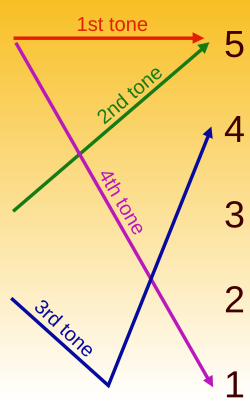
Standard Chinese, specifically Mandarin, utilizes five tones. These are often transcribed using diacritics over vowels to indicate the pitch movement. For example, the syllable "ma" can change meaning entirely based on its tone:
- High level: mā (mother)
- Rising: má (hemp)
- Dipping: mǎ (horse)
- Falling: mà (scold)
- Neutral: ma (interrogative particle)
Phonetic Notation and Pitch Levels
Because pitch is relative, linguists use various numbering systems to transcribe tones. However, these systems can be idiosyncratic. For instance, one system might assign "1" to a high tone, while another assigns "1" to a low tone. To avoid ambiguity, the International Phonetic Alphabet (IPA) uses specific tone letters and diacritics to represent pitch levels accurately.
Common pitch levels include:
- Extra-high: ◌̋
- High: ◌́
- Mid: ◌̄
- Low: ◌̀
- Extra-low: ◌̏
The Evolution of Tone: Tonogenesis
Languages are not always tonal. Through a process called tonogenesis, atonal languages can develop tonal systems over time. This often occurs due to the loss of certain consonant distinctions. For example, the loss of a final consonant like "-s" or "-h" can trigger a split in pitch, leading to the creation of rising or falling tones.
Frequently Asked Questions
What is the difference between tone and intonation?
Tone is used to distinguish the actual meaning of words (lexical meaning), whereas intonation is used to convey emotion, attitude, or sentence type (such as a question) without changing the core meaning of the words themselves.
What is tone sandhi?
Tone sandhi refers to the process where the tone of a syllable changes when it is placed next to another syllable. This is common in many Chinese dialects to make speech flow more naturally.
Can tone be used for grammar?
Yes. While many people associate tone with word meaning, grammatical tone uses pitch to indicate things like whether a noun is singular or plural, or to indicate the tense and aspect of a verb.
How are tones written?
Tones are often written using diacritics, such as the acute accent (´) for rising tones or the grave accent (`) for falling tones. In some systems, like Pinyin for Chinese, marks are placed directly above the vowels.
What is a pitch contour?
A pitch contour is the specific pattern of pitch movement within a single syllable, such as a single steady note, a rise, a fall, or a combination like a dipping (falling then rising) pattern.