Tone in Linguistics: How Pitch Shapes Meaning
In the study of linguistics, tone is the use of pitch contour, pitch register, or both to distinguish lexical or grammatical meaning. While many English speakers associate changes in pitch with emotion or questioning—known as intonation—tonal languages use pitch as a fundamental building block to differentiate between entirely different words or to inflect a word's grammatical function.
At its simplest, a tone is the movement of a syllable's musical pitch. This can be a steady level, a slide upward or downward, or a complex combination of these movements. Some scholars also include phonation—changes in how the vocal cords vibrate—under the broader umbrella of tone.
Key Facts
- Lexical Tone: Pitch changes that create entirely different words (e.g., "mother" vs. "horse" in Mandarin).
- Grammatical Tone: Pitch changes used to indicate tense, aspect, or case.
- Pitch Contour: The specific "shape" of the pitch movement (rising, falling, dipping).
- Tonogenesis: The historical process by which a non-tonal language develops a tonal system.
- Tone Sandhi: The phenomenon where a tone changes based on the tones of surrounding words.
The Mechanics of Tonal Systems
Tonal languages vary significantly in how they employ pitch. Some use a small number of distinct levels, while others use complex contours.
Standard Chinese (Mandarin)
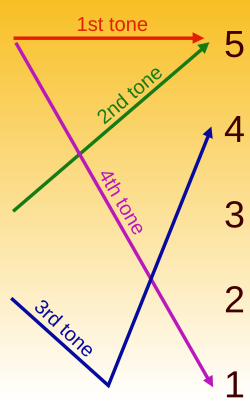
Mandarin Chinese utilizes five primary tones. A classic example is the syllable ma, which can mean "mother," "hemp," "horse," "scold," or serve as an interrogative particle depending on the pitch used.
- High level: A steady high pitch.
- Rising: Starting mid-pitch and rising high.
- Dipping: Falling then rising.
- Falling: A sharp drop from high to the bottom of the vocal range.
Vietnamese Tones
Vietnamese features a more complex system of six tones, often marked by specific diacritics (accent marks) over vowels to indicate the pitch and phonation.
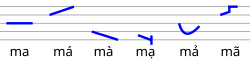
These tones range from the "flat" (ngang) mid-level tone to the "heavy" (nặng) tone, which is characterized by a mid-falling pitch and glottalization.
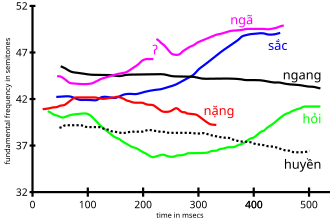
| Tone Name | Description | Diacritic | Example |
|---|---|---|---|
| ngang (flat) | Mid level | (none) | ma |
| huyền (deep) | Low falling | ◌̀ | mà |
| sắc (sharp) | Mid rising, tense | ◌́ | má |
| nặng (heavy) | Mid falling, glottalized | ◌̣ | mạ |
| hỏi (asking) | Mid falling-rising | ◌̉ | mả |
| ngã (tumbling) | Mid rising, glottalized | ◌̃ | mã |
Lexical vs. Grammatical Tone
While lexical tone distinguishes word meanings, grammatical tone uses pitch to change the function of a word. For example, in some languages, a change in tone can indicate whether an action is completed (completive) or ongoing (incompletive), or it can distinguish between the nominative and accusative case of a pronoun.
Tone Sandhi and Variation
Tones are not always static. Tone sandhi occurs when a tone changes its contour to blend more smoothly with the following syllable. This is common in various Chinese dialects, where the "neutral tone" may be added to the second syllable of a word, altering the pitch of the first.
Tonogenesis: How Tones Develop
Tones often evolve from the loss of certain consonants. This process, called tonogenesis, typically follows a pattern where final consonants (like -s or -h) disappear, leaving behind a pitch variation on the preceding vowel. Over time, these pitch variations become the primary way to distinguish words.
Frequently Asked Questions
What is the difference between tone and intonation?
Tone is used at the word or syllable level to change the actual meaning of a word (lexical) or its grammar. Intonation refers to the pitch changes across a whole sentence to convey emotion, attitude, or to signal a question.
Can a language have both lexical and grammatical tone?
Yes, many languages utilize pitch for both purposes, using it to distinguish between different nouns or verbs while also using it to mark tense or case.
What is a "neutral tone"?
A neutral tone is a syllable that lacks its own inherent tone and instead takes on a short, typically mid-level or reduced pitch, often influenced by the tone of the preceding syllable.
How is tone represented in writing?
Tones are commonly represented using diacritics (marks above or below vowels), numbers (e.g., 1 for high, 5 for low), or specialized phonetic symbols from the International Phonetic Alphabet (IPA).