Titan and the Oceanus Mission: Searching for Habitability in Saturn's Moon
Titan, the largest moon of Saturn, is a world of striking contradictions and immense scientific potential. Comparable in size to the planet Mercury and roughly 40% the size of Earth, Titan is more than just a satellite; it is a complex laboratory for organic chemistry. Because ancient Earth may have shared a similar methane-rich atmosphere and reducing chemistry—a chemical environment where oxygen is absent and electrons are readily available—Titan serves as a window into the conditions that may have sparked life on our own planet.
A World of Two Oceans
One of Titan's most fascinating characteristics is its dual-ocean system. On the surface, Titan hosts an ocean composed primarily of liquid methane (CH4) and ethane (C2H6). This creates a landscape of hydrocarbon seas and lakes that behave much like water does on Earth.
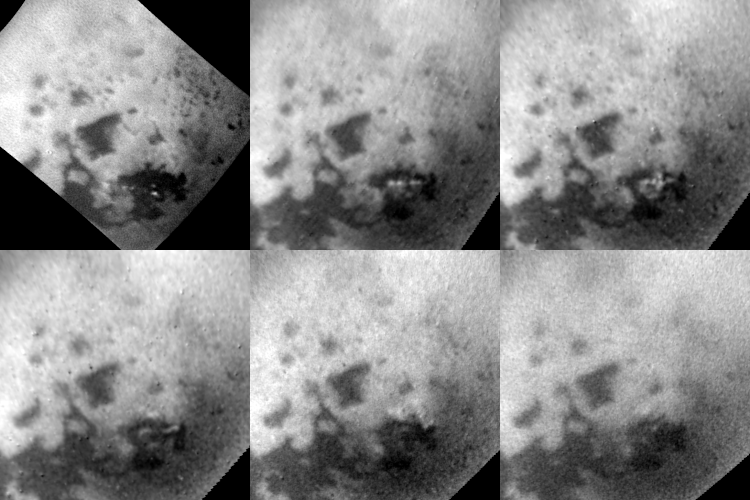
Beneath this icy exterior lies a second, hidden ocean. This subsurface sea consists of brine, a high-concentration salt solution. The interaction between the surface hydrocarbons and the deep brine ocean creates a unique environment where abiotic organic synthesis—the creation of organic compounds without the involvement of living organisms—occurs high in the atmosphere.
The Oceanus Mission Overview
The Oceanus mission, led by Christophe Sotin, the chief scientist for Solar System exploration at NASA's Jet Propulsion Laboratory in Pasadena, California, is designed to investigate these organic processes. By studying Titan's organic haze, scientists hope to better understand the role such chemistry played in the early stages of Earth's development and the broader potential for habitability across the universe.
Mission Timeline and Logistics
Proposed for a February 2024 launch, the Oceanus spacecraft would undertake a 10-year journey to reach the Saturnian system. The mission profile includes:
- Saturnian Phase: Two years spent orbiting Saturn and performing flybys of Titan.
- Titan Phase: Two years spent in a dedicated circular orbit around Titan.
- Power Source: The spacecraft would be powered by solar panels.
- Potential Add-on: The mission may consider the deployment of a small lake probe to sample the surface liquids.
Scientific Instrumentation
To uncover the secrets of Titan's chemistry and potential for abiogenesis (the natural process by which life arises from non-living matter), Oceanus would utilize a suite of advanced tools:
- Multistage Mass Spectrometer: To analyze the chemical composition of the atmosphere and surface.
- Infrared Camera: Specifically designed to see through the thick atmospheric haze.
- Radar Altimeter: To map the topography and measure the height of the surface features.
Key Facts
- Size: Titan is approximately the size of Mercury and 40% the size of Earth.
- Surface Liquids: Composed mainly of liquid methane and ethane.
- Subsurface Liquids: A vast ocean of brine exists beneath the icy crust.
- Mission Duration: 10-year flight time followed by a 4-year operational phase (2 years at Saturn, 2 years at Titan).
- Primary Goal: Understanding organic processes and habitability in the universe.
| Feature | Detail |
|---|---|
| Lead Scientist | Christophe Sotin (NASA JPL) |
| Proposed Launch | February 2024 |
| Power Source | Solar Panels |
| Key Instruments | Mass Spectrometer, Infrared Camera, Radar Altimeter |
| Target Body | Titan (Moon of Saturn) |
Frequently Asked Questions
What makes Titan similar to ancient Earth?
Titan possesses a methane-rich atmosphere and reducing chemistry, conditions that scientists believe may have existed on Earth during its earliest stages.
What are the two types of oceans on Titan?
Titan has a surface ocean made of liquid methane and ethane, and a subsurface ocean made of brine.
What is the primary goal of the Oceanus mission?
The mission aims to explore Titan's organic processes to understand the role of organic haze in early Earth and evaluate habitability across the universe.
How will Oceanus see through Titan's thick atmosphere?
The spacecraft will use a specialized infrared camera designed to penetrate the atmospheric haze.
Who is leading the Oceanus mission?
The mission is led by Christophe Sotin, the chief scientist for Solar System exploration at NASA's Jet Propulsion Laboratory.