Tiki-taka: The Rise and Fall of Football's Possession Revolution
In the world of football, few tactical philosophies have left as indelible a mark as tiki-taka. Characterized by short, rapid passing and constant movement, this style focuses on maintaining possession and working the ball through various channels to dismantle the opposition. While it became a global phenomenon in the late 2000s, its roots stretch back decades, blending scientific precision with artistic flair.
Key Facts
- Core Philosophy: Prioritizes ball possession, short passing, and fluid movement over physical strength.
- Primary Proponents: The Spain national team (2006–2012) and FC Barcelona (2008–2012).
- Major Achievements: Spain won Euro 2008, the 2010 World Cup, and Euro 2012.
- Barcelona's Peak: Under Pep Guardiola, Barcelona won six trophies in 2009, including a Continental Treble.
- Key Figures: Managers Luis Aragonés, Vicente del Bosque, and Pep Guardiola.
The Ancestry of Possession
Tiki-taka did not emerge in a vacuum. It was the evolution of several earlier systems that emphasized movement without the ball and technical passing. One early precursor was the Schalker Kreisel ("Schalke spinning top") used by Schalke 04, which secured six German championships between 1934 and 1942 by overwhelming opponents with quick passing.
In the 1970s, the Dutch national team and Ajax popularized Total Football, a system of constant rotation and fluid positioning. Simultaneously, manager Angelo Niculescu introduced the Temporizare ("delaying") style to the Romania national team. This approach focused on keeping the ball as long as possible to find a breach in the defense, leading Romania to the 1970 FIFA World Cup. Consequently, both FIFA (2011) and UEFA (2014) recognized Niculescu as the inventor of the tiki-taka style.
The Golden Era: Spain and Barcelona
The modern iteration of tiki-taka reached its zenith between 2008 and 2012. For the Spain national team, the shift began in 2006. Recognizing they lacked the physical power to outmuscle opponents, managers Luis Aragonés and Vicente del Bosque pivoted toward monopolizing the ball.
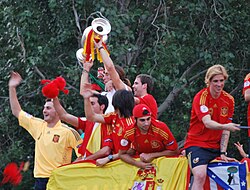
This tactical shift yielded unprecedented success. Spain captured Euro 2008 under Aragonés, followed by the 2010 FIFA World Cup and Euro 2012 under del Bosque. While the style was technical, Sid Lowe notes that Aragonés tempered it with pragmatism during Euro 2008, using possession to protect a suspect defense rather than pursuing the style to "evangelical extremes."
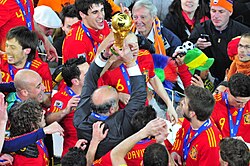
Parallel to the national team, FC Barcelona embraced these methods under Pep Guardiola. Utilizing a 4–3–3 formation, Barcelona dominated European football, winning six trophies in 2009 alone. Later, manager Luis Enrique evolved the style; while he maintained the possession-based build-up from the back, he adopted a more direct approach, leading the club to a second continental treble in the 2014–15 season.
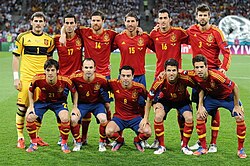
![Spain's players celebrating their Euro 2012 victory. Barcelona and Spain dominated the world of football in the same period (2008–2012).[1]](/images/ed/b5/edb589b80fd46b3241df5b321123739f46197941c816ae36adc90ebad580f88d.jpg)
Tactical Analysis and Criticism
At its peak, tiki-taka was praised for its beauty and dominance. However, it was not without critics. By Euro 2012, some media outlets labeled the style "dull" due to a lack of pure strikers. Spain often employed a false 9 (a midfield player acting as a forward), which led to high possession rates but fewer goals. During their three group matches in Euro 2012, Spain averaged 63% possession, yet their goal average was 25% lower than the tournament average.
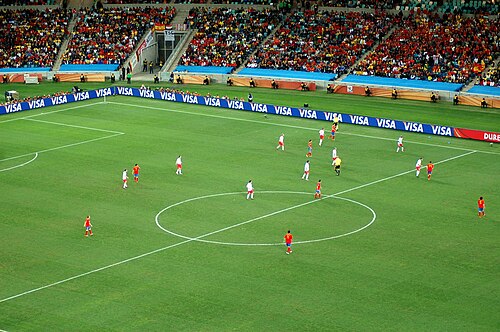
Critics like journalist Guy Hedgecoe argued that the game became a clash of midfielders, lacking the traditional excitement provided by dedicated strikers and defenders.
The Decline and Counter-Tactics
As tiki-taka dominated, opponents developed specific strategies to neutralize it. José Mourinho's Internazionale provided an early blueprint in 2010 by denying space and double-marking key players like Lionel Messi to disrupt the passing rhythm.
The vulnerability of the system was further exposed in the 2012–13 Champions League semi-finals, where Bayern Munich defeated Barcelona 7–0 on aggregate. Coach Jupp Heynckes utilized a fluid attacking style and a compact midfield to shut down the passing lanes of Xavi and Andrés Iniesta.
The definitive end of the era arrived during the 2014 World Cup. The Netherlands, managed by Louis van Gaal, used a 5–3–2 formation and swift counter-attacks to defeat Spain 5–1—Spain's worst defeat in 64 years. Chile followed with a fluid 3–4–3 formation that used man-marking to stifle Spain's midfield. These defeats, combined with Barcelona's shift toward a more direct style, signaled the conclusion of the tiki-taka epoch.
Summary of Tiki-taka's Impact
| Entity | Key Manager(s) | Peak Period | Major Achievement |
|---|---|---|---|
| Spain National Team | Aragonés, del Bosque | 2008–2012 | World Cup 2010, Euro 2008 & 2012 |
| FC Barcelona | Pep Guardiola | 2008–2012 | 2009 Continental Treble |
| Romania National Team | Angelo Niculescu | 1970s | 1970 FIFA World Cup Qualification |
Frequently Asked Questions
What exactly is tiki-taka?
Tiki-taka is a style of play in football characterized by short passing, constant movement, and a heavy emphasis on maintaining possession to control the game and wear down the opponent.
Who is credited with inventing tiki-taka?
While popularized by Spain and Barcelona, FIFA and UEFA have credited Angelo Niculescu, the former manager of the Romania national team, as the inventor of the style through his "Temporizare" approach.
Why did tiki-taka eventually stop working?
Opponents developed counter-tactics such as compact defensive blocks, strict man-marking of key midfielders, and high-speed counter-attacks that exploited the space left by possession-heavy teams.
What is a "false 9" in the context of tiki-taka?
A false 9 is a tactical role where a player nominally positioned as a center-forward drops deep into midfield. This creates numerical superiority in the midfield and draws opposing defenders out of position.
How did Total Football influence tiki-taka?
Total Football, used by the Dutch in the 1970s, introduced the concepts of fluid positioning and quick passing, which served as a foundational philosophy for the modern tiki-taka system.