Tigranes the Great: The Architect of the Armenian Empire
In the 1st century BC, one man rose to unify the Armenian plateau and forge an empire that commanded respect from the most powerful states of the ancient world. Tigranes the Great, a monarch of the Artaxiad dynasty, transformed Armenia from a vassal state into a regional superpower, earning his place as the most celebrated ruler in Armenian history.
His journey to power was not immediate. Born around 140 BC, Tigranes spent much of his youth as a political hostage in the Parthian court at Ctesiphon. This period was formative; he was schooled in Parthian language and culture, gaining an intimate understanding of the geopolitical dynamics of the Near East. It was only around 96/95 BC that the Parthian king Mithridates II released him to ascend the Armenian throne.
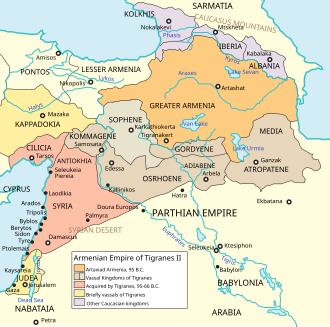
Key Facts
- Reign: 95–55 BC.
- Peak Territory: Approximately 900,000 km² (350,000 sq mi).
- Population: Estimated at ten million multi-ethnic inhabitants.
- Dynasty: Artaxiad.
- Religion: Zoroastrianism.
- Legacy: The only native ruler to unify the entire Armenian plateau.
The Rise to Power and Imperial Expansion
Tigranes began his reign as a vassal of the Parthians, even ceding the "seventy valleys" of the Caspiane to Mithridates II to secure his position. However, through strategic alliances—most notably with the Kingdom of Pontus—and military prowess, he expanded his borders far beyond the traditional Armenian heartland.
At the height of his power, Tigranes adopted the title "King of Kings," signaling his status as a sovereign over other monarchs. His empire eventually encompassed not only Armenia but also Syria and various client kingdoms, creating a multi-ethnic state of unprecedented scale for a native Armenian ruler.
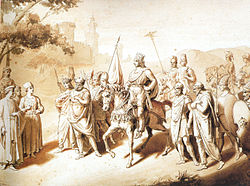
Conflict with the Roman Republic
The rapid expansion of the Armenian Empire inevitably brought Tigranes into conflict with the Roman Republic. The Roman general Lucullus launched a precipitate attack that caught Tigranes by surprise. Despite the courage of generals like Mithrobazanes—who led a cavalry charge of 2,000 to 3,000 men against the Romans—the Armenian forces were routed during the initial encounters.
Following these defeats, Tigranes withdrew to the north to regroup, leaving the city of Tigranocerta to be besieged by Lucullus. The struggle against Rome continued until 66 BC, when the Roman general Pompey advanced into Armenia.
Now nearly 75 years old, Tigranes chose submission over total destruction. Pompey allowed him to retain the Armenian kingdom, though he was forced to surrender his foreign conquests and pay a massive indemnity of 6,000 talents (approximately 180 tonnes of silver). Pompey viewed Armenia as a vital buffer state against other eastern threats.
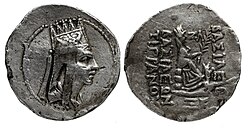
Imperial Ideology and Coinage
Tigranes used coinage as a powerful tool for propaganda and imperial identity. His tetradrachms (silver coins) are noted by historians for their high artistic quality and fine portraits, serving as a testament to the wealth and sophistication of his court.
![A late 19th century depiction of Tigranes based on his coinage[74]](/images/b1/2c/b12c9f1a044995938f4f4c74f6a816033b3bfc3e74c71366b075f7af19070b6f.jpg)
Legacy and Modern Recognition
Tigranes is remembered as the most powerful and valiant of all Armenian kings. The early historian Movses Khorenatsi praised him for glorifying the nation through his valor. His ability to unify all Armenian-inhabited lands remains a unique achievement in the region's history.
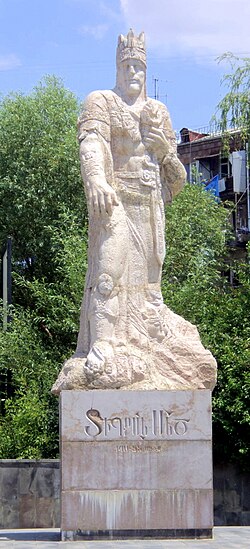
In the modern era, Tigranes has become a symbol of Armenian national revival. Following the collapse of the Soviet Union, his name was given to a major avenue in Yerevan. He is also the only king featured on Armenian currency (the 500 dram banknote from 1993 to 2005). His memory is further honored through the Order of Tigran the Great and several statues located in Yerevan, Vagharshapat, and at the President's Residence.
| Category | Details |
|---|---|
| Dynasty | Artaxiad |
| Reign Period | 95–55 BC |
| Major Titles | King of Kings, King of Armenia, King of Syria |
| Key Adversaries | Roman Republic (Lucullus, Pompey) |
| Max Empire Size | 900,000 km² |
| Burial Site | Tigranocerta |
Frequently Asked Questions
How did Tigranes the Great come to power?
Tigranes spent his youth as a hostage in the Parthian court at Ctesiphon. Around 96/95 BC, King Mithridates II released him and appointed him as the King of Armenia, though he initially remained a Parthian vassal.
What was the extent of his empire at its peak?
At its height, the empire covered approximately 900,000 km² and included Armenia and Syria, with a multi-ethnic population estimated at ten million people.
Why did Tigranes surrender to Pompey?
By 66 BC, Tigranes was nearly 75 years old and faced the advancing forces of Pompey. To preserve his core kingdom, he surrendered his conquests and paid 180 tonnes of silver in exchange for retaining the Armenian throne.
What is the significance of Tigranes in modern Armenia?
He is a central figure in Armenian national identity. He is honored with statues in major cities, a presidential order named in his honor, and was featured on the national currency between 1993 and 2005.
Which religion did Tigranes the Great practice?
Tigranes the Great practiced Zoroastrianism.