Thurso Railway Station: The Northernmost Outpost of Britain's Rail Network
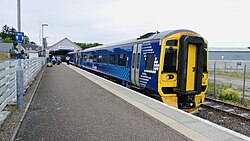
Located in the Highland council area of far north Scotland, Thurso railway station (Scottish Gaelic: Inbhir Theòrsa) holds a unique distinction as the northernmost station on mainland Britain's National Rail network. Serving the town of Thurso and its surrounding regions, the station acts as a vital transport link, connecting the mainland to ferry services bound for Stromness in the Orkney Islands.
Managed by ScotRail, the station serves as the terminus of a short branch line that diverges from the Far North Line. While it is the end of the physical line, it is not the terminus for passenger services, which typically extend further east to Wick.
Key Facts
- Location: Thurso, Highland Scotland (58°35′24″N 3°31′40″W).
- Status: Northernmost station on mainland Britain's National Rail network.
- Opening Date: 28 July 1874.
- Heritage: Designated as a Category B Listed Building since 1984.
- Operator: Managed and operated by ScotRail.
- Connectivity: Linked to Inverness via Georgemas Junction.
Station Facilities and Location
The station is situated 10.7 km (6 miles 50 chains) from Georgemas Junction and approximately 247.6 km (153 miles 70 chains) from Inverness. Designed for efficiency and accessibility, the station features a single platform capable of accommodating trains up to nine carriages in length.
Modern passenger amenities include:
- Full wheelchair accessibility.
- A part-time ticket office and LED departure boards.
- Waiting rooms and toilet facilities.
- A small on-site car park.
Historical Development
Plans for a railway to Thurso emerged in the 1860s, though funding delays pushed construction back a decade. Following a 1870 survey and land offers from the town, the station was officially opened by the Sutherland and Caithness Railway on 28 July 1874, following an inspection trip on 25 July.
Interestingly, the route to Wick was not designed as a direct line from Thurso due to challenging terrain, including a valley and a hill. Consequently, passenger trains must reverse at Thurso to continue their journey toward Wick.
Industrial and Military Significance
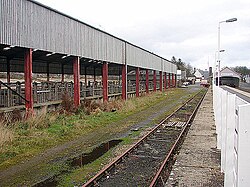
In its early years, the station featured a goods yard, an engine shed, and a 45-foot (14 m) wrought-iron turntable manufactured by the Railway Steel and Plant Company of Manchester. The station played a critical strategic role during both World War I and World War II, transporting soldiers and supplies destined for the naval base at Scapa Flow.
During the development of the Dounreay nuclear site, officials surveyed the possibility of extending the line toward the facility. Ultimately, this extension was never built, and construction materials were instead transported via the existing Thurso station.
Modernization
The station has evolved significantly over the decades. The turntable was removed in the mid-1950s, and the engine shed was demolished before diesel services were introduced in May 1961. More recently, the station roof was refurbished in 1999 to prepare for the introduction of Class 158 trains.
Passenger Traffic and Services
Passenger numbers at Thurso have shown a steady recovery and growth following a significant dip during the 2020/21 period. Recent data indicates a consistent upward trend in entries and exits.
| Financial Year | Entries and Exits |
|---|---|
| 2020/21 | 6,474 |
| 2021/22 | 25,200 |
| 2022/23 | 31,446 |
| 2023/24 | 37,626 |
| 2024/25 | 36,980 |
Current Timetable
Based on the May 2026 timetable, service frequency is as follows:
- Weekdays and Saturdays: Eight trains per day to Georgemas Junction. Four of these continue to Inverness (via Dingwall, Tain, Lairg, Golspie, and Helmsdale), and four continue to Wick.
- Sundays: Two trains per day to Georgemas Junction, with one destined for Inverness and one for Wick.
Frequently Asked Questions
Is Thurso the end of the line for passenger trains?
While Thurso is the physical terminus of the branch line, it is not the terminus for passenger services. Trains typically reverse at Thurso to continue their journey to Wick.
What is the historical significance of the station's architecture?
The station is recognized as a Category B Listed Building, having been designated on 28 November 1984, reflecting its architectural and historical importance to the region.
How does the station connect to the Orkney Islands?
The station serves as a primary rail link for passengers traveling to the ferry services that connect the Scottish mainland with Stromness in the Orkney Islands.
What role did the station play during the World Wars?
Thurso was essential for military logistics, transporting goods and personnel bound for Scapa Flow during both World War I and World War II.
Is the station accessible for passengers with disabilities?
Yes, Thurso railway station is fully wheelchair-accessible.