Highland Railway: The History of Scotland's Northern Rail Network
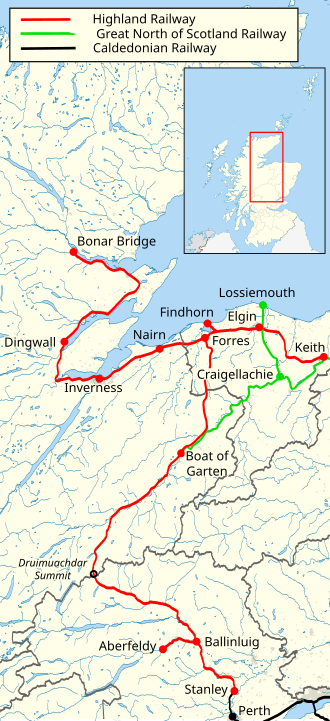
The Highland Railway (HR) was a pivotal transport network that connected the rugged landscapes of northern Scotland to the rest of the United Kingdom. Operating from 1865 to 1923, it transformed the accessibility of the Highlands, linking key hubs like Inverness, Perth, and Aberdeen, and extending deep into the north to Wick and Thurso.
The railway began as a collection of smaller, ambitious projects designed to conquer some of the most challenging terrain in Britain. Through a series of mergers and strategic expansions, it evolved into a comprehensive system that served as the lifeline for remote communities and the tourism industry of the Scottish north.
Key Facts
- Operational Period: 1865 – 1923.
- Headquarters: Inverness.
- Maximum Reach: 667 miles 65 chains of track by 1919.
- Successor: London, Midland and Scottish Railway (LMS).
- Gauge: Standard gauge (4 ft 8 1⁄2 in).
- Key Routes: Inverness to Perth, Inverness to Aberdeen, and the Far North Line.
Origins and Formation
The Highland Railway was born from the merger of two primary predecessors: the Inverness and Aberdeen Junction Railway and the Inverness and Perth Junction Railway. These two entities merged on February 1, 1865, and were formally established under the Highland Railway Act 1865.
The Path to Aberdeen and Perth
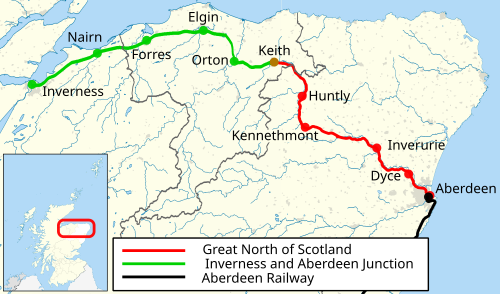
The route to Aberdeen was established early, with the Inverness and Aberdeen Junction Railway opening in August 1858. Meanwhile, the route to Perth saw significant progress in 1863, with the line from Dunkeld to Pitlochry opening in June and the full connection to Inverness completed by September 1863. To facilitate traffic from both Keith and Inverness, a triangular station was constructed at Forres.
Early Expansion and Absorption
The network grew rapidly through the absorption of smaller lines. The Inverness and Ross-shire Railway was absorbed in 1862, and extensions were pushed toward Bonar Bridge by 1864. By the time of the 1865 merger, the railway owned 242 miles of line and operated additional sections of the Scottish North Eastern Railway (SNER) to reach Perth.
Expanding the Northern Frontier
The railway's growth continued with the development of the Far North Line, a feat of engineering that pushed the rails toward the coast.
The Duke of Sutherland's Contribution
The 3rd Duke of Sutherland played a critical role in extending the line from Golspie to Helmsdale, passing his family seat at Dunrobin Castle. This section opened on November 1, 1870. Subsequently, the Sutherland and Caithness Railway linked Thurso and Wick, opening on July 28, 1874. This extension significantly reduced travel times; by 1914, the "Further North Express" could travel from Inverness to Wick in just 5.5 hours.
![Shin Viaduct, a category A listed structure, crossing the Kyle of Sutherland[38]](/images/b4/de/b4de0a74d96c452e7852edd5552a98b42daa4ba386d07c790bb71b968cc42499.png)
The Dingwall and Skye Railway
To the west, the Dingwall and Skye Railway was absorbed into the Highland Railway system. This expansion included the construction of the line to Kyle of Lochalsh and a short branch into the spa town of Strathpeffer, which opened in 1885.
Infrastructure and Engineering
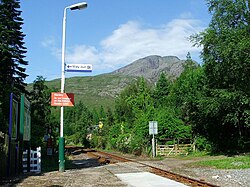
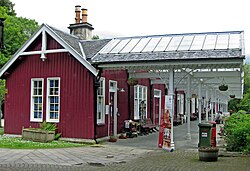
Operating in the Highlands required robust engineering to handle steep gradients and crossing waterways. The railway is noted for several listed structures, including the Shin Viaduct and the Culloden Moor Viaduct (Nairn viaduct), both of which are Category A listed structures.
![Nairn railway station was built by the Highland in 1885–91, and is currently a Category B Listed Building.[62]](/images/8f/2f/8f2f134b807cbe77b5226b7cb0a2d0dcf04de5c8981a0ce1a2074987bf4aed82.jpg)
![The Nairn viaduct, otherwise known as the Culloden Moor Viaduct is a Category A listed structure.[71]](/images/e0/56/e05664751b86bcb86d77fb5d1e96e6881e72c2eb6277147babb5c6ee9d7455e6.jpg)
Locomotives and Rolling Stock
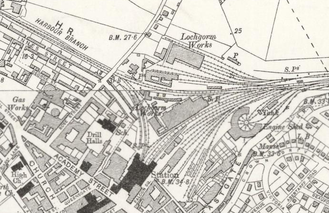
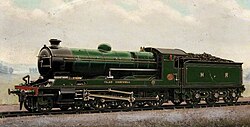
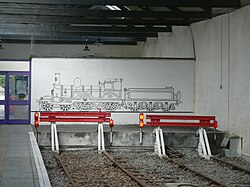
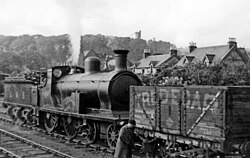
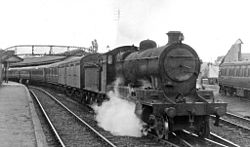
The Highland Railway maintained its own locomotive works at Lochgorm. David Jones, the locomotive supervisor from 1870, introduced a signature 4-4-0 passenger locomotive featuring a double chimney, which became a standard for the line. Later designs included the "Small Ben" 4-4-0 by Drummond and the "Clan Goods" locomotives used for express services.
![Highland Railway locomotive works at Lochgorm, built c. 1860 and now a Category B listed building.[132]](/images/df/bb/dfbbef27752c71480ac36460242e6b6ea189c49c29050c8fe21666691736d09e.jpg)
The 20th Century and Decline
The early 1900s saw the addition of light railways to Dornoch (1902) and Lybster (1903). However, the railway faced increasing competition from road transport. On January 1, 1923, the Highland Railway was absorbed into the London, Midland and Scottish Railway (LMS) during the grouping of British railways.
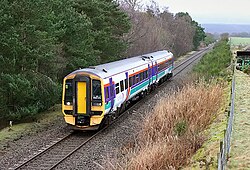
Post-war changes and the 1963 Beeching Report—a government initiative to close underused lines—led to the closure of several branches, including the Aberfeldy branch and the line between Aviemore and Forres in 1965. Despite these cuts, the lines north of Inverness remained operational.
Summary of Railway Specifications
| Feature | Detail |
|---|---|
| Total Track Length | 667 miles 65 chains (1,074.7 km) |
| Route Length | 505 miles 79 chains (814.3 km) |
| Track Gauge | 4 ft 8 1⁄2 in (Standard Gauge) |
| Primary Hub | Inverness |
| Major Successor | London, Midland and Scottish Railway (LMS) |
Frequently Asked Questions
When was the Highland Railway formed?
The Highland Railway was formed on February 1, 1865, through the merger of the Inverness and Aberdeen Junction Railway and the Inverness and Perth Junction Railway.
Who was the first General Manager of the Highland Railway?
Andrew Dougall, who had served as the founding General Manager for both constituent railways, became the first General Manager of the Highland Railway.
What happened to the railway after 1923?
On January 1, 1923, the Highland Railway became part of the London, Midland and Scottish Railway (LMS) as part of the railway grouping process.
How did the Beeching Report affect the network?
The 1963 Beeching Report recommended closing the least-used stations and lines. This resulted in the closure of the Aberfeldy branch and the line between Aviemore and Forres in 1965, though lines north of Inverness were preserved.
What were some of the notable locomotive designs?
Notable designs include David Jones' 4-4-0 passenger locomotives with double chimneys, Drummond's "Small Ben" 4-4-0, and the "Clan Goods" locomotives.