Threatened Species: Definitions, Classifications, and Global Conservation Frameworks
A threatened species is any animal, plant, or fungus that is vulnerable to extinction in the near future. To determine the level of risk, scientists sometimes use a mathematical measure called critical depensation. This metric analyzes the relationship between biomass and population growth rates, allowing researchers to evaluate the degree of endangerment based on population dynamics without needing to reference human activity directly.
Key Facts
- The IUCN classifies threatened species into three main categories: Vulnerable, Endangered, and Critically Endangered.
- Australia uses the EPBC Act to manage six distinct categories of extinction risk.
- In the United States, "threatened" is a specific legal status for species likely to become endangered in the foreseeable future.
- Germany's Red List includes unique categories such as a "warning list" and rare species.
- Threatened status can apply not only to entire species but also to subspecies, populations, and stocks.
The IUCN Red List Framework
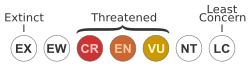
The International Union for Conservation of Nature (IUCN) is the global authority on species at risk. Rather than using "threatened" as a single label, the IUCN treats it as an umbrella term for three distinct categories based on the severity of the risk:
- Critically Endangered: The highest risk of extinction.
- Endangered: A very high risk of extinction.
- Vulnerable: A high risk of extinction.
Species that do not fall into these three categories are considered "less-than-threatened." This group includes those listed as near threatened or least concern. Additionally, species that have not yet been evaluated (NE) or those with insufficient data (data deficient) are not classified as threatened. While "threatened" and "vulnerable" are sometimes used interchangeably, "threatened" refers to the entire group, whereas "vulnerable" specifically denotes the least at-risk of the three threatened categories.
Species identified under this system are often called red-listed species because they are recorded in the IUCN Red List of Threatened Species.
National Conservation Approaches
Australia
At the federal level, Australia protects biodiversity through the Environment Protection and Biodiversity Conservation Act 1999 (EPBC Act). Section 179 of this Act defines six categories of risk:
- Extinct: No reasonable doubt that the last member has died.
- Extinct in the wild: Survives only in cultivation.
- Critically endangered: Extremely high risk of extinction in the immediate future.
- Endangered: Very high risk of extinction in the near future.
- Vulnerable: High risk of extinction in the medium-term future.
- Conservation dependent: Species that would enter one of the above categories without a specific conservation program.
The EPBC Act also extends protection to threatened ecosystems, including plant communities and Ramsar Convention wetlands. Data on these species is managed via the Species Profile and Threats Database (SPRAT). Furthermore, the Threatened Species Index (combining mammal and bird data) tracks overall trends. For instance, the Threatened Mammal Index reported a decline of over one-third of threatened mammal numbers between 1995 and 2016, though it also noted that targeted conservation efforts are yielding results.
Individual Australian states and territories may implement additional protections. For example, the Wildlife Conservation Act 1950 in Western Australia provides further safeguards. Some species, such as Lewin's rail, may be listed as threatened by a state even if they are not listed under the federal EPBC Act.
Germany
The German Federal Agency for Nature Conservation (BfN) maintains a regional Red List covering approximately 48,000 animals and 24,000 plants and fungi. While similar to the IUCN system, Germany's approach includes a "warning list" and specific categories for rare species that, while not currently endangered, are at high risk due to small population sizes.
![Red-List-Categories of the Federal Agency for Nature Conservation of Germany.[10]](/images/82/8c/828c78cf873c14a3e55725c7a6aed6dd00cce9d5b083bca4d15c1d7854b1f807.webp)
United States
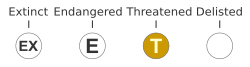
Under the U.S. Endangered Species Act (ESA), a species is defined as "threatened" if it is likely to become an endangered species within the foreseeable future throughout all or a significant portion of its range. In the U.S. legal framework, "threatened" is the less protected of the two primary categories. An example of a protected subspecies under this definition is the Bay checkerspot butterfly.
State wildlife agencies also have the authority to manage species that are threatened within a specific state but not nationally. For example, the trumpeter swan is listed as threatened in Minnesota, despite having large populations in Alaska and Canada.
Summary of Conservation Categories
| Authority/Region | Primary Categories | Unique Features |
|---|---|---|
| IUCN | Critically Endangered, Endangered, Vulnerable | Global standard; uses "Red List" terminology. |
| Australia (EPBC Act) | Extinct, Extinct in Wild, Critically Endangered, Endangered, Vulnerable, Conservation Dependent | Protects both species and threatened ecosystems. |
| Germany (BfN) | Similar to IUCN | Includes a "warning list" and rare species category. |
| United States (ESA) | Endangered, Threatened | "Threatened" is a precursor to "Endangered" status. |
Frequently Asked Questions
What is the difference between "threatened" and "vulnerable" in the IUCN system?
In the IUCN framework, "threatened" is a broad group that encompasses three categories: Critically Endangered, Endangered, and Vulnerable. "Vulnerable" is specifically the category for species that are at the lowest risk of the three threatened levels.
How does the U.S. Endangered Species Act define a threatened species?
The ESA defines a threatened species as any species likely to become an endangered species within the foreseeable future throughout all or a significant portion of its range.
What is critical depensation?
Critical depensation is a mathematical measure of biomass related to population growth rates. It is used to quantitatively evaluate how endangered a species is without directly referencing human activities.
Can a species be threatened in one region but not another?
Yes. For example, in the United States, state agencies can list species as threatened within their state borders even if the species is not listed on the national federal list, such as the trumpeter swan in Minnesota.
What does "extinct in the wild" mean under the EPBC Act?
A species is considered extinct in the wild if it is known to survive only in cultivation and has not been seen in the wild despite exhaustive surveys.