Thomas Aquinas: The Angelic Doctor of Faith and Reason
Thomas Aquinas (c. 1225–1274) stands as one of the most influential figures in Western philosophy and theology. Known as the Doctor Angelicus (Angelic Doctor), he dedicated his life to synthesizing Aristotelian logic with Christian revelation, creating a comprehensive intellectual framework that continues to shape Catholic doctrine and philosophical inquiry today.
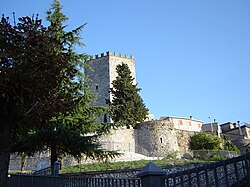
Born as Tommaso d'Aquino in Roccasecca, within the Kingdom of Sicily, his name "Aquinas" served as an indicator of his birthplace rather than a family surname. His academic journey took him through the prestigious institutions of his time, including the Abbey of Monte Cassino, the University of Naples, and the University of Paris, where he studied under the renowned Albertus Magnus.
Key Facts
- Born: c. 1225 in Roccasecca, Kingdom of Sicily.
- Died: March 7, 1274, in Fossanova, Papal States.
- Major Works: Summa Theologiae and Summa contra Gentiles.
- Core Philosophy: Reconciling faith (revelation) with reason (Aristotelian logic).
- Canonization: Canonized on July 18, 1323, by Pope John XXII.
- Legacy: Named a Doctor of the Church and a Confessor of the Faith.
The Intellectual Journey of a Scholar
Aquinas's career was defined by his tenure at the University of Paris and his membership in the Dominican Order (OP). His work was characterized by a rigorous method of questioning and resolution, which he applied to everything from the nature of God to the ethics of human law.
Despite his eventual acclaim, his path was not without conflict. In 1277, Bishop Étienne Tempier of Paris issued a condemnation of 219 propositions, twenty of which were Thomistic. This move aimed to assert that God's absolute power transcended the logical constraints proposed by Aristotle or Averroes, temporarily damaging Thomas's reputation.
Academic Contributions and Institutions
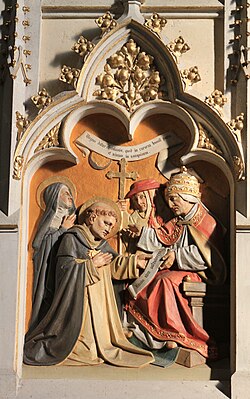
Thomas's influence extended beyond his writings to the very structure of religious education. His association with the studium at Santa Sabina and later the Church of Santa Maria sopra Minerva laid the groundwork for what would eventually become the Pontifical University of Saint Thomas Aquinas, also known as the Angelicum.
Core Theological and Philosophical Concepts
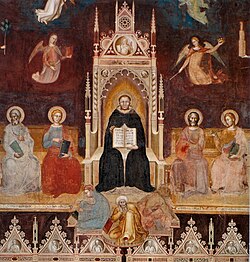
The heart of Thomism—the philosophical school based on his teachings—is the belief that reason and faith are complementary. Aquinas argued that because both originate from God, they cannot truly contradict one another.
Metaphysics and the Nature of God
Aquinas is famous for the Five Ways, a series of logical arguments intended to prove the existence of God. He explored the concept of Divine Simplicity and the Essence-existence distinction, positing that God is Actus purus (pure act), the first cause of all that exists.
Ethics, Law, and Politics
In the realm of ethics, Aquinas developed the theory of Natural Law, suggesting that humans possess an innate understanding of right and wrong derived from eternal law. He also addressed complex social issues, including:
- Just Price: The idea that goods should be exchanged at a fair value.
- Just War: Criteria under which a conflict may be morally justified.
- Usury: His views on the morality of lending money at interest.
Major Works and Literary Legacy
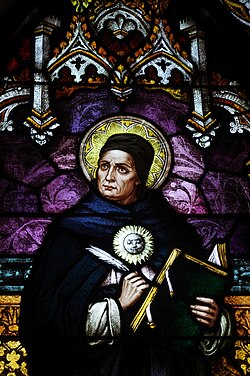
Aquinas's bibliography is vast, ranging from scriptural commentaries to liturgical hymns. His most enduring contribution is the Summa Theologiae, an unfinished but comprehensive guide to Catholic theology.
| Work | Focus | Key Contribution |
|---|---|---|
| Summa Theologiae | Comprehensive Theology | Systematic guide to the Catholic faith. |
| Summa contra Gentiles | Apologetics | Defending Christian faith against non-believers. |
| Disputed Questions on Truth | Epistemology | Exploration of truth and human knowledge. |
| Eucharistic Hymns | Liturgy | Poetic works used in Church worship. |
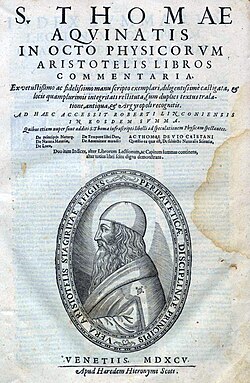
Artistic Representation and Veneration
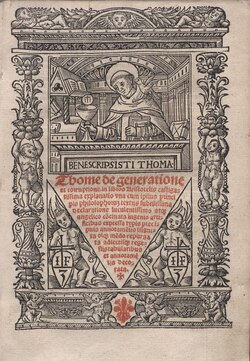
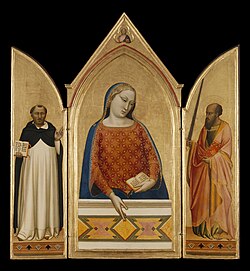
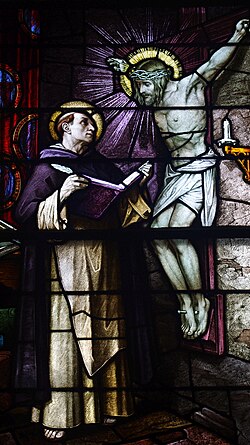
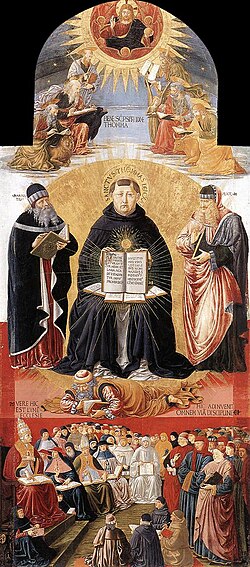
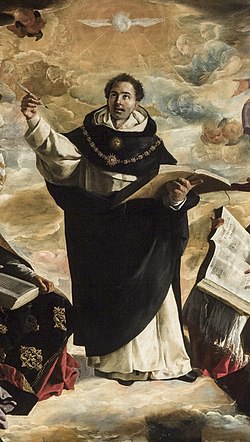
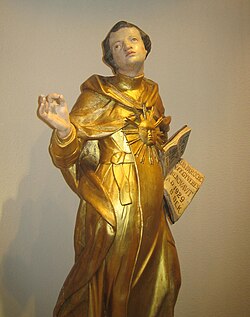
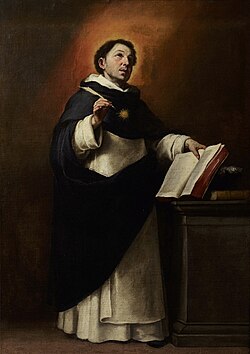
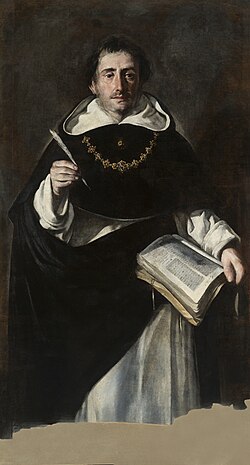
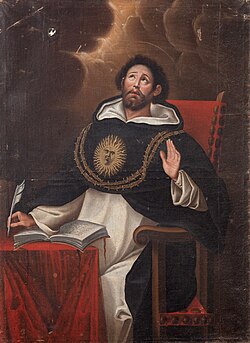
Throughout history, artists have depicted Aquinas as a symbol of wisdom and purity. He is often shown with the Summa Theologiae, a model church, or a sun on his chest, symbolizing the light of divine truth.
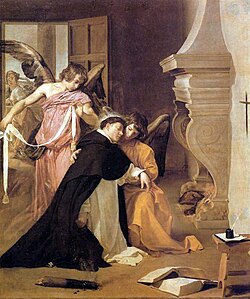
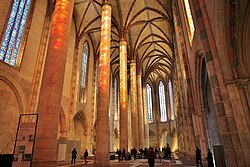
His physical remains are preserved in the Church of the Jacobins in Toulouse, France, which serves as a major shrine for pilgrims and scholars alike.
Frequently Asked Questions
What are the "Five Ways" of Thomas Aquinas?
The Five Ways are five logical arguments used to prove the existence of God, focusing on concepts such as motion, efficient cause, necessity, gradation, and the governance of the world.
How did Aquinas reconcile faith and reason?
He argued that reason can lead us to certain truths about God (such as His existence), but divine revelation is necessary for truths that exceed human reason (such as the Trinity). Since both come from the same divine source, they are harmonious.
What is the "Just Price" theory?
The Just Price is an economic concept where the value of a good is determined by its utility and the cost of production, ensuring that neither the buyer nor the seller is exploited in a transaction.
Why was he called the "Angelic Doctor"?
The title Doctor Angelicus refers to the perceived clarity, purity, and divine inspiration of his theological insights, as well as his profound intellect.
What was the Condemnation of 1277?
It was a decree by the Bishop of Paris that condemned 219 propositions, including some of Aquinas's, to ensure that the absolute omnipotence of God was not limited by Aristotelian logic.