Thermoregulation: How Animals and Humans Maintain Body Temperature
Thermoregulation is the biological process that allows an organism to maintain its internal body temperature within specific boundaries, regardless of how much the surrounding environment changes. This process is a critical component of homeostasis—the state of dynamic stability that keeps an organism's internal conditions functioning correctly, far from thermal equilibrium with the outside world.
While many creatures actively regulate their heat, some are thermoconforming organisms. These animals simply adopt the temperature of their surroundings, removing the need for complex internal regulation systems.
Key Facts
- Homeostasis is the overarching process of maintaining internal stability.
- Endotherms generate heat internally, while ectotherms rely on external heat sources.
- The preoptic area (POA) of the hypothalamus acts as the primary control center for temperature in vertebrates.
- Hyperthermia occurs when body temperature rises dangerously high; hypothermia occurs when it drops too low.
- Human core temperature is typically around 37 °C (98.6 °F), with hypothermia beginning below 35 °C (95 °F).
The Dangers of Thermal Imbalance
When homeostatic mechanisms fail, organisms face two primary risks: hyperthermia and hypothermia.
Hyperthermia occurs when the body temperature increases significantly above normal. In humans, lethal hyperthermia can occur if the wet-bulb temperature (a measure combining heat and humidity) remains above 35 °C (95 °F) for six hours. However, research from 2022 indicates that young, healthy adults may experience uncompensable heat stress at a lower wet-bulb temperature of 30.55 °C.
Hypothermia is the opposite condition, where the body loses heat faster than it can produce it, causing the core temperature to drop below 35 °C (95 °F). This is typically caused by prolonged exposure to cold and is treated by methods designed to safely raise the body temperature back to a normal range.
Classification of Thermal Strategies
Animals are broadly categorized by how they manage their heat: endotherms and ectotherms.
Ectotherms
Ectotherms rely on the environment to regulate their body temperature. They use behavioral adaptations to move between heat sources and cooling areas.
To cool down, ectotherms use several physical processes:
- Vaporization: Evaporating water from the body.
- Convection: Moving air or water across the skin.
- Conduction: Touching a colder surface to transfer heat away from the body.
- Radiation: Emitting heat into the surrounding air.
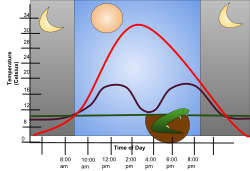
To warm up or minimize heat loss, ectotherms may use conduction (basking on a warm rock), radiation (absorbing sunlight), or insulation.
Endotherms
Endotherms, such as birds and mammals, generate their own heat through metabolic processes. This allows them to remain active in a wider range of environments.
In cold weather, endotherms minimize heat loss by storing energy as fat, shortening their extremities, or huddling together to increase thermal inertia.
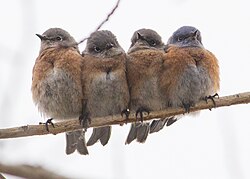
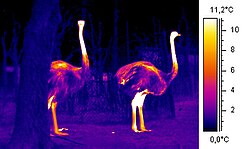
In hot weather, they maximize heat loss through elongated, vascularized extremities that conduct heat into the air, or by storing fat in localized areas (like a camel's hump) to prevent overall body insulation.
The Biological Control Center
In vertebrates, thermoregulation is primarily managed by the preoptic area (POA) of the anterior hypothalamus. This region uses specific neurons that express the prostaglandin E receptor 3 (EP3) to control temperature bidirectionally.
These neurons send inhibitory signals using the transmitter gamma-aminobutyric acid (GABA) to other parts of the brain. When the environment is hot, these signals increase to suppress heat production and dilate blood vessels (vasodilation) to release heat. When it is cold, the inhibition decreases, triggering shivering, blood vessel narrowing (vasoconstriction), and the production of heat from brown fat.
![Simplified control circuit of human thermoregulation.[22]](/images/ec/47/ec477bee8b5a21d71a1b70fec91cf82d21f6cf4cdde3e755c2fa383d62fe2dda.png)
Human Temperature Variations
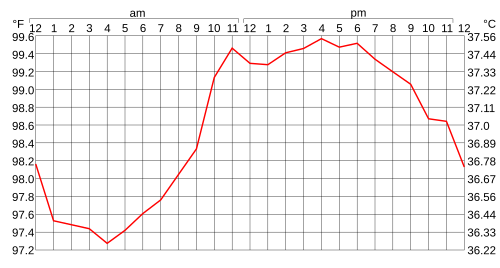
While 37.0 °C (98.6 °F) was long considered the average oral temperature for healthy adults, modern data shows a range of 36.1 to 37.8 °C (97.0 to 100.0 °F). Temperature also varies based on where it is measured:
| Measurement Site | Relative Temperature Difference | Common Use/Context |
|---|---|---|
| Rectal | 0.3–0.6 °C higher than oral | Most accurate reflection of internal organs |
| Oral | Baseline | Standard clinical measurement |
| Axillary (Under arm) | 0.3–0.6 °C lower than oral | Common in China, Poland, and Russia |
Other factors influence human temperature, including circadian rhythms and the menstrual cycle. During the follicular phase, basal body temperature is lower (36.45 to 36.7 °C). Following ovulation, progesterone levels rise, increasing the metabolic rate and raising the temperature to between 36.7 and 37.3 °C during the luteal phase.
Specialized Adaptations in Nature
Some animals exhibit extreme thermal capabilities. For example, the South Californian mite Paratarsotomus macropalpis can run at speeds of 322 body lengths per second on concrete temperatures up to 60 °C (140 °F), far exceeding the lethal limit for most species.
Other animals use dormancy to conserve energy. This includes hibernation in bears and torpor in bats, where the body allows its temperature to drop temporarily.

Frequently Asked Questions
What is the difference between an ectotherm and an endotherm?
Ectotherms rely on external environmental sources to regulate their body temperature, whereas endotherms generate their own heat internally through metabolic processes.
At what temperature does hypothermia begin in humans?
Hypothermia is clinically recognized when the core body temperature drops below 35 °C (95 °F).
How does the brain control body temperature?
The preoptic area (POA) of the hypothalamus monitors temperature and uses GABAergic signaling to either suppress or increase sympathetic output, controlling blood vessel diameter and heat production.
Why does a woman's body temperature change during her menstrual cycle?
After ovulation, the hormone progesterone increases the metabolic rate, which typically raises the basal body temperature by 0.15–0.45 °C during the luteal phase.
What is the "wet-bulb temperature" and why does it matter?
Wet-bulb temperature accounts for both heat and humidity. It is critical because high humidity prevents the body from cooling via evaporation; if this temperature exceeds certain thresholds (around 30.55 °C for some healthy adults), heat stress becomes uncompensable.