The Trinity: Doctrine, History, and Theological Meaning
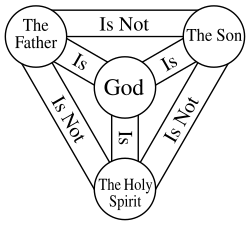
The Trinity (from the Latin Trinitas, meaning "triad") is a foundational Christian doctrine regarding the nature of God. It defines one God who exists eternally in three consubstantial divine persons: God the Father, God the Son (Jesus Christ), and God the Holy Spirit. While these three persons are distinct, they share a single essence, substance, or nature, a concept known in theology as homoousion.
To distinguish between the nature and the identity of the Divine, theologians often explain that the one essence defines what God is, while the three persons (or hypostases) define who God is. This framework allows for both the distinction of the persons and their indissoluble unity.
Key Facts
- One God, Three Persons: The Trinity consists of the Father, the Son, and the Holy Spirit.
- Coeternal and Consubstantial: All three persons exist eternally and share the same divine substance.
- Distinct Roles: The Father begets, the Son is begotten, and the Holy Spirit proceeds.
- Shared Action: Creation and grace are viewed as a single shared action of the three persons.
- Trinitarianism: The formal name for the belief in the Trinity; those who reject it are termed nontrinitarians.
Theological Foundations
The Nature of the Divine Persons
According to the declarations of the Fourth Lateran Council, the relationship between the persons is defined by their origin: the Father is the source who begets, the Son is the one begotten, and the Holy Spirit is the one who proceeds. This structure ensures that everything is understood as coming "from the Father," "through the Son," and "in the Holy Spirit."
Biblical Origins and Inferences
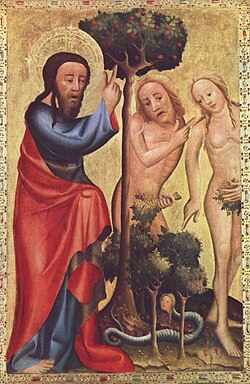
While the term "Trinity" does not appear in the Bible, adherents point to several scriptural passages as evidence. In the Old Testament, Genesis 1:26 ("Let us make man in our image") and Genesis 3:22 ("the man has become like one of us") are often cited as early hints of a plural divine nature. Some Church Fathers also identified the "divine messenger" in various Genesis and Exodus passages as the Son, and the "spirit of the Lord" as the Holy Spirit.
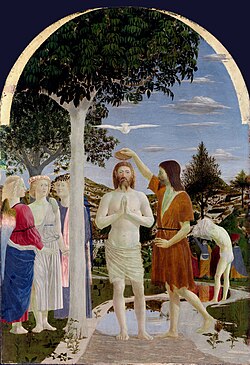
In the New Testament, the Deity of Christ is inferred from various accounts, and the Holy Spirit is explicitly described as God in the Acts of the Apostles. The baptismal formula in Matthew 28:19, which commands baptism in the name of the Father, the Son, and the Holy Spirit, serves as a primary scriptural pillar for the doctrine.
Historical Development
The Early Church and the Council of Nicaea
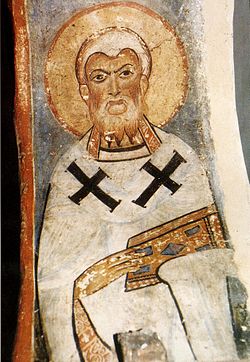
The formalization of Trinitarianism occurred through early ecumenical councils. The First Council of Nicaea in AD 325 was a pivotal moment where the Deity of Christ was declared orthodox and Arianism—the belief that the Son was a created being—was condemned.
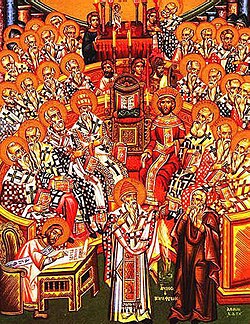
This was further refined at the First Council of Constantinople in 381, which helped solidify the Nicene Creed, the statement of faith that remains central to most Christian denominations today.
Middle Ages and Later Theology
During the Middle Ages, the doctrine was further explored through concepts such as perichoresis, the mutual indwelling of the three divine persons. The study of the Trinity, known as triadology, continued to evolve, distinguishing between the "immanent Trinity" (God's internal nature) and the "economic Trinity" (how God reveals Himself in the world).
Artistic and Architectural Representations
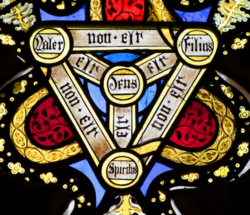
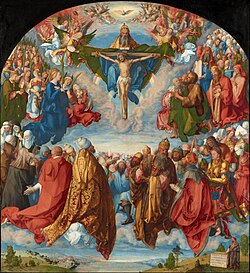
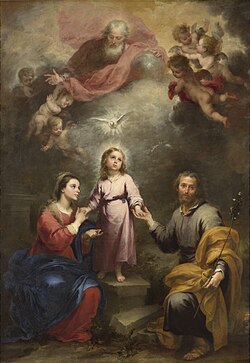
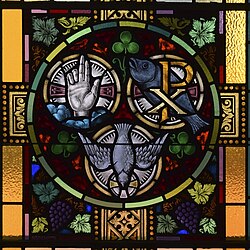
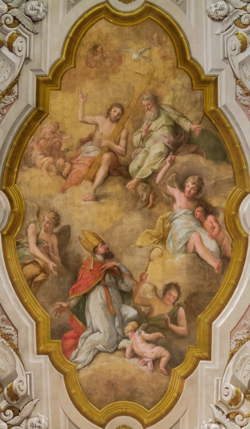
Because the Trinity is a complex mystery, artists have used various symbols to represent it. Common motifs include the dove for the Holy Spirit, the cross for the Son, and an elderly man or a hand for the Father.
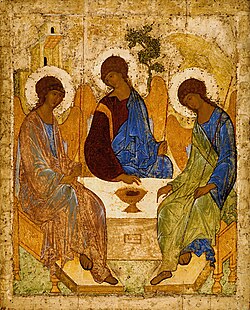
Early examples include the Dogmatic or Trinity Sarcophagus (c. 350), which shows three similar figures involved in the creation of Eve.
![Detail of the earliest known artwork of the Trinity, the Dogmatic or Trinity Sarcophagus, c. 350 (Vatican Museums). Three similar figures, representing the Trinity, are involved in the creation of Eve, whose much smaller figure is cut off at lower right; to her right, Adam lies on the ground.[85]](/images/6c/08/6c08ba4d424a4aae8432b02e07c998a1de7960332c6bb44983b651feae2daddc.jpg)
Later works, such as those by Albrecht Dürer and Murillo, often depicted the "Heavenly Trinity" in a vertical hierarchy. Architecture has also mirrored this belief; for example, the Cathedral of Saint John the Evangelist in Cleveland, Ohio, features three entrance doors symbolizing the Father, Son, and Holy Spirit.
![Three doors representing the trinity at a cathedral in Cleveland, Ohio[202]](/images/d6/be/d6be3d88fe06c78e67b5349c9b7fc1cd51728b3a99b121754e6c2e5f909ae2d1.jpg)
Summary of Trinitarian Concepts
| Concept | Trinitarian View | Nontrinitarian View |
|---|---|---|
| Nature of God | One essence in three persons | Single person or different structure |
| Status of Jesus | Coeternal and consubstantial with Father | Created being or distinct from Father |
| Holy Spirit | The third person of the Trinity | Force, power, or non-personal entity |
| Key Terminology | Homoousion, Hypostasis | Unitarianism, Modalism |
Frequently Asked Questions
What is the difference between essence and person in the Trinity?
Essence (or nature) refers to what God is—the divine substance that is shared by all three. Person (or hypostasis) refers to who God is—the distinct identities of the Father, Son, and Holy Spirit.
What is the Council of Nicaea's significance to this doctrine?
The First Council of Nicaea (AD 325) was the first ecumenical council to formally declare that Jesus Christ is of the same substance as the Father, thereby rejecting Arianism and establishing the orthodox Trinitarian position.
What is nontrinitarianism?
Nontrinitarianism encompasses various beliefs that reject the doctrine of the Trinity. This includes Unitarianism, binitarianism, and modalism. Many mainline Christian groups consider these positions to be outside of traditional Christianity.
How is the Trinity represented in Christian art?
The Trinity is often represented through symbols: a dove for the Holy Spirit, the Chi Rho or a crucified figure for the Son, and a hand or an elderly man for the Father. Some art uses a "Shield of the Trinity" diagram to show the relationships between the three persons.