The Times: A History of Britain's Influential Newspaper
Founded in the late 18th century, The Times has evolved from a small venture born of personal hardship into one of the most influential publications in the English-speaking world. Known for its deep ties to policymakers, financiers, and the British establishment, the paper has mirrored the political and technological shifts of the last two centuries.
Foundations and Early Growth (1785–1890)
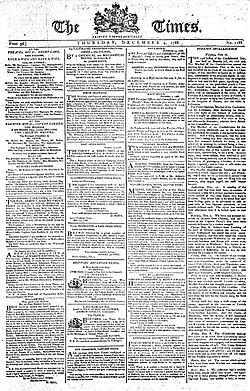
The publication began on January 1, 1785, as The Daily Universal Register, founded by John Walter. Walter had been left unemployed after his insurance company went bankrupt following a Jamaican hurricane. He initially invested in logography—a typesetting system designed by Henry Johnson to increase printing speed by using pre-set common words and letter groups—though the system later proved less efficient than claimed.
On January 1, 1788, after 940 editions, Walter renamed the publication The Times. By 1803, ownership passed to his son, also named John. The paper built a formidable reputation for providing continental news, particularly from France, which made it essential reading for the British elite, despite the founder's brief incarceration in Newgate Prison for libel.
Technological Innovation and Influence
The paper's growth was fueled by early adoption of industrial technology. In 1814, it began using Friedrich Koenig's steam-driven cylinder press. This technological edge, combined with the use of steam trains for distribution to urban centers, allowed circulation to soar from 5,000 in 1815 to 51,200 by 1854.
Under the leadership of general editor Thomas Barnes (appointed 1817) and later John Thadeus Delane (1841), the paper became known as "The Thunderer" due to its powerful and sometimes satirical political commentary. It also pioneered the use of war correspondents, most notably William Howard Russell, whose reports from the Crimean War had a profound impact on the British public.
The Era of Transition (1890–1981)
The turn of the century brought financial instability and changes in ownership. After a period of rescue by editor Charles Frederic Moberly Bell and a brief association with the Encyclopædia Britannica, the paper was purchased by newspaper magnate Alfred Harmsworth (Lord Northcliffe) in 1908. In 1922, it was acquired by John Jacob Astor.
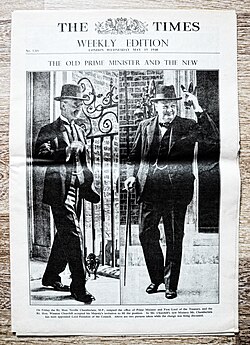
The mid-20th century was marked by significant political controversies. During the 1930s, editor Geoffrey Dawson was closely aligned with Neville Chamberlain's policy of appeasement toward Nazi Germany, often rewriting reports from Berlin to support this stance. The paper also faced scrutiny for its 1920 endorsement of The Protocols of the Learned Elders of Zion, an antisemitic forgery which the paper retracted a year later after correspondent Philip Graves exposed the fraud.
Other notable figures included Kim Philby, a Spanish Civil War correspondent who was later revealed as a Soviet double agent, and E. H. Carr, whose pro-Soviet editorials in the 1940s led Winston Churchill to mockingly refer to the paper as the "threepenny Daily Worker."
In 1966, the paper underwent a visual shift, resuming news on the front page (which had previously been reserved for advertisements) and removing the Royal Arms from its masthead. That same year, it was sold to Canadian magnate Roy Thomson.
The Murdoch Era and Modernization (1981–Present)
In 1981, Rupert Murdoch's News International purchased The Times and The Sunday Times. Murdoch introduced aggressive modernization, replacing the 19th-century hot-metal Linotype printing process with computer input and photocomposition between 1981 and 1982, which halved the print room staff.
The paper continued to evolve its format and identity:
- 1986: Moved operations to Wapping to further modernize production.
- 2004: Transitioned exclusively to a tabloid format.
- 2008: Switched to new printing plants, enabling full-color pages.
- 2012: Added "of London" to the masthead for the London Olympics.
Legal Challenges and Ethical Controversies
Recent decades have seen a series of legal battles and corrections. The paper has faced multiple rulings from the Independent Press Standards Organisation (IPSO) regarding reporting on fostering cases, pollution, and electric vehicle sales. Notable libel settlements include cases brought by Imam Abdullah Patel, Sultan Choudhury, and Moazzam Begg (along with the group Cage).
In October 2025, a high-profile error occurred when the paper published quotes attributed to former NYC Mayor Bill de Blasio, only to discover the interviewee was actually a wine importer of the same name who had used ChatGPT to respond to the reporter.
Furthermore, a 2026 Amnesty International report alleged that The Times and other major dailies amplified the anti-transgender movement by marginalizing transgender voices and magnifying anti-trans figures.
Key Facts
- Founded: January 1, 1785, as The Daily Universal Register.
- Renamed: Became The Times on January 1, 1788.
- Technological Firsts: Early adopter of the steam-driven cylinder press (1814) and rotary press.
- Format Change: Moved permanently to tabloid format on November 1, 2004.
- Current Ownership: News UK (part of the Murdoch empire since 1981).
| Year | Milestone / Circulation | Key Figure/Owner |
|---|---|---|
| 1815 | 5,000 circulation | John Walter Jr. |
| 1854 | 51,200 circulation | John Thadeus Delane (Editor) |
| 1908 | Acquisition | Alfred Harmsworth |
| 1922 | Acquisition | John Jacob Astor |
| 1966 | Acquisition | Roy Thomson |
| 1981 | Acquisition | Rupert Murdoch |
Frequently Asked Questions
Why was The Times called "The Thunderer"?
The nickname arose from the paper's powerful, authoritative, and often satirical style of political and social commentary, specifically referencing a quote about "thundering out" an article on reform.
When did The Times switch to a tabloid format?
While it began producing both broadsheet and tabloid sizes in 2003, it transitioned solely to the tabloid format on November 1, 2004.
What was the "Wapping dispute"?
The Wapping dispute occurred in 1986 when The Times moved its offices from New Printing House Square to Wapping to implement new technology and bypass restrictive union agreements.
How did the paper handle the "Protocols of the Learned Elders of Zion"?
In 1920, the paper endorsed the document as genuine. However, after correspondent Philip Graves exposed it as a forgery in 1921, The Times issued a retraction.
What is the significance of the Royal Arms on the masthead?
The Royal Arms were a feature from inception until 1966. They were reintroduced under Rupert Murdoch, but instead of the reigning monarch's arms, the paper uses the arms of the House of Hanover, who ruled when the paper was founded.