The Rosariazo: Argentina's Wave of Civil Unrest in 1969
The Rosariazo was a powerful protest movement characterized by mass demonstrations and strikes in Rosario, Santa Fe, Argentina. Occurring between May and September 1969, these events took place under the military dictatorship of de facto President General Juan Carlos Onganía. The movement did not happen in isolation; it was sparked by social injustice and unrest across Argentina and, in turn, served as a catalyst for further uprisings nationwide.
Key Facts
- Timeline: May to September 1969.
- Location: Rosario, Santa Fe, Argentina.
- Primary Participants: University students, secondary school students, and labor unions (CGT).
- Political Context: The military regime of General Juan Carlos Onganía.
- Outcome: Hundreds of casualties and arrests, contributing to the eventual removal of President Onganía in 1970.
The Prelude to Unrest
By early 1969, a general climate of instability had gripped Argentina due to widespread social injustice. Several regional conflicts set the stage for the events in Rosario:
- Tucumán (May 13): Former sugar mill workers took a factory and its manager hostage to demand overdue payments.
- Córdoba (May 14): Automobile industry workers protested the removal of Saturday rest periods.
- Corrientes (May 15): A fivefold increase in cafeteria food ticket prices at the University of Corrientes led to protests and the police killing of student Juan José Cabral.
The First Rosariazo
On May 16, 1969, students at the Faculty of Medicine of the Universidad Nacional de Rosario (UNR) protested these national injustices. As other faculties joined, the university rector suspended activities. Tensions escalated the following day when a protest at the UNR cafeteria was violently suppressed by police, resulting in the death of student Adolfo Bello.
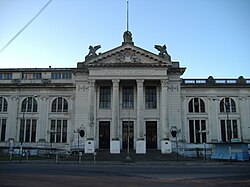
The murder of Bello prompted the CGT (the main national labor union) to call for a state of alert. By May 21, a silent march involving 4,000 students and CGT members took place. Although police were forced to retreat, they killed 15-year-old student Luis Blanco. This sequence of events became known as the First Rosariazo.
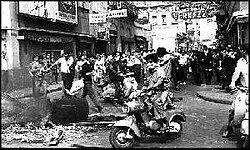
In the aftermath, the city was declared an emergency zone under military jurisdiction. A massive strike involving workers in Rosario and the nearby Industrial Corridor followed on May 23, with over 7,000 people attending Luis Blanco's funeral. This period of unrest coincided with the Cordobazo—a civil uprising in Córdoba on May 29—and led to President Onganía being declared persona non grata during his customary visit to Rosario for National Flag Day on June 20.
The Second Rosariazo
Following a period of relative calm, protests resumed on September 7, 1969, as students held memorials for victims of state repression. The situation intensified on September 8 when railroad workers went on strike following the suspension of union deputy Mario Horat, eventually escalating to a nationwide indefinite strike by September 12.
On September 16, the CGT of Rosario led a massive march. This event, known as the Second Rosariazo (or the Proletarian Rosariazo), saw between 100,000 and 250,000 participants. Workers and students converged on the CGT headquarters, engaging in widespread street fighting and erecting barricades.
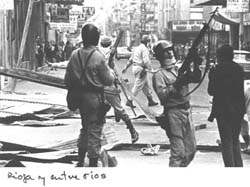
Protesters set fire to public transport and overwhelmed police forces, who were only able to maintain control over a few strategic sites, including the courts, major radio stations, the Police Headquarters, and the Command Seat of the Second Army Corps. The conflict eventually spread to the outlying barrios of the city.
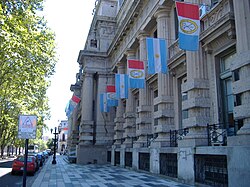
On September 17, the Army intervened to restore order. Among the personnel involved in the repression was Colonel Leopoldo Galtieri. Brigadier General Herbert Robinson, Commander of the II Army Corps, issued a stark warning that troops were ordered to fire without warning on any attack. This military intervention effectively ended the uprising, leaving hundreds dead or wounded and many others arrested.
Impact and Aftermath
The combined pressure of the Rosariazo and the Cordobazo severely weakened President Onganía's authority. Although he initially refused to step down when asked by the dominant military faction, he was ultimately forced out of office by a military junta on June 8, 1970.
| Phase | Key Date(s) | Primary Trigger | Key Outcome |
|---|---|---|---|
| Prelude | May 13–15 | Labor disputes and student deaths in Tucumán, Córdoba, and Corrientes | National climate of unrest |
| First Rosariazo | May 16–23 | Death of students Adolfo Bello and Luis Blanco | City declared emergency zone; massive worker strikes |
| Second Rosariazo | Sept 7–17 | Railroad union strike and memorials for repression victims | Massive urban uprising; Army intervention |
Frequently Asked Questions
What was the Rosariazo?
The Rosariazo was a series of protests, strikes, and civil uprisings in Rosario, Argentina, between May and September 1969, directed against the military dictatorship of General Juan Carlos Onganía.
Who participated in the protests?
The movement was a coalition of university students, secondary school students, and labor unions, specifically the CGT (Confederación General del Trabajo).
What is the difference between the First and Second Rosariazo?
The First Rosariazo in May was primarily sparked by student deaths and university grievances. The Second Rosariazo in September was a larger, more "proletarian" uprising involving massive railroad and general labor strikes.
How did the military government respond to the Second Rosariazo?
The government deployed the Army, led by figures such as Brig Gen. Herbert Robinson and Colonel Leopoldo Galtieri, who used lethal force and orders to fire without warning to suppress the protesters.
What was the political result of these uprisings?
The Rosariazo and the Cordobazo significantly eroded the power of President Juan Carlos Onganía, leading to his forced removal from office by a military junta in June 1970.