The Man Without a Country: Edward Everett Hale's Tale of Patriotism and Exile
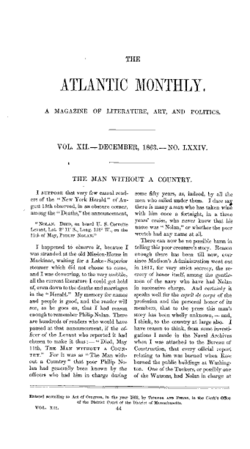
First published in the December 1863 issue of The Atlantic Monthly, "The Man Without a Country" is a poignant short story by American writer Edward Everett Hale. Written during the height of the American Civil War, the narrative serves as a powerful parable about national identity, the cost of treason, and the enduring bond between a citizen and their homeland.
The story follows the tragic trajectory of a young American officer whose momentary outburst of hatred for his nation leads to a lifelong sentence of isolation. Through the character of Philip Nolan, Hale explores the transition from arrogant disdain to a desperate, lifelong longing for the country he once renounced.
Plot Summary: The Sentence of Philip Nolan
The protagonist, Philip Nolan, is a young lieutenant in the US Army. His life takes a drastic turn when he becomes associated with Aaron Burr. When Burr is tried for treason, Nolan is also brought to trial as an accomplice. During the proceedings, Nolan suffers an "intemperate outburst," shouting, "Damn the United States! I wish I may never hear of the United States again!"
Shocked by this renunciation, the judge grants Nolan's wish literally. He is sentenced to spend the remainder of his life aboard US Navy warships in exile. The conditions of his sentence are absolute: he is forbidden from ever setting foot on US soil again, and no person is permitted to mention the United States to him or provide him with any news regarding the country.
A Life of Isolation
For over five decades, the sentence is carried out with strict precision. Nolan is moved from ship to ship, treated according to his former rank but kept in total ignorance of his homeland's progress. His newspapers are censored, and the sailors in his custody are ordered to remain silent about the US. While initially unrepentant, Nolan eventually becomes consumed by sadness and a desperate need for news.
In his later years, Nolan attempts to warn others of his mistake, urging a young sailor to stand by his country as he would stand by his own mother. He even attempts to plead for information from a former acquaintance during a party on a ship, but she refuses to speak to him.
The Final Days and Redemption
As Nolan nears death aboard the USS Levant, he reveals a secret shrine in his room. The space is decorated with the Stars and Stripes draped around a picture of George Washington, a painting of a bald eagle grasping the globe, and an outdated map of the United States. Because the map is old, it shows territories that had not yet become states, allowing Nolan to feel he still possessed a country of his own.
In his final hours, an officer named Danforth provides Nolan with a summary of American history from 1807 to 1860, detailing the nation's expansion and technological growth, though Danforth avoids mentioning the "infernal rebellion" of the Civil War. Nolan reveals that for fifty-five years, he had found a loophole in his sentence: the US Navy failed to confiscate his Presbyterian Book of Public Prayer. By reading the prayers for the President of the United States every morning and night, he had maintained a spiritual connection to his nation.
Nolan dies that day, leaving behind a self-written epitaph: "In memory of PHILIP NOLAN, Lieutenant in the Army of the United States. He loved his country as no other man has loved her; but no man deserved less at her hands."
Key Facts
- Author: Edward Everett Hale.
- First Publication: December 1863 in The Atlantic Monthly.
- Purpose: Written to bolster support for the Union during the American Civil War.
- Historical Basis: While presented as fact, the story is fictional; however, the name Philip Nolan was borrowed from a real bookkeeper for James Wilkinson.
- Core Theme: The essential nature of national identity and patriotism.
Historical Context and Influence
Hale utilized specific dates, locations, and contemporary references to make the story feel like a historical record. This technique was so effective that many readers believed Philip Nolan was a real person. Hale later admitted the story was partly a commentary on the 1863 election of Clement Vallandigham, an antiwar Democrat who had expressed similar disgust for the US during his own treason trial.
The narrative highlights the Northern case for the preservation of the Union by emphasizing the US's resilience against Great Britain, the establishment of the Smithsonian Institution, and the invention of the steamboat.
Despite its patriotic success, the story contains a historical anachronism: the Presbyterian Book of Public Prayer used by Nolan was not published until 1857, making it impossible for him to have read it daily since 1807.
Adaptations and Legacy
The story's impact extended far beyond the printed page, spawning numerous adaptations across various media:
- Film: Adapted in 1917, 1918, 1925, 1937 (Warner Brothers), and a 1973 television movie.
- Radio: Featured on The Weird Circle (1943), Philco Radio Time (1947), and The General Mills Radio Adventure Theater (1977).
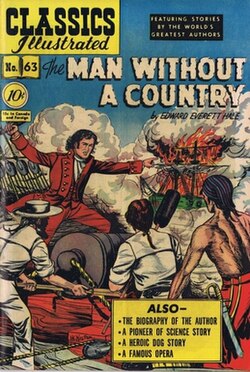
- Other Media: An opera by Walter Damrosch (1937), a Classics Illustrated comic (1949), and a historical novel by Chuck Pfarrer (2016).
The story's legacy is further cemented by a physical monument placed in 1975 in front of the Covington County Courthouse in Andalusia, Alabama, featuring Nolan's self-composed epitaph.
| Category | Details |
|---|---|
| Protagonist | Philip Nolan, US Army Lieutenant |
| Crime | Treason (accomplice to Aaron Burr) and renouncing the US |
| Punishment | Life exile on US Navy ships; total ban on news of the US |
| Duration of Exile | 55 years |
| Key Symbol | Presbyterian Book of Public Prayer |
| Author's Goal | Promote Union nationalism during the Civil War |
Frequently Asked Questions
Was Philip Nolan a real person?
No, the character of Philip Nolan is fictional. However, Edward Everett Hale used the name of a real person—a bookkeeper for James Wilkinson who died in 1801—and grounded the story in real historical events to make it seem like a factual account.
Why did the author write the story in 1863?
Hale wrote the story during the American Civil War to encourage patriotism and bolster support for the Union in the North.
How did Nolan manage to read about the US despite his sentence?
Nolan possessed a Presbyterian Book of Public Prayer, which the US Navy neglected to take from him. He read the prayers for the President of the United States every morning and night for 55 years.
What is the significance of the map in Nolan's room?
The map was outdated, showing the US before many of its territories became states. Because it did not reflect the current state of the union, it served as a personal "country" that Nolan could claim as his own without violating the spirit of his isolation.
Where can the Philip Nolan monument be found?
A monument bearing Nolan's epitaph was placed in 1975 in front of the Covington County Courthouse in Andalusia, Alabama.