The Little Boy from Manly: Satire and Patriotism in Colonial Australia
In the late 19th century, the colony of New South Wales found itself caught between a wave of imperial loyalty and a growing current of domestic skepticism. This tension was perfectly encapsulated in the story of The Little Boy from Manly, a figure who evolved from a real-life child donor into a lasting satirical symbol of Australia's early colonial identity.
The Sudan Expedition of 1885
The narrative begins in February 1885, when William Bede Dalley, the acting premier of New South Wales, offered to send a detachment of troops to the Sudan. This force was intended to support British efforts in suppressing the Mahdist uprising (a religious and political revolt against Egyptian and British rule). While the offer sparked patriotic fervor and the creation of a public fund for contributions, the decision was not universally praised. Working-class suburbs and rural districts expressed doubt, and the influential magazine The Bulletin dismissed the move as a piece of "political legerdemain," suggesting it was more of a political trick than a strategic necessity.
On March 4, 1885, as the troops departed Sydney, a 10-year-old boy named Ernest Lawrence wrote to Dalley. Ernest, whose father was a partner in the legal firm Stephen, Lawrence and Jaques, enclosed £25 from his savings and his father's contributions. In his letter, he expressed a longing to help "punish the wicked Arabs who killed General Gordon." This gesture of childhood innocence and patriotism was widely publicized in the Sydney Morning Herald and other major newspapers.
From Innocence to Satire
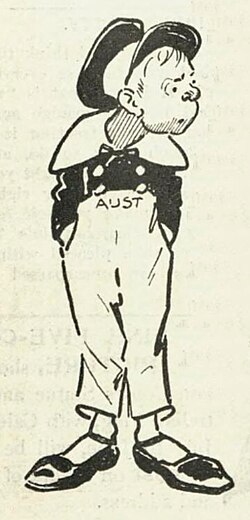
While the public largely viewed Ernest Lawrence as a symbol of purity, The Bulletin saw an opportunity for critique. The magazine responded with a satirical poem titled 'Nemesis; or, "The Little Boy From Manly"' and a series of cartoons by artist Livingston Hopkins. In one notable piece from April 4, 1885, titled 'Innocent Triflers; or, the Joys of His First and Her Second Childhood,' Hopkins depicted the boy feeding a devouring money-box labeled "Patriotic Fund." Behind the boy loomed a spectral figure representing the grim realities of war: pensions, war expenses, and the support of widows and orphans.
Hopkins portrayed 'The Little Boy at Manly' in early-Victorian attire—high-waisted pantaloons, a frilled collar, and a peaked cap—effectively turning the child into a caricature of naive colonial enthusiasm.
The Return of the New South Wales Contingent
The New South Wales Contingent arrived at Suakin on the Red Sea in late March, marking the first time an Australian colony deployed a military force overseas. Their service was characterized by minor skirmishes, guard duties, and the construction of a railway. While combat casualties were low, some soldiers succumbed to disease. The troops returned to Sydney on June 19, 1885, and were officially received on June 23 by thousands of people and Governor Lord Augustus Loftus at Circular Quay.
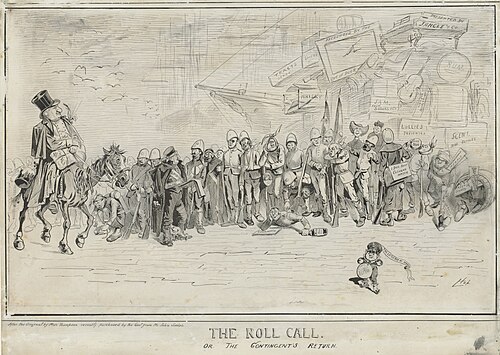
To mark the return, Hopkins produced a major parodic illustration titled 'The Roll-Call. – The Return of the N.S.W. Contingent.' This work was a direct satire of Elizabeth Thompson's revered Crimean War painting, The Roll Call. Hopkins' version stripped away the heroism, depicting a drunken soldier falling from the line and an adjutant with eggs in his pocket and a hen between his feet. The transport ship was shown laden with absurd public donations, including a grand piano, a cello, and barrels of rum and whiskey.
The Legacy of a Colonial Myth
Over time, 'The Little Boy from Manly' transitioned from a specific critique of the Sudan expedition to a broader personification of Australia. Livingston Hopkins later explained that the figure filled a vacancy for a "myth" that could represent the colony. To Hopkins, the boy typified the "well-meant impetuosity" of a young nation eagerly embracing a cause that the British Empire was already well-equipped to handle.
Key Facts
- First Deployment: The New South Wales Contingent's trip to Sudan was the first overseas military deployment by an Australian colony.
- The Catalyst: 10-year-old Ernest Lawrence donated £25 to the Patriotic Fund, sparking both public admiration and satirical mockery.
- The Satirist: Artist Livingston Hopkins used the boy as a recurring symbol in The Bulletin to critique colonial naivety.
- The Mission: Troops were sent to Suakin to support British forces against the Mahdist uprising.
- The Symbolism: 'The Little Boy from Manly' came to represent the impetuous nature of a young colony.
| Detail | Information |
|---|---|
| Acting Premier | William Bede Dalley |
| Destination | Suakin, Sudan |
| Departure Date | March 1885 |
| Return Date | June 19, 1885 |
| Primary Activities | Railway construction, guard duties, minor skirmishes |
| Key Satirical Source | The Bulletin (Livingston Hopkins) |
Frequently Asked Questions
Who was the real 'Little Boy from Manly'?
He was Ernest Lawrence, a 10-year-old boy who donated £25 of his savings to support the New South Wales troops sent to Sudan in 1885.
Why did The Bulletin mock the boy's contribution?
The magazine used the boy's innocence to satirize the perceived naivety and "impetuosity" of the Australian colony in supporting a British imperial war.
What happened to the New South Wales troops in Sudan?
The troops performed guard duties and helped build a railway. While they faced few major battles, some fatalities occurred due to disease.
What was the significance of 'The Roll-Call' illustration?
Created by Livingston Hopkins, it was a parody of a famous Crimean War painting intended to deflate the heroism of the Sudan expedition by depicting the troops and leaders in ridiculous situations.
What did 'The Little Boy from Manly' eventually symbolize?
He became an "office myth" for The Bulletin, representing the well-meaning but impulsive nature of a young Australia espousing imperial causes.