The Great Depression: Causes, Global Impact, and Economic Recovery
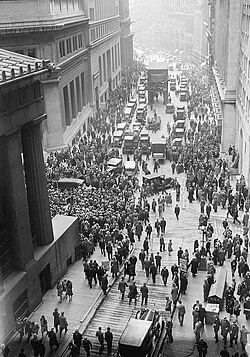
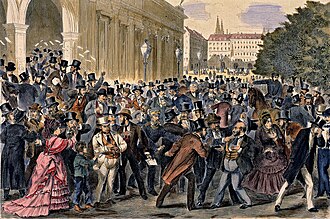
The Great Depression (1929–1939) remains the most profound economic downturn in modern history. Triggered by the Wall Street Crash of 1929, the crisis rapidly evolved from a financial panic in the United States into a global catastrophe that reshaped political landscapes and economic theories worldwide.
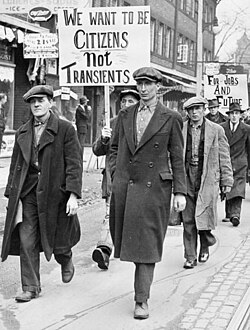
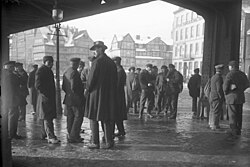
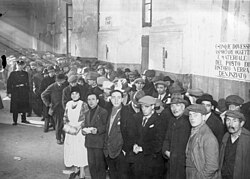
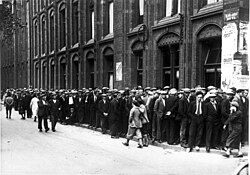
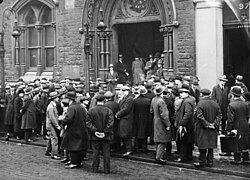
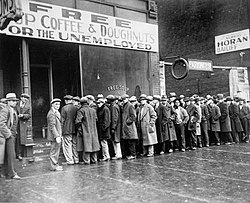
From the breadlines of Chicago to the industrial hubs of Germany and the rural plains of the American Dust Bowl, the Depression was characterized by mass unemployment, collapsing trade, and a systemic failure of the banking sector.
Key Facts
- Timeline: 1929 to 1939.
- Primary Trigger: The Wall Street Crash of 1929.
- U.S. Industrial Impact: Industrial production fell by 46%.
- Global Trade: Foreign trade plummeted by 70% in the U.S. and over 50% in other major economies.
- Major Policy Response: The New Deal in the United States.
- Recovery Catalyst: The onset of World War II.
The Economic Picture at the Onset
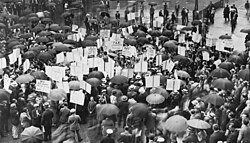
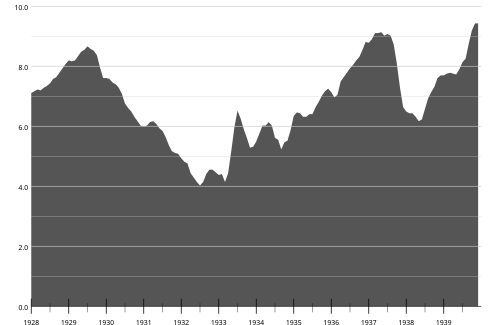
The crisis began with a sudden collapse of asset prices, but the subsequent decline was systemic. In the United States, the contraction was severe, with industrial production dropping by 46% and wholesale prices falling by 32%. The human cost was staggering, as unemployment rates surged by 607%.
![The overall course of the Depression in the United States, as reflected in per-capita GDP (average income per person) shown in constant year 2000 dollars, plus some of the key events of the period. Dotted red line = long-term trend 1920–1970.[46]](/images/dc/89/dc893d17c109fe4da89f726db67ab0d9345958ef1d3e8d1c63f48010e3f55b76.webp)
Global Economic Decline
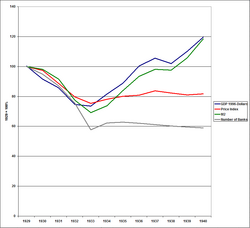
The depression was not limited to North America. Major industrial powers experienced similar, though varying, degrees of collapse. The following table summarizes the impact on key nations:
| Country | Industrial Production | Wholesale Prices | Foreign Trade | Unemployment |
|---|---|---|---|---|
| United States | −46% | −32% | −70% | +607% |
| United Kingdom | −23% | −33% | −60% | +129% |
| France | −24% | −34% | −54% | +214% |
| Germany | −41% | −29% | −61% | +232% |
Origins and Propagation
![The Depression in international perspective[36]](/images/bb/8f/bb8ffe5c7bb2e0fa1733687888178d11ffb4b607b02bdd8d3acf118bab4beec6.webp)
The transition from a stock market crash to a decade-long depression was fueled by several critical factors. One primary driver was the Smoot–Hawley Tariff Act, which increased import duties and led to a breakdown in international trade as other nations retaliated with their own tariffs.
The Gold Standard and Banking Crises
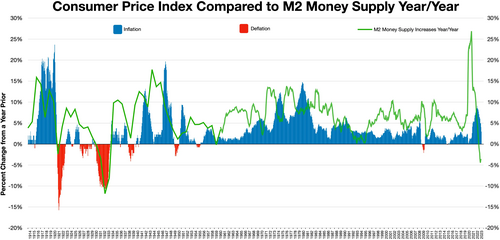
The Gold Standard—a monetary system where a currency's value is directly linked to gold—acted as a "golden fetter," preventing countries from adjusting their currencies to combat deflation. This rigidity helped spread the depression globally.
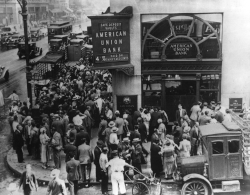
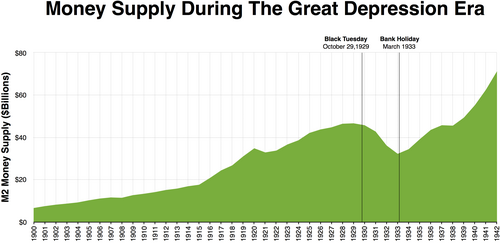
By 1931, the crisis intensified with the German banking crisis and a subsequent crisis in Britain. This led to a wave of bank runs (where depositors rush to withdraw their money simultaneously), causing the money supply to contract sharply.
Economic Theories on the Cause
Economists continue to debate the primary causes of the Great Depression, with two main schools of thought dominating the discourse.
The Monetarist View
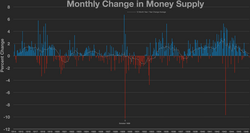
Monetarists argue that the crisis was caused by a massive contraction in the money supply. They point to the failure of central banks to provide liquidity, which allowed bank failures to spiral and reduced the total amount of money circulating in the economy.
The Keynesian View
Keynesians emphasize a collapse in aggregate demand. They argue that a loss of confidence led to a decrease in spending and investment, creating a vicious cycle of falling profits, reduced output, and rising unemployment.
Debt Deflation Theory
This theory suggests that the crisis was exacerbated by debt deflation: a process where businesses and individuals sell assets to pay off debts, which lowers asset prices further, reduces net worth, and precipitates more bankruptcies.
Social Impact and Recovery
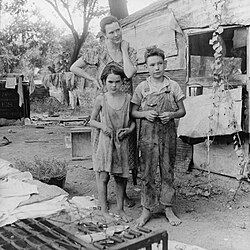
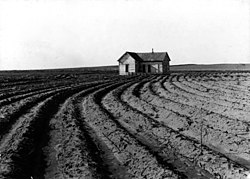
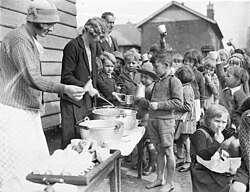
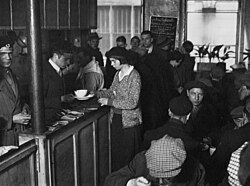
The social consequences were devastating. Families lived in shanties, and soup kitchens became a common sight in cities like Chicago and Paris. In the U.S., the Dust Bowl—a period of severe dust storms—coincided with the economic crash, displacing thousands of farmers.
![Buried machinery in a barn lot; South Dakota, May 1936. The Dust Bowl on the Great Plains coincided with the Great Depression.[212]](/images/76/08/76088f92935721a0ffa6b110e59043008d50b701e19e707d87012e241559ecc0.jpg)
The New Deal and Government Intervention
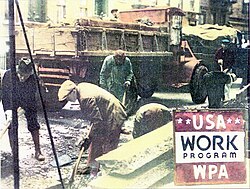
To combat the crisis, the U.S. government introduced the New Deal, which included programs like the Civilian Conservation Corps (CCC), which employed over 3 million young men, and the Works Progress Administration (WPA), which employed 2 to 3 million unskilled laborers.
![CCC workers constructing drainage culvert, 1933. Over 3 million unemployed young men were taken out of the cities and placed into 2,600+ work camps managed by the CCC.[213]](/images/d2/cc/d2cce4a8313e44083c03d37776fb2193ecffb9589cf92e5cbfff3fd4c31d96da.jpg)
The Role of Women and World War II
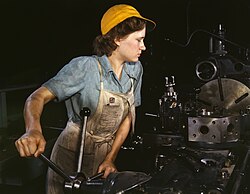
Household economics shifted as women took on more significant roles in managing limited resources. Eventually, the massive industrial mobilization required for World War II provided the final push toward full employment and economic recovery.
Frequently Asked Questions
![Burning shacks on the Anacostia flats, Washington, D.C., put up by the Bonus Army (World War I veterans) after the marchers with their wives and children were driven out by the regular Army by order of President Hoover, 1932[207]](/images/f3/1e/f31e0ef2ff0d26000610048d222b41a41b7216e2545c48b47f87bd10d6ac8d43.jpg)
What was the primary cause of the Great Depression?
While the Wall Street Crash of 1929 was the immediate trigger, the depression was sustained by a combination of bank failures, a contraction in the money supply, protectionist trade policies like the Smoot-Hawley Tariff, and the constraints of the gold standard.
How did the gold standard contribute to the crisis?
The gold standard limited the ability of governments to expand their money supply or devalue their currency to make exports more competitive, effectively "locking in" deflationary pressures across borders.
What was the New Deal?
The New Deal was a series of programs, public work projects, and financial reforms enacted by the U.S. government to provide relief for the unemployed, recovery for the economy, and reform of the financial system to prevent future crashes.
Did World War II end the Great Depression?
Yes, the war effort required unprecedented levels of government spending and industrial production, which eliminated unemployment and stimulated economic growth on a global scale.
What is the difference between the Monetarist and Keynesian views?
Monetarists focus on the failure of the money supply and central banking, while Keynesians focus on the collapse of total spending (aggregate demand) and the need for government fiscal stimulus.