The Deccan Horse (9 Horse)
The Deccan Horse (9 Horse) stands as one of the oldest and most distinguished armoured regiments of the Indian Army. With a lineage stretching back to 1790, the regiment has evolved from irregular cavalry units serving the Nizam of Hyderabad into a modern powerhouse of the Indian Armoured Corps. Throughout its long history, it has earned a reputation for gallantry across diverse terrains, from the plains of the Deccan to the trenches of France and the deserts of Punjab.
Key Facts
- Active Service: 1790 to present.
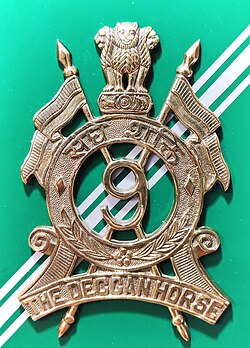
- Motto: Sanghe Shakti (संघे शक्ति), meaning "Strength in Unity".
- Current Role: Armoured regiment utilizing tanks.
- Major Honours: Recipient of the President's Guidon (1984) and multiple Victoria Crosses.
- Notable Engagements: The Battle of the Somme, Burma Campaign, and the Battle of Asal Uttar.
Formation and Evolution
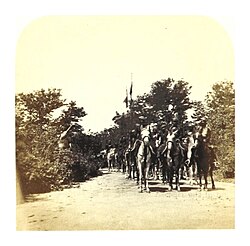
The origins of the regiment date back to 1790 as Asif Sah's Irregular Cavalry. Initially, two regiments were raised to serve the Nizam of Hyderabad in Berar, who was allied with the British East India Company. These units underwent several name changes and reorganizations over the next century.
The first lineage evolved from Nawab Jalal-ud-Daula's Risalas (1816) to the 1st Cavalry, Hyderabad Contingent (1854), and eventually became the 20th Deccan Horse in 1903. The second lineage began with Nawab Murtaza Yar Jang's Risalas (1816), becoming the 2nd Cavalry, Hyderabad Contingent (1854), and later the 29th Lancers (Deccan Horse) in 1903.
During Lord Kitchener's reforms of the Indian Army in 1903, the Hyderabad Contingent was incorporated into the regular British Indian Cavalry. In 1921, the 20th Deccan Horse was granted the title "Royal" for its distinguished service in World War I. The two regiments merged in 1921 as "The 9th Royal Deccan Horse," later becoming "The Royal Deccan Horse (9th Horse)" in 1927. Upon India becoming a Republic in 1950, the unit was renamed The Deccan Horse (9th Horse).
Regimental Composition
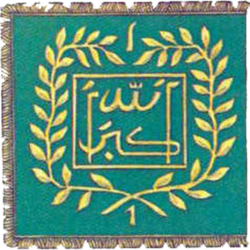
The ethnic composition of the regiment shifted over time to reflect the strategic needs of the era. During the Hyderabad Contingent period, the unit consisted of squadrons of Sikhs, Deccani Mussalmans, and Jats. By 1927, the composition had transitioned to Punjabi Muslims, Sikhs, and Jats.
Early Military History
For much of the 18th and 19th centuries, the Deccan Horse operated as a local corps in the Deccan region. They were frequently deployed to suppress rebellions and secure borders, including operations against the Pindaris (1811), the Third Anglo-Maratha War (1817–18), and various campaigns against the Bhils and Rohillas throughout the 1820s to 1840s.
The regiment played a critical role during the Indian Rebellion of 1857, seeing action in locations such as Jhansi, Gwalior, and Kalpi. For these efforts, the unit was awarded the battle honour "Central India" and saw one of its members, Captain Herbert Clogstoun, earn the Victoria Cross in 1859.
Beyond India, the regiment's reach extended globally, with deployments in the Second Afghan War, the Burma War (1886–1888), the Boxer Rebellion in China (1900), and the South African War (1900–1901).
World War I: From Trenches to the Jordan Valley
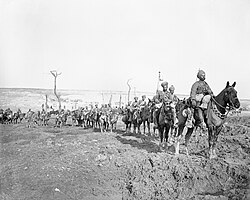
The 20th Deccan Horse was deployed to the Western Front in France in September 1914. After initial fighting around Festubert and Givenchy, where they suffered heavy casualties, the regiment spent much of 1915 behind the lines.
A defining moment occurred on 14 July 1916 during the Battle of the Somme. At Bazentin Ridge, the regiment charged German infantry at High Wood with lances and swords. This daring assault was highlighted in Sir Douglas Haig's dispatches and received significant British press coverage.
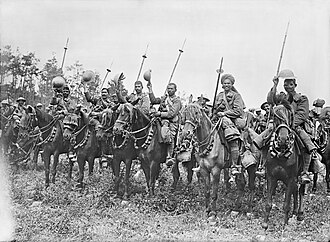
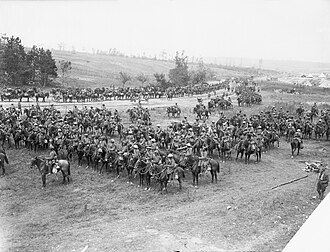
In 1918, the regiment moved to Egypt and Palestine, joining the 14th Cavalry Brigade. They fought in the Battle of Megiddo and the capture of Damascus. It was during this campaign that Risaldar Badlu Singh performed a legendary act of bravery on 23 September 1918, capturing a machine-gun position on the west bank of the River Jordan. He was awarded the Victoria Cross posthumously, and the date is still commemorated as "Jordan Valley Day."
World War II and the Transition to Armour
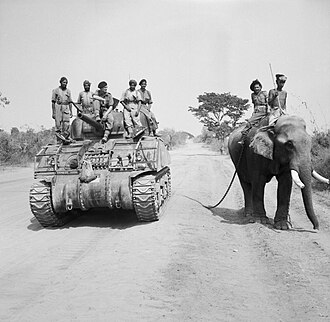
The Second World War marked a fundamental shift in the regiment's identity as it converted from horses to tanks. Now part of the 255th Indian Tank Brigade, the unit trained in Assam before participating in the re-conquest of Burma, fighting through the jungles and roads to Meiktila.
Post-Independence and Modern Conflicts
Following India's independence, the Deccan Horse continued to serve at the forefront of national defense.
Indo-Pakistani War of 1947–1948
A squadron of the regiment operated in the Chhamb sector of Jammu and Kashmir, where tanks were rafted across the Chenab River at Akhnoor to secure the region.
Indo-Pakistani War of 1965
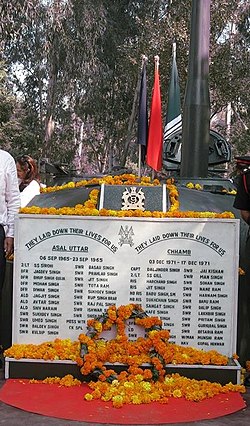
The regiment achieved legendary status during the Battle of Asal Uttar in the Khemkaran Sector. Using Sherman tanks, they were instrumental in creating the "Patton Graveyard," destroying 75 of Pakistan's latest Patton tanks. Lt Col (later Gen) A S Vaidya was awarded the Maha Vir Chakra for his leadership during this engagement.
Indo-Pakistani War of 1971
Equipped with T-54 tanks, the regiment fought in the Battle of Chamb. Their actions blunted the largest offensive mounted by Pakistan since independence, earning the unit six gallantry awards.
Summary of Regimental Legacy
| Category | Details |
|---|---|
| Founded | 1790 (as Asif Sah's Irregular Cavalry) |
| Primary Equipment | Tanks (Sherman, T-54) |
| Key Battle Honours | Central India, Somme, Meiktila, Asal Uttar, Punjab 1965 |
| Highest Awards | Victoria Cross, Maha Vir Chakra, President's Guidon |
| Current Affiliation | Indian Armoured Corps |
Frequently Asked Questions
What is the significance of the "Patton Graveyard"?
The "Patton Graveyard" refers to the aftermath of the Battle of Asal Uttar in 1965, where the Deccan Horse and other Indian units destroyed a massive number of Pakistani Patton tanks, effectively neutralizing a major armored thrust.
Who was Risaldar Badlu Singh?
Risaldar Badlu Singh was a soldier of the 29th Lancers (Deccan Horse) who was posthumously awarded the Victoria Cross for his bravery in capturing a German machine-gun position during the Palestine campaign in 1918.
When did the regiment switch from horses to tanks?
The regiment converted to tanks during World War II, becoming part of the 255th Indian Tank Brigade for the Burma Campaign.
What is the President's Guidon?
The Guidon is a ceremonial standard presented to the regiment by President Giani Zail Singh on 9 January 1984, in recognition of the unit's distinguished service to the nation.
What does the motto "Sanghe Shakti" mean?
The motto "Sanghe Shakti" is written in Sanskrit and translates to "Strength in Unity," reflecting the regimental spirit of cohesion and collective power.