The Daily Telegraph: A History of Ownership, Influence, and Controversy
Founded in the mid-19th century, The Daily Telegraph has evolved from a personal grievance publication into one of the United Kingdom's most prominent news organizations. Its journey reflects the broader shifts in the British media landscape, moving from the traditional hub of Fleet Street to a modern multimedia operation, while navigating complex battles over ownership and editorial integrity.
Founding and Early Years
The newspaper, originally titled The Daily Telegraph and Courier, was established in June 1855 by Colonel Arthur B. Sleigh. The publication was born out of Sleigh's desire to air a personal grievance against Prince George, the Duke of Cambridge and future commander-in-chief of the British Army. Joseph Moses Levy, owner of The Sunday Times, handled the printing, and the first edition debuted on June 29, 1855.
The early paper was a modest four-page publication costing 2d. Despite its small size, it championed a "high tone of independent action." However, the venture was not initially profitable, leaving Sleigh unable to pay his printing bills to Levy.
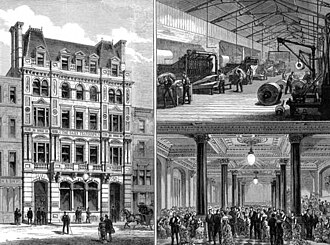
Growth and the World War Eras
By the early 20th century, the paper had become a significant player in international discourse. In 1908, it published an interview with Kaiser Wilhelm II of Germany, an event that strained Anglo-German relations and contributed to the tensions preceding World War I.
Ownership shifted in 1928 when Harry Lawson Webster Levy-Lawson, 2nd Baron Burnham, sold the paper to William Berry (1st Viscount Camrose), Gomer Berry (1st Viscount Kemsley), and Edward Iliffe (1st Baron Iliffe). In 1937, the publication absorbed The Morning Post, a conservative paper popular among retired officers. For a period, it operated as The Daily Telegraph and Morning Post before reverting to its original name.
During the late 1930s, the paper was a site of political friction. Diplomatic editor Victor Gordon Lennox published The Whitehall Letter, an anti-appeasement private newsletter fueled by leaks from Foreign Office officials Sir Robert Vansittart and Rex Leeper, which led to Lennox being monitored by MI5. In 1939, the paper broke the scoop that Germany intended to invade Poland.
The Blitz of 1940 forced the paper to adapt. Due to frequent Luftwaffe bombing raids on Fleet Street, printing operations were moved to Kemsley House in Manchester. This facility, later renamed Thomson House in 1959, often handled the entire print run when London offices were under threat.
Post-War Evolution and the Conrad Black Era
From 1946 to 1985, management remained within the Camrose and Burnham families. A significant milestone occurred in 1960 with the launch of the sister publication, The Sunday Telegraph.
In 1986, Canadian businessman Conrad Black acquired the Telegraph Group through a complex web of holding companies, including Ravelston Corporation and Hollinger International. This era ended abruptly in January 2004, when Black was dismissed as chairman of Hollinger International following allegations of financial wrongdoing.
The Barclay Era and Digital Transformation
Following Black's exit, the Barclay brothers acquired a controlling interest in the paper in 2004 after a bidding war that saw competitors like Richard Desmond and Daily Mail and General Trust withdraw as the price exceeded £600 million.
The 21st century brought a shift toward multimedia. The Electronic Telegraph (now telegraph.co.uk) launched in 1995, initially as a paid subscription service. By 2006, the company rebranded as the Telegraph Media Group and moved to new "hub and spoke" offices at Victoria Plaza in London to better integrate print and digital content.
Technological milestones included the introduction of full-color printing on every page in September 2008 and the launch of the UK's first regular newspaper podcast service in November 2005.
Editorial Controversies and Criticisms
The publication has faced significant scrutiny regarding its editorial standards and commercial partnerships:
- State-Funded Content: The paper was criticized for accepting payments from Russian and Chinese state-run media. It received £900,000 annually for the Russia Beyond the Headlines supplement and £750,000 annually for China Watch, the latter of which was removed in April 2020.
- Scientific Accuracy: The Independent Press Standards Organisation (IPSO) ordered a correction in 2021 regarding COVID-19 misinformation published by Toby Young. Additionally, the paper has been accused of promoting pseudoscientific views on climate change.
- Regulatory Issues: In January 2017, the paper had more upheld complaints from IPSO than any other UK newspaper, primarily regarding inaccuracy.
- Ideological Criticism: The paper has been accused of publishing articles linked to "Cultural Marxism," described by critics as an antisemitic conspiracy theory.
The Turbulent Path to Axel Springer
Between 2023 and 2026, the paper underwent a chaotic series of ownership attempts. Following a financial dispute with Lloyds Banking Group, the bank seized control and sought a buyer. A bid by RedBird IMI, a UAE-backed venture, sparked national security concerns and government intervention due to the UAE's record on free speech.
After several failed attempts, including a brief deal with DMGT in November 2025, the Telegraph Media Group was finally acquired by the German company Axel Springer SE in March 2026 for £575 million. The acquisition was completed on June 30, 2026, with the goal of expanding the brand's international reach while preserving its editorial character.
Key Facts
- Founded: June 29, 1855, by Colonel Arthur B. Sleigh.
- First Price: 2d for a four-page edition.
- Major Mergers: Absorbed The Morning Post in 1937.
- Digital Launch: The Electronic Telegraph debuted in 1995.
- Current Owner: Axel Springer SE (acquired June 2026).
- Notable Scoops: Reported the German invasion of Poland in 1939 and MP expenses in 2009.
| Period | Primary Owner/Controller | Key Event |
|---|---|---|
| 1855 – 1928 | Sleigh / Levy-Lawson family | Founding and early growth |
| 1928 – 1986 | Berry (Camrose/Kemsley) & Iliffe | Absorption of The Morning Post |
| 1986 – 2004 | Conrad Black (Hollinger) | Corporate consolidation |
| 2004 – 2023 | The Barclay Brothers | Digital transformation and rebranding |
| 2023 – 2026 | Lloyds Bank / RedBird IMI (Attempted) | Financial dispute and regulatory battles |
| 2026 – Present | Axel Springer SE | International expansion focus |
Frequently Asked Questions
Why was The Daily Telegraph originally founded?
It was founded by Colonel Arthur B. Sleigh in 1855 specifically to voice a personal grievance against Prince George, the Duke of Cambridge.
What was the "China Watch" controversy?
The paper received £750,000 annually to publish a supplement from the Chinese state-run China Daily. Following criticism, the supplement was removed from the website in April 2020.
How did World War II affect the paper's operations?
Due to Luftwaffe bombing raids on Fleet Street in 1940, the paper moved its printing operations to Kemsley House in Manchester to ensure continuity.
Why did the UK government block the RedBird IMI takeover?
The government and MPs raised national security and press freedom concerns because RedBird IMI was backed by the UAE, which has a poor reputation for freedom of speech.
Who currently owns The Daily Telegraph?
The Telegraph Media Group is owned by the German media company Axel Springer SE, which completed its acquisition on June 30, 2026.