The London Gazette: History and Role of the UK's Official Journal of Record
The London Gazette, commonly referred to as The Gazette, serves as one of the primary official journals of record for the Government of the United Kingdom. Unlike a standard newspaper, it functions as a government gazette—a publication used to announce legal and statutory notices that are required by law to be made public.
While it is the most prominent of its kind in the UK, it works alongside The Edinburgh Gazette and The Belfast Gazette. These regional counterparts handle specific publications for Scotland and Northern Ireland, respectively, though they often reproduce nationwide materials from the London edition. Conversely, The London Gazette publishes notices relevant to England and Wales, as well as certain items of interest to the other UK nations.
Key Facts
- Founded: 7 November 1665 (originally as The Oxford Gazette).
- Purpose: Official publication of statutory notices, royal proclamations, and government appointments.
- Publisher: The Stationery Office (TSO) on behalf of His Majesty's Stationery Office.
- Availability: Published every weekday (excluding bank holidays); fully digitized and available online since 2014.
- Legal Status: Subject to Crown copyright and generally available under the Open Government Licence v3.0.
The Evolution of a National Record
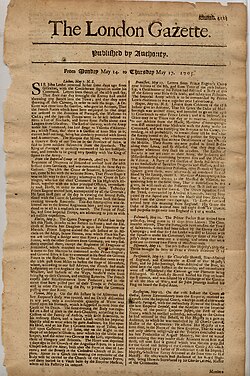
The publication began as The Oxford Gazette on 7 November 1665. Its origin was born of necessity: King Charles II and the Royal Court had relocated to Oxford to escape the Great Plague of London. Because courtiers feared contagion from materials coming out of the city, Henry Muddiman published the Gazette "By Authority" in Oxford. The first issue was notably mentioned in the diary of Samuel Pepys.
As the plague subsided and the King returned to the capital, the publication followed. The first issue officially branded as The London Gazette (Issue No. 24) was released on 5 February 1666. In its early years, it differed from modern newspapers; it was not sold to the general public but was instead delivered via post to a list of subscribers.
Ownership and Digital Transition
His Majesty's Stationery Office (HMSO) took over the publication in 1889. In 2006, the publication moved to the private sector under government supervision when HMSO was sold and renamed The Stationery Office (TSO). The 21st century brought a digital revolution to the archive; Gazettes-Online launched on 28 January 2003, and by 2014, the publication transitioned to an exclusively online format.
Current Functions and Publication Scope
Today, The London Gazette remains essential for the legal and administrative functioning of the UK. It publishes a wide array of official notices, including:
- Legislative Actions: Granting of royal assent to bills from the UK Parliament, the Scottish Parliament, the Senedd, and the Northern Ireland Assembly.
- Political Processes: The issuance of writs of election for House of Commons vacancies.
- Public Appointments: Appointments to public offices and commissions or promotions within the Armed Forces.
- Legal and Financial Notices: Corporate and personal insolvency filings.
- Honours: The granting of military medals and awards of honours.
- Personal Records: Changes of names or coats of arms, and royal proclamations.
To ensure accessibility, the content is provided in machine-readable formats such as XML and RDFa via Atom feeds.
The Meaning of Being "Gazetted"
The influence of the journal has permeated the English language, specifically through the term gazetted. In a military context, when a soldier is mentioned in despatches or promoted, they are said to have been "gazetted."
Historically, the term also carried a more ominous meaning regarding financial ruin. To be "in the gazette" often meant that an official notice of bankruptcy had been published. This social fall from grace was famously satirized in a 19th-century poem contrasting the frugal habits of 1722 with the lavish spending of 1822, which inevitably led to being "Gazetted." In the past, the journal also served as a venue for publishing notices of engagement and marriage.
Summary of The London Gazette
| Feature | Details |
|---|---|
| Original Name | The Oxford Gazette |
| First Published | 7 November 1665 |
| Format | Broadsheet (Historically), Digital (Current) |
| Primary Purpose | Official Government Journal of Record |
| Regional Affiliates | The Edinburgh Gazette, The Belfast Gazette |
| Current Publisher | The Stationery Office (TSO) |
Calendar and Colonial Legacy
Researchers looking at early issues must be aware of the Julian calendar. Until the Calendar (New Style) Act 1750 took effect on 1 January 1752, the Gazette dated its issues based on a year that began on 25 March. This can lead to discrepancies in modern secondary sources, where a date like 24 March 1723 (Old Style) might be recorded as 1724 to align with the modern solar year.
The model of The London Gazette was so successful that it was exported across the British Empire. Most British colonial possessions issued their own gazettes, many of which continue to operate today following their respective nations' independence.
Frequently Asked Questions
Is The London Gazette the oldest newspaper in the UK?
The London Gazette claims to be the oldest surviving English newspaper and the oldest continuously published newspaper in the UK. However, this claim is also made by other publications, including the Berrow's Worcester Journal (1690) and the Stamford Mercury (1712).
What does it mean to be "gazetted"?
In modern usage, it typically refers to members of the armed forces being officially named in despatches or receiving a promotion. Historically, it could also refer to the official publication of a person's bankruptcy.
How can I access old issues of The Gazette?
His Majesty's Stationery Office has digitized all issues, and they are available online through the official website, thegazette.co.uk.
Who publishes The London Gazette today?
It is published by The Stationery Office (TSO) on behalf of His Majesty's Stationery Office.
Why was it originally called The Oxford Gazette?
It was founded in Oxford because King Charles II and the Royal Court had moved there to avoid the Great Plague of London, and courtiers feared handling newspapers coming from the infected city.