The Crop: Biological Function and Diversity in Animals
In the animal kingdom, the ability to store food efficiently is a critical survival strategy. One of the most specialized structures for this purpose is the crop (also known as the craw, ingluvies, or sublingual pouch). The crop is a thin-walled, expanded section of the alimentary tract—the passage through which food passes—designed specifically to store food before it undergoes digestion.
While most commonly associated with birds, this anatomical feature is found across a diverse range of species, including invertebrates such as insects, earthworms, leeches, and gastropods like snails and slugs.
Key Facts
- Primary Function: Temporary storage of food prior to digestion.
- Location: In birds, it is an enlarged part of the esophagus near the throat.
- Occurrence: Found in various vertebrates (birds) and invertebrates (insects, annelids, gastropods).
- Specializations: Used for producing crop milk in pigeons and for social communication (trophallaxis) in ants.
- Variability: Not all bird species possess a crop; for example, owls and buttonquail lack one.
The Crop in Insects
For many insects, the crop is located in the foregut and serves as a vital reservoir. Bees, for instance, use their crops to temporarily store nectar collected from flowers. Other members of the order Hymenoptera similarly utilize this structure for liquid food storage.
In eusocial insects, such as ants, the crop has evolved to be highly distensible (stretchable). This adaptation facilitates trophallaxis, a form of social communication and nutrient exchange where colony members transfer liquid food from one individual's crop to another.
The Crop in Birds
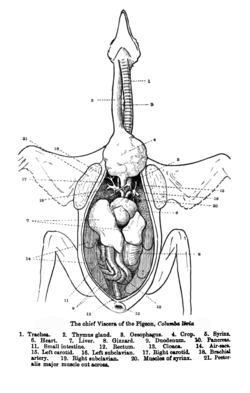
In avian anatomy, the crop is a muscular pouch located near the gullet. It acts as a holding chamber, allowing birds to ingest large amounts of food quickly and process it slowly later.
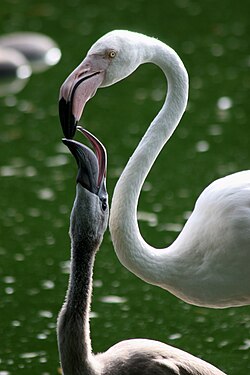
Certain species have developed unique biological functions within the crop. Adult pigeons and doves can produce crop milk, a nutrient-rich secretion used to feed their newly hatched young.
The behavior of scavenging birds, such as vultures, highlights the crop's capacity for volume. These birds often gorge themselves when prey is abundant, causing the crop to bulge visibly. After such a feast, they typically enter a state of sleepiness or torpor to focus energy on digestion.
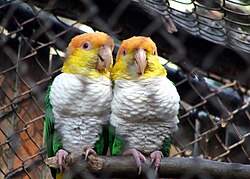
While common, the crop is not universal among birds. It is present in chickens, turkeys, ducks, geese, parrots, and most raptors (including hawks and eagles). However, owls and buttonquail do not have one. Fossil evidence also indicates that some extinct birds, such as the Enantiornithes, lacked this structure.
Comparison of Crop Presence in Birds
| Group/Species | Crop Present? | Notes |
|---|---|---|
| Pigeons & Doves | Yes | Can produce crop milk |
| Vultures, Hawks, Eagles | Yes | Used for gorging on prey |
| Owls | No | Lacks this storage structure |
| Chickens, Turkeys, Waterfowl | Yes | Standard digestive feature |
| Buttonquail | No | Unlike true quail |
| Enantiornithes (Extinct) | No | Absent in this ancestral group |
Cultural and Literary Context
The concept of the crop has occasionally appeared in literature and language. In Arthur Conan Doyle's 1892 Sherlock Holmes story, "The Adventure of the Blue Carbuncle," a precious gemstone is discovered hidden inside a bird's crop.
Additionally, the obsolete term "craw" persists in the English idiom "it sticks in my craw." This phrase metaphorically describes a situation that is unacceptable or annoying, referencing the physical sensation of food being unable to pass the crop into the rest of the digestive system.
Frequently Asked Questions
What is the main purpose of a crop?
The primary purpose of a crop is to serve as a temporary storage chamber for food, allowing an animal to eat quickly and digest the food more gradually.
Do all birds have a crop?
No, not all birds possess a crop. While common in many species, it is absent in owls, buttonquail, and certain extinct avian groups like Enantiornithes.
What is crop milk?
Crop milk is a specialized secretion produced in the crops of adult pigeons and doves to provide essential nutrition to their hatchlings.
How do insects use their crops for communication?
In eusocial insects like ants, the distensible crop allows for trophallaxis, which is the mouth-to-mouth transfer of liquid food and chemical cues between colony members.
What is the difference between a crop and a gular pouch?
While both are in the throat area, a crop is part of the internal digestive tract used for storage before digestion, whereas a gular pouch is an external flap of skin used by some birds to hold prey while hunting.