The 2nd Millennium BC: A Global Transition from Bronze to Iron
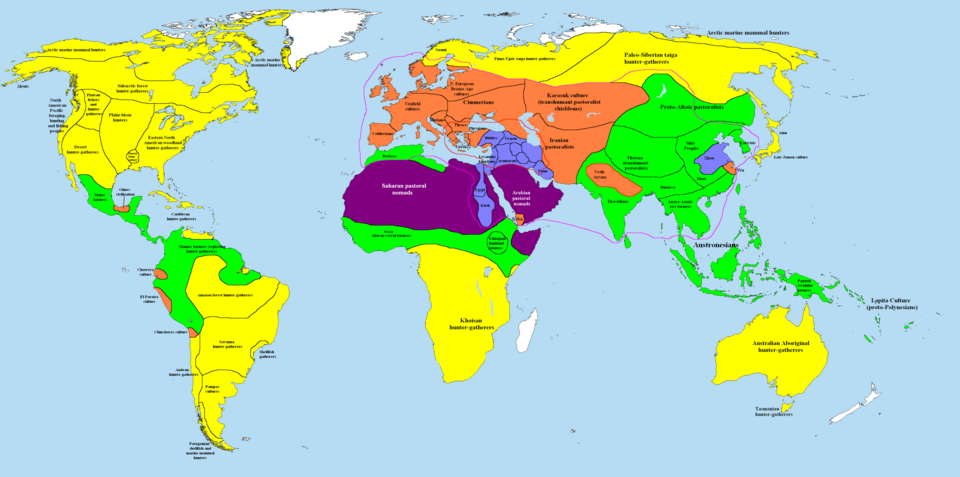
The 2nd millennium BC, spanning from 2000 BC to 1001 BC, was a pivotal era of human history. In the Ancient Near East, this period witnessed the transition from the Middle Bronze Age to the Late Bronze Age, characterized by the rise and fall of powerful empires and the birth of the alphabet. While some regions entered a recorded historical era, others remained in prehistoric stages, evolving through migrations and technological shifts.
During this time, the global population grew steadily, potentially surpassing 100 million people for the first time in history.
Key Facts
- Timeline: 2000 BC to 1001 BC.
- Major Powers: Egypt (Middle and New Kingdoms), Babylonia, and the Hittite Empire.
- Technological Leap: The introduction of horse-drawn, spoke-wheeled chariots revolutionized warfare.
- Literacy: The development of the Phoenician alphabet laid the groundwork for most modern alphabetic writing systems.
- Global Shifts: The era ended with the Bronze Age collapse, leading into the Iron Age.
The Middle Bronze Age: Stability and Decline
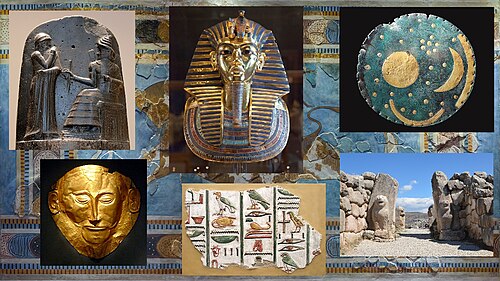
The early part of the millennium was defined by a period of recovery. In Egypt, the Middle Kingdom flourished, while in Mesopotamia, the Kings of Babylon (of Amorite origin) established governance that was generally popular among their subjects. Both civilizations focused on elegant art and architecture.
However, this stability was fragile. Military tactics relied on foot soldiers and donkeys, leaving these empires vulnerable. Meanwhile, in the east, the Indus Valley Civilization began to decline, likely due to catastrophic flooding.
The 16th Century BC: The Chariot Revolution
Around 1500 BC, the geopolitical landscape shifted violently. Indo-European invaders from the Central Asian plains introduced the spoke-wheeled chariot—a fast, horse-powered weapon of war previously unknown to the classical civilizations of the Near East.
The impact was immediate and devastating. In 1630 BC, the Hyksos invaded the Nile Delta in Egypt, and by 1595 BC, the Hittites swept into Mesopotamia, overwhelming the traditional foot-soldier armies.
The Late Bronze Age: Superpowers and Diplomacy
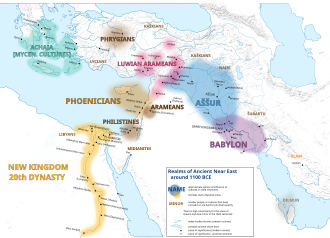
The surviving civilizations quickly adapted to chariot warfare, leading to a new international order. The New Kingdom of Egypt emerged as the dominant superpower, though it competed for hegemony with other regional powers. Interestingly, Babylon avoided these conflicts, instead becoming the world's center for religion and intellect.
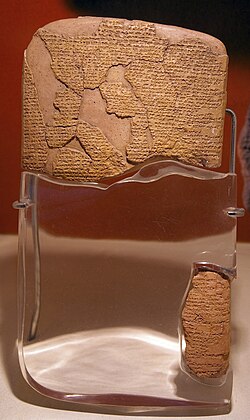
This era was marked by grandiose architecture, vivid diplomatic correspondence on clay tablets, and a rigid social hierarchy. Society was split between a powerful military elite and a tiny minority of educated scribes, while the vast majority of the population remained illiterate peasants and craftsmen.
The Bronze Age Collapse
Toward the end of the millennium, the established order crumbled. A combination of waves of horseback-riding "barbarians" and the Sea Peoples—ship-faring raiders of the Mediterranean—destroyed much of the Bronze Age world, triggering the transition to the Iron Age.
Global Developments Beyond the Near East
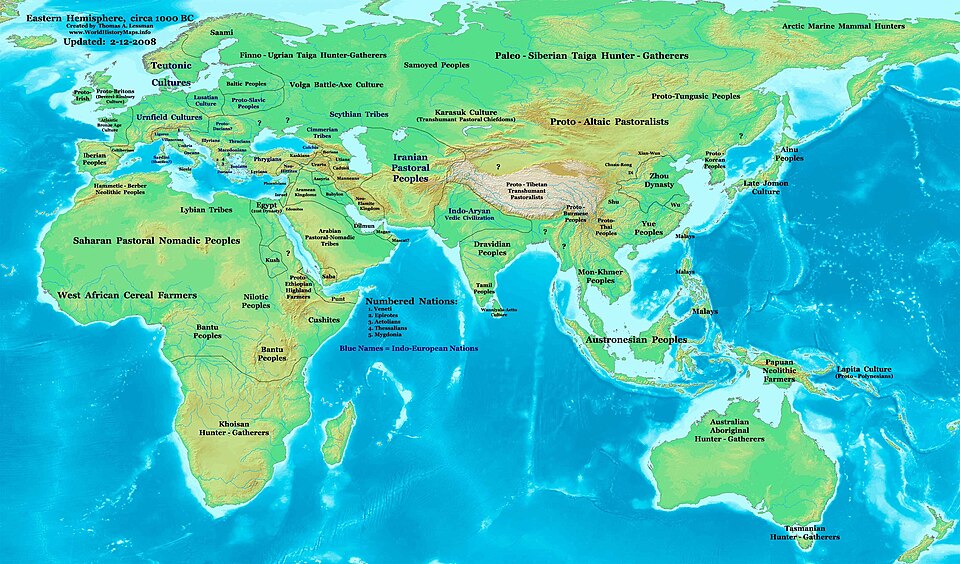
While the Near East recorded its history, other regions underwent significant prehistoric transformations:
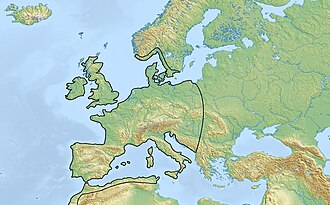
- Europe: The Beaker culture introduced the Bronze Age, likely linked to Indo-European expansion. This period also saw the rise of the Minoan and Mycenaean civilizations in the Aegean.
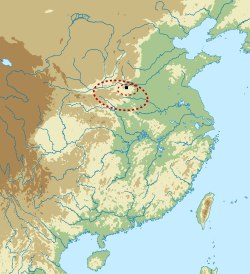
- Asia: In China, the Erlitou culture emerged, followed by the Shang and Zhou dynasties. In India, the Indo-Iranian expansion brought the chariot to the subcontinent, leading to the Vedic period.
- Africa: The desiccation of the Sahara was completed, sparking the Bantu expansion, which spread pastoralism and iron metallurgy into Central, Eastern, and Southern Africa.
- Americas: Mesoamerica entered the Pre-Classic period with the rise of the Olmec civilization, while North America remained in the late Archaic stage.

![Volcano eruption at Thera, c. 1500 BC. Thera today[3]](/images/53/81/538150d56f4cbc49bce859782cd5a895ebc76344f6e1fa9e7c4e63dc7f808801.jpg)
Innovations and Language
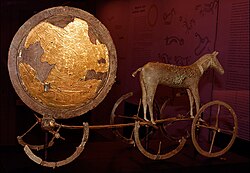
The 2nd millennium BC was a golden age of invention. Notable breakthroughs included the Nebra sky disc (the oldest concrete representation of astronomical phenomena), Chinese oracle bone script, and diamond-tipped drills in India for bead manufacturing.
Language also evolved rapidly. The Phoenician alphabet, developed from Proto-Canaanite script, became the parent of nearly all alphabetic writing systems. In Anatolia, the Hittite language became the first attested Indo-European language recorded in cuneiform.
| Approximate Date | Event/Innovation | Region |
|---|---|---|
| c. 2000 BC | Seima-Turbino Phenomenon | Eurasia |
| 1627 BC | Minoan eruption | Aegean |
| 1500 BC | Bantu expansion begins | Africa |
| 1478 BC | Battle of Megiddo | Near East |
| 1274 BC | Battle of Kadesh | Near East |
| 1269 BC | Kadesh peace treaty signed | Near East |
| 1045 BC | Founding of Zhou dynasty | China |
Frequently Asked Questions
What caused the transition from the Middle to Late Bronze Age?
The transition was largely driven by the introduction of horse-drawn, spoke-wheeled chariots by Indo-European invaders, which rendered the traditional foot-soldier armies of Egypt and Babylonia obsolete and forced a military evolution.
Who were the Sea Peoples?
The Sea Peoples were ship-faring raiders of the Mediterranean who, along with other migrating groups, contributed to the widespread destruction of Bronze Age civilizations toward the end of the 2nd millennium BC.
Why is the Phoenician alphabet so significant?
The Phoenician alphabet was one of the first fully phonemic scripts. Because it was spread by maritime traders across the Mediterranean, it became the foundation for virtually all subsequent alphabetic writing systems.
What was the significance of the Battle of Kadesh?
The Battle of Kadesh (1274 BC) was a major conflict between the Egyptians and the Hittites. It eventually led to the Kadesh peace agreement in 1269 BC, which is believed to be the earliest known international peace treaty.
How did the Bantu expansion change Africa?
The Bantu expansion spread agricultural practices, pastoralism, and iron metallurgy from West and East Africa into the central, eastern, and southern regions of the continent.