Terete Structures in Botany and Lichenology
In the precise world of botanical description, the shape of a plant organ's cross section provides critical clues for identification and classification. One of the most specific terms used by scientists to describe these shapes is terete. While it may sound obscure, it describes a common geometric form found throughout the natural world, from the sturdy branches of ancient trees to the delicate filaments of lichens.
What Does Terete Mean?
In botany, a structure is described as terete when its cross section is circular or nearly circular. A key characteristic of a terete organ is that it possesses a single, continuous surface that wraps entirely around the structure, rather than having distinct upper and lower sides.
This is most easily understood when contrasted with flattened structures. For example, a typical leaf has a clear upper surface (adaxial) and a lower surface (abaxial). Because of this differentiation, a standard leaf is not terete. In contrast, a tree branch is generally round in cross section, making it terete.
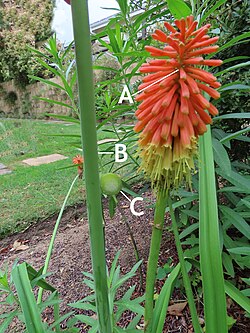
Variations in Plant Forms
While many leaves are flat, some plants evolve different morphologies. The fleshy leaves of certain succulents are often terete, adapting their shape to better manage water storage and reduce surface area exposure. Additionally, when a plant structure is almost circular but not perfectly so, botanists use the term subterete to indicate it is not completely terete.
Terete Forms in Lichens
The term terete is equally important in lichenology, the study of lichens. Lichens are categorized largely by their growth forms, and the cross section of their body (thallus) is a primary distinguishing factor.
- Fruticose lichens are characterized as terete. They feature a roughly circular cross section and are enveloped by a single, wrap-around skin-like surface known as the cortex.
- Foliose and crustose lichens, by contrast, have flattened cross sections with a distinct upper surface that differs from the lower surface.
Summary of Botanical Shapes
| Structure Type | Cross Section Shape | Surface Characteristics | Classification |
|---|---|---|---|
| Tree Branch | Circular | Single wrap-around surface | Terete |
| Standard Leaf | Flattened | Distinct upper and lower surfaces | Non-terete |
| Succulent Leaf | Circular/Cylindrical | Single wrap-around surface | Terete |
| Fruticose Lichen | Roughly Circular | Single cortex surface | Terete |
| Foliose Lichen | Flattened | Distinct upper and lower surfaces | Non-terete |
Key Facts
- Terete refers to a circular or nearly circular cross section.
- Terete structures have a single surface wrapping around them, lacking a distinct top and bottom.
- Subterete is the term used for structures that are nearly, but not completely, terete.
- In lichens, the cortex is the skin-like surface that wraps around terete fruticose lichens.
- Common examples of terete structures include tree branches and certain succulent leaves.
Frequently Asked Questions
What is the difference between terete and subterete?
A structure is terete if it is circular or nearly circular in cross section. If the structure is close to being circular but does not fully meet the criteria, it is described as subterete.
Are all leaves non-terete?
No. While most leaves are flattened with distinct upper and lower surfaces, the fleshy leaves of some succulents are terete.
How does the term terete apply to lichens?
It is used to distinguish fruticose lichens, which have a circular cross section and a single wrap-around cortex, from foliose and crustose lichens, which are flattened.
What is a cortex in the context of terete lichens?
The cortex is the skin-like outer layer that wraps around the circular body of a fruticose lichen.
Why is the distinction between terete and flattened important?
This distinction helps botanists and lichenologists accurately describe and identify species based on their physical morphology and growth patterns.