Temple Mount Administration and Access Since 1967
Following the Six-Day War in June 1967, the administration of the Temple Mount—known to Muslims as the Haram al-Sharif—entered a complex phase of shared oversight. While Israel occupied the Old City of Jerusalem, the site remained under the internal control of the Jordan-based Jerusalem Islamic Waqf, an Islamic trust. However, the Israeli government assumed responsibility for overall security and the regulation of access to the site.
To signal that sovereignty would be determined through final status negotiations, Israel implemented several diplomatic measures. These included prohibiting the flying of the Israeli flag over the site and refraining from applying certain Israeli laws, such as those governing Holy Places, to the area. Uzi Narkis, then chief of the IDF's Central Command, clarified that while the IDF would maintain security outside the platform, the Israeli administration would not interfere with internal guarding or the daily operations of the Mount.
Currently, eleven gates are open to the Muslim public, while non-Muslims are restricted to entering through the Moors' Gate.
Key Facts
- Administrative Split: Internal management is handled by the Jordanian Waqf, while external security is managed by Israel.
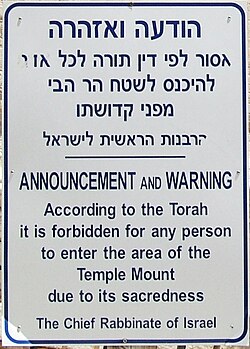
- Jewish Access: The Chief Rabbinate of Israel prohibits Jews from entering the site due to halakhic (Jewish religious law) purity concerns.
- Visitor Limits: Non-Muslims may visit as tourists for four hours per day, five days a week.
- Demographic Restrictions: Access for Palestinian Muslims from the West Bank is often restricted by age, particularly during Ramadan.
Religious Perspectives and Halakhic Debates
The Chief Rabbinate of Israel maintains that entering the Temple Mount is forbidden for Jews. This is based on the prohibition of temei ha'met, which refers to impurity caused by contact with the dead. Because the exact location of the Second Temple's Holy of Holies—the most sacred zone—is unknown, the Rabbinate warns that any visitor risks inadvertently treading upon it.
This stance is supported by the teachings of Maimonides, who asserted that while the Temple must be treated with the same respect and fear as it was before its destruction, entry is limited to permitted areas.
Despite this official stance, an ideological debate persists within the Jewish community:
- Haredi (Ultra-Orthodox): Generally prohibit entry to all areas of the Mount to avoid any risk of entering the Temple location.
- Halakhic Observants: Some argue that entry is permissible provided that purity laws are observed and visitors remain in specific areas.
- Religious Zionists: Some view visiting the site as a Mitzvah (a religious commandment or duty), believing prayer there is a religious obligation.
Entry Restrictions and the "Status Quo"
The Israeli government imposes specific restrictions on Jews, Christians, and Muslims to maintain order and security. For Jews and Christians, visits are limited to tourist status with a strict time window. For religious Jews, the number of people allowed on the site at one time has been incrementally increased over the years: from five people until 2003, to 10 in 2003, 20 in 2010, and 50 in 2011.
Palestinian Muslims face different restrictions, often tied to security tensions. As of 2024, Palestinian Muslim men under 55 and women under 50 from the West Bank are generally barred from obtaining permits to pray in East Jerusalem during Ramadan.
Historically, age-based restrictions have been frequent during periods of violence. For example, in October 2009, entry was limited to men over 45 and women over 35; in July 2017, it was restricted to men over 50. The NGO Emek Shaveh reported in 2015 that these frequent restrictions—occurring 41 times in 2014 alone—represent a shift in the "status quo," potentially fueled by security concerns or pressure from right-wing groups.
| Group | Access Type | Key Restrictions |
|---|---|---|
| Muslims (Local) | Worship/General | Access via 11 gates; subject to security-based age limits. |
| Muslims (West Bank) | Worship | Permits often restricted by age (e.g., men 55+, women 50+ during Ramadan). |
| Jews & Christians | Tourism | Moors' Gate only; 4 hours/day, 5 days/week. |
| Religious Jews | Visit | Capped at 50 people at a time (as of 2011). |
Frequently Asked Questions
Who manages the internal affairs of the Temple Mount?
The site is managed internally by the Jerusalem Islamic Waqf, a Jordan-based trust, while the Israeli government controls security and access.
Why does the Chief Rabbinate of Israel forbid Jews from entering?
The prohibition is based on halakhic laws regarding ritual impurity (temei ha'met) and the risk of accidentally entering the Holy of Holies, the exact location of which is unknown.
What is the "status quo" regarding the site?
The status quo refers to the established arrangements of administration and access. Some organizations, such as Emek Shaveh, argue that frequent age-based restrictions on Muslim worshippers constitute a change to this status quo.
How have restrictions for religious Jews changed over time?
The number of religious Jews permitted on the site at one time has increased gradually: from 5 (pre-2003) to 10 (2003), 20 (2010), and finally 50 (2011).
Which gate is used by non-Muslims?
Non-Muslims are permitted to enter the site only through the Moors' Gate.