Syrian National Emblem: A History of Symbols and Sovereignty
The national emblem of Syria is more than a mere government seal; it is a visual chronicle of the nation's political shifts, ideological transitions, and aspirations for identity. From the early days of the republic to the modern era, the evolution of Syria's heraldry reflects its complex relationship with pan-Arabism and its internal governance.
The Foundation of the Syrian Republic (1945)
The first official emblem of the Syrian Republic was established by Decree No. 158 on February 18, 1945. Designed by Khaled Al-Asali—a diplomat and visual artist known for his work in journalistic caricature—the emblem was rich in cultural and agricultural symbolism.
The design featured an Arab shield centered with three stars, mirroring the Syrian flag. This shield was embraced by an eagle, a symbol derived from Arab history, specifically associated with the banner of Quraysh during the Jahiliyah period and the conquests of Khalid ibn al-Walid in Damascus. To emphasize the nation's agricultural roots, two wheat stalks were placed at the bottom of the shield. The eagle held a ribbon inscribed with "The Syrian Republic" in Kufic script (an early, angular form of Arabic calligraphy).
The United Arab Republic and the Eagle of Saladin
Between 1958 and 1961, Syria entered a political union with Egypt to form the United Arab Republic (UAR). Under Law No. 190 of 1958, the nation adopted the Eagle of Saladin as its coat of arms. This ornamental eagle, modeled after depictions found on the walls of the Citadel of Cairo, stood upon a base inscribed with "United Arab Republic" in Kufic script, with a shield on its chest representing the UAR flag.
The adoption of the eagle was not without controversy. Some conservative Syrians resisted the symbol, arguing that the bird depicted was a "spear-eater" (scavenger). There were also ornithological debates regarding whether the original Cairo motif represented an eagle or a falcon. Despite these objections, the emblem remained in use until the union dissolved.
Return to the Hawk of Quraish
Following the dissolution of the UAR on September 29, 1961, Syria formally reinstated its pre-1958 symbols. Legislative Decree No. 2, issued on September 30, 1961, officially returned the Hawk of Quraish (al-‘Uqab) as the national emblem.
The Ba'athist Modifications (1969)
On February 10, 1969, Decree No. 394 introduced further refinements to the emblem. The revised design featured a metallic-colored hawk with silver and gold wing decorations. The central shield displayed three green stars on a silver background, encircled by three lines of red, white, and black. The hawk clutched a scroll reading "Syrian Arab Republic" in Kufic script.
The Federation of Arab Republics (1972–1977)
The Hawk of Quraish was later integrated into the symbols of the Federation of Arab Republics, a union between Syria, Egypt, and Libya. During this period, the distinction between the hawk and the eagle became a point of national pride. According to Retired Brigadier General Dr. Adeeb Al-Shaa’r, the hawk was chosen because it symbolizes courage and leadership, hunting only live prey unlike the scavenging eagle. Visually, Syria distinguished its hawk by depicting it with wings spread open, whereas the Egyptian eagle featured folded wings.
Finalization and Modern Transitions
By Law No. 37 on June 21, 1980, the coat of arms was finalized. It featured the Hawk of Quraish supporting a shield with the Syrian national flag (vertical stripes of red, white, and black with two green stars) and a scroll reading "Syrian Arab Republic." While Egypt eventually reverted to the Eagle of Saladin in 1984, Syria maintained the Hawk of Quraish.
The period following March 2011 saw a fragmentation of symbols, as various opposition groups, including the Syrian Interim Government and the Syrian Salvation Government, utilized their own emblems during the civil war.
Post-2024 Developments
Following the fall of the Assad regime in December 2024, a short-lived, unofficial emblem appeared in the Constitutional Declaration, featuring a hawk facing dexter (right) and a shield based on the 1946 independence flag.
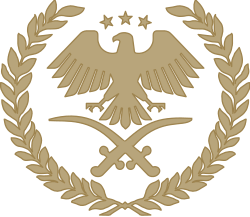
A new official emblem was adopted on July 3, 2025. This design features a golden eagle inspired by ancient motifs from Palmyra. The new symbolism is highly specific:
- Three Stars: Positioned above the eagle to signify the primacy of the people over the state and their liberation.
- 14 Wing Feathers: Representing the 14 governorates of Syria.
- Five Tail Feathers: Representing the five principal geographic regions (North, East, West, South, and Center).
Key Facts
- Original Designer: Khaled Al-Asali designed the 1945 emblem.
- Hawk vs. Eagle: Syria prefers the Hawk of Quraish over the Eagle of Saladin to symbolize bravery and a preference for live prey over scavenging.
- Kufic Script: Used consistently across various versions of the emblem for official inscriptions.
- 2025 Symbolism: The current eagle's feathers specifically represent the 14 governorates and 5 geographic regions of the country.
| Period | Primary Symbol | Key Feature | Political Context |
|---|---|---|---|
| 1945–1958 | Eagle/Hawk | Wheat stalks and three stars | Syrian Republic |
| 1958–1961 | Eagle of Saladin | Ornamental eagle with UAR shield | United Arab Republic |
| 1961–2024 | Hawk of Quraish | Spread wings, Kufic scroll | Syrian Arab Republic |
| 2025–Present | Golden Eagle | 14 wing feathers, 5 tail feathers | Post-Assad Caretaker Government |
Frequently Asked Questions
Who designed the original 1945 Syrian emblem?
The original emblem was designed by Khaled Al-Asali, a Syrian diplomat and visual artist who was also known for his work in journalistic caricature.
What is the difference between the Hawk of Quraish and the Eagle of Saladin?
Beyond the visual difference—where the Syrian hawk is typically depicted with open wings and the Egyptian eagle with folded wings—the hawk was chosen to symbolize pride and courage, specifically because it hunts live prey rather than scavenging.
What do the feathers on the 2025 emblem represent?
The 14 wing feathers represent Syria's 14 governorates, while the five tail feathers represent the country's five main geographic regions: north, east, west, south, and center.
Why are there three stars above the eagle in the current emblem?
The three stars are taken from the Syrian flag and signify the liberation of the people. Their position above the eagle is intended to symbolize that the people hold primacy over the state.
What is Kufic script and why was it used?
Kufic script is an early, stylized form of Arabic calligraphy. It was used on the ribbons and scrolls of the national emblems to provide a formal and historical aesthetic to the state's name.