Synallaxis: The Diverse Spinetails of the Neotropics
The genus Synallaxis represents one of the most diverse groups within the ovenbird family, Furnariidae. These small, elusive birds are specialized inhabitants of the Neotropical region, where they thrive in the dense undergrowth of tropical and subtropical habitats. Because they spend most of their time ensconced in thick vegetation, they are often more easily heard than seen.
Physically, most species are recognized by their long, graduated tails featuring pointy feathers—a hallmark of the spinetails. While many species possess subtle plumage, some exhibit striking contrasts, such as rufous patches on the crown and wings or distinct black throat patches.
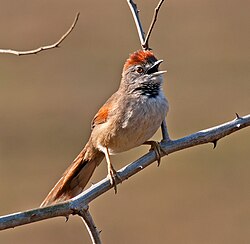
Key Facts
- Family: Furnariidae (Ovenbirds).
- Distribution: Found across the Neotropical region, including Central and South America.
- Habitat: Dense undergrowth in tropical and subtropical environments.
- Nesting: They build large, domed nests made of sticks, characterized by a long entrance tube.
- Identification: Many species are distinguished by their unique vocalizations rather than plumage.
- Diversity: The genus currently contains 37 recognized species.
Taxonomy and History
The genus Synallaxis was first introduced in 1818 by the French ornithologist Louis Pierre Vieillot. The name is derived from the Ancient Greek word sunallaxis, which translates to "exchange." Although Vieillot did not initially specify a type species, George Gray designated the rufous-capped spinetail (Synallaxis ruficapilla) as the type species in 1840.
Species Diversity and Identification
With 37 species, the genus shows a wide range of distribution across the Americas. Because several species look nearly identical, ornithologists rely heavily on their distinctive vocalizations to tell them apart. Their range extends from southeastern Mexico and Central America down through the Amazon basin and into Argentina.
Distribution of Synallaxis Species
The following table provides a comprehensive overview of the species within the genus, their scientific names, and their primary geographic ranges.
| Common Name | Scientific Name | Distribution |
|---|---|---|
| Ochre-cheeked spinetail | Synallaxis scutata | Brazil, eastern Bolivia, northwestern Argentina |
| Grey-bellied spinetail | Synallaxis cinerascens | Southern Brazil, eastern Paraguay, Uruguay, Selva Misionera |
| Plain-crowned spinetail | Synallaxis gujanensis | Guianas, southern Amazonia, Colombia |
| Araguaia spinetail | Synallaxis simoni | Goiás |
| White-lored spinetail | Synallaxis albilora | Pantanal |
| Maranon spinetail | Synallaxis maranonica | Lower Marañón River |
| Great spinetail | Synallaxis hypochondriaca | Upper Marañón River |
| Chinchipe spinetail | Synallaxis chichipensis | Chinchipe and Maranon river |
| Necklaced spinetail | Synallaxis stictothorax | Tumbes |
| Russet-bellied spinetail | Synallaxis zimmeri | Western Peru |
| Slaty spinetail | Synallaxis brachyura | Central America and Tumbes-Chocó-Magdalena |
| Silvery-throated spinetail | Synallaxis subpudica | Cordillera Oriental (Colombia) |
| Red-shouldered spinetail | Synallaxis hellmayri | Caatinga |
| Rufous-capped spinetail | Synallaxis ruficapilla | Southern Atlantic Forest |
| Bahia spinetail | Synallaxis cinerea | Bahia |
| Pinto's spinetail | Synallaxis infuscata | Pernambuco forests |
| Dusky spinetail | Synallaxis moesta | Eastern Northern Andes |
| McConnell's spinetail | Synallaxis macconnelli | Tepuis and Guiana Shield |
| Cabanis's spinetail | Synallaxis cabanisi | Eastern Central Andes |
| Cinereous-breasted spinetail | Synallaxis hypospodia | Cerrado, Caatinga, central Southern Amazonia |
| Spix's spinetail | Synallaxis spixi | Northeastern Brazil to northeastern Argentina |
| Dark-breasted spinetail | Synallaxis albigularis | Western Amazonia |
| Rio Orinoco spinetail | Synallaxis beverlyae | Venezuela |
| Pale-breasted spinetail | Synallaxis albescens | South America |
| Sooty-fronted spinetail | Synallaxis frontalis | Central/eastern South America |
| Azara's spinetail | Synallaxis azarae | Andes |
| Apurimac spinetail | Synallaxis courseni | Ampay |
| White-whiskered spinetail | Synallaxis candei | Northern Colombia, northwestern Venezuela |
| Rufous-breasted spinetail | Synallaxis erythrothorax | Southeastern Mexico, northern Central America |
| Hoary-throated spinetail | Synallaxis kollari | Branco River and tributaries |
| Blackish-headed spinetail | Synallaxis tithys | Tumbes |
| Rusty-headed spinetail | Synallaxis fuscorufa | Sierra Nevada de Santa Marta |
| Rufous spinetail | Synallaxis unirufa | Northern Andes |
| Black-throated spinetail | Synallaxis castanea | Central Venezuelan Coastal Range |
| Stripe-breasted spinetail | Synallaxis cinnamomea | Northeastern Colombia, Venezuela, Trinidad-and-Tobago |
| Ruddy spinetail | Synallaxis rutilans | Amazonia |
| Chestnut-throated spinetail | Synallaxis cherriei | Amazonia (scattered range) |
Frequently Asked Questions
What is the defining physical characteristic of Synallaxis birds?
Most species are characterized by a long, graduated tail with pointy feathers, which is typical of the spinetail group.
How do these birds build their nests?
They construct large, domed nests made from sticks, which notably include a long entrance tube.
Why are some species difficult to distinguish by sight?
Many species have very similar plumage and spend most of their time hidden in dense vegetation, making visual identification challenging.
How can different Synallaxis species be told apart?
Because their plumage can be similar, their distinctive vocalizations are often the most reliable way to differentiate between species.
Where are Synallaxis birds primarily found?
They inhabit tropical and subtropical regions across the Neotropics, ranging from Mexico and Central America through South America.