Sympatry and the Mechanisms of Speciation
In the study of evolutionary biology, the spatial relationship between related species provides critical clues about how life diversifies. When two closely related species or populations exist within the same geographic area and frequently encounter one another, they are described as sympatric. This overlap creates a dynamic environment where natural selection must navigate the complexities of interbreeding and competition.
While it may seem intuitive that species would diverge when separated by a physical barrier, the concept of sympatric speciation suggests that new species can emerge even while sharing the same range. This process occurs when an initially interbreeding population splits into distinct species through reproductive isolation, which prevents hybrid offspring from being viable or capable of reproducing, thereby reducing gene flow.
Key Facts
- Sympatry occurs when related species share the same geographic range.
- Sympatric speciation is the evolution of new species without geographic isolation.
- Syntopy is a stricter form of sympatry where species share the exact same habitat at the same time.
- Reinforcement is the process where natural selection strengthens reproductive barriers to avoid maladaptive hybridization.
- Secondary contact occurs when species diverge in isolation (allopatry) and later expand their ranges to overlap.
Comparing Population Types
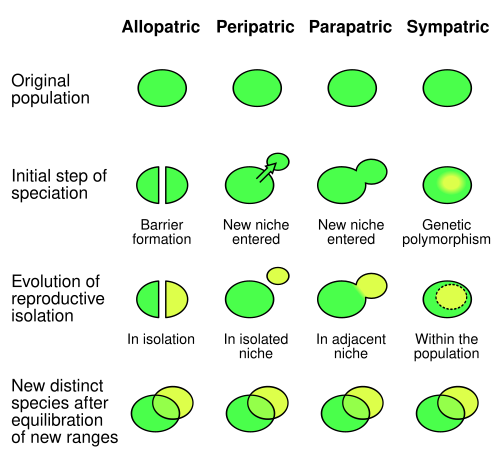
To understand sympatry, it is helpful to contrast it with other modes of population distribution. Biologists categorize population pairs based on their geographic relationship and whether they interbreed.
| Type | Geographic Relationship | Interbreeding Status |
|---|---|---|
| Sympatric | Shared geographic area | May or may not interbreed |
| Parapatric | Adjacent ranges (contact at borders) | Do not interbreed |
| Peripatric | Separated by uninhabited areas | Isolated |
| Allopatric | Entirely distinct, non-overlapping ranges | Isolated |
Allopatric speciation, driven by physical barriers like mountains or oceans, is widely considered the dominant mode of speciation. However, the validity of sympatry has historically been debated, particularly regarding parasites. While some researchers, like Ernst Mayr, argued that internal parasites in different hosts are allopatric, many modern biologists view them as sympatric.
Sympatry vs. Syntopy
While often used interchangeably in casual conversation, syntopy is a specific subset of sympatry. Syntopy refers to the joint occurrence of two species in the same habitat at the same time. Sympatric species may live in the same general region but utilize different localities.
For example, the bat species Myotis auriculus and M. evotis are syntopic in North America. Conversely, the marbled newt and northern crested newt share a large sympatric range in western France but rarely occur syntopically because they prefer different breeding ponds.
Mechanisms of Species Discrimination
Because sympatric populations lack geographic barriers, they must rely on other mechanisms to avoid interbreeding. As speciation progresses, isolating mechanisms—such as gametic incompatibility—are selected to increase the reproductive divide.
Reinforcement and Character Displacement
Reinforcement occurs when natural selection favors individuals that can accurately identify mates of their own species. This prevents maladaptive hybridization, where hybrid offspring are sterile or less fit. This often leads to reproductive character displacement, where traits crucial to reproduction (like mating signals) diverge more sharply in areas where species overlap than in areas where they live alone.
Differential Fusion
An alternative theory is differential fusion. This suggests that many species may have come into contact in the past, but only those with strong existing mating discrimination persisted as separate species. Those lacking such discrimination simply fused back into a single species. While less widely accepted than character displacement, it remains a possible contributor to species discrimination.
Real-World Examples of Sympatry
The Great Spotted Cuckoo and the Magpie
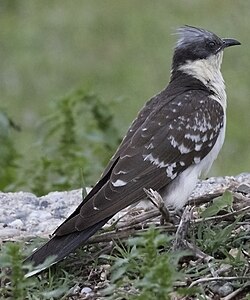
The great spotted cuckoo is a brood parasite that lays eggs in magpie nests. These two species are completely sympatric in Southern Europe. Research indicates that in areas of ancient sympatry, magpies have evolved counter-adaptations to identify and reject cuckoo eggs more effectively than magpies in areas of recent sympatry. This demonstrates coevolution, where both species genetically change in response to the other.
Orcas and Secondary Contact
In the North Pacific, "transient," "resident," and "offshore" killer whales exhibit partial sympatry. Genetic analysis suggests this is the result of secondary contact—where populations diverged elsewhere and later migrated back into the same area. In this case, the overlap did not result in total reproductive isolation, as interbreeding still occurs.
Acromyrmex Leafcutter Ants
Leafcutter ants of the genus Acromyrmex maintain a mutualistic relationship with Basidiomycete fungi. The ants actively protect their fungal gardens from foreign fungi, removing invaders to prevent interbreeding and competition. This active isolation within a shared habitat can facilitate sympatric speciation of the fungi.
Frequently Asked Questions
What is the main difference between sympatry and allopatry?
Sympatry occurs when two related species live in the same geographic area, whereas allopatry occurs when they are separated by a physical barrier, such as a mountain range or body of water.
Can species evolve without being geographically separated?
Yes, this is known as sympatric speciation. It requires strong forces of natural selection acting on heritable traits to create reproductive isolation without the aid of a physical barrier.
What is the difference between sympatry and syntopy?
Sympatry is a broad term for species sharing a general region. Syntopy is more specific, referring to species that share the exact same habitat and occur there at the same time.
How does reinforcement prevent hybridization?
Reinforcement is a process of natural selection that favors individuals who can distinguish their own species from others. By selecting against the mating of different species (which often produces less-fit hybrids), the reproductive barrier is strengthened.
What is secondary contact in evolutionary biology?
Secondary contact happens when two populations that previously diverged in allopatry (geographic isolation) expand their ranges and meet again, creating a new area of sympatry.