Speciation: The Evolutionary Process of Creating New Species
In the grand tapestry of life, the emergence of new species is one of the most fundamental drivers of biodiversity. This phenomenon, known as speciation, is the evolutionary process by which populations evolve to become distinct, separate species. While the concept of changing life forms has long been understood, the specific mechanics of how one lineage splits into two—a process called cladogenesis—remains a central focus of biological research.
The term was coined in 1906 by biologist Orator F. Cook to distinguish the splitting of lineages from anagenesis, which refers to evolutionary change occurring within a single lineage over time. The foundational role of natural selection in this process was famously detailed by Charles Darwin in his 1859 landmark work, On the Origin of Species. Darwin also suggested that sexual selection—selection based on an organism's ability to obtain a mate—might play a role, though he noted the complexities involved in that mechanism.
![African pygmy kingfisher, showing coloration shared by all adults of that species to a high degree of fidelity.[15]](/images/35/59/35593bdf63a66b7a40977cc4cdd7a0f7869d5e86bf6e23c3af1cff4585633b52.jpg)
African pygmy kingfisher, showing coloration shared by all adults of that species to a high degree of fidelity.[15]
Key Facts
- Cladogenesis is the splitting of a lineage into distinct species.
- Anagenesis is evolutionary change within a single lineage.
- Speciation can occur through four primary geographic modes: allopatric, peripatric, parapatric, and sympatric.
- Polyploidy, a doubling of chromosome numbers, can cause rapid sympatric speciation.
- Natural selection and reproductive isolation are critical drivers of species formation.
Geographic Modes of Speciation
Biologists categorize speciation based on the degree of geographic isolation between populations. The extent to which populations are separated determines the mode of evolution.
Allopatric and Peripatric Speciation
Allopatric speciation occurs when populations are physically isolated from one another by geographic barriers. Peripatric speciation is a specific version of this, occurring when a small population becomes isolated at the edge of a larger group's range.
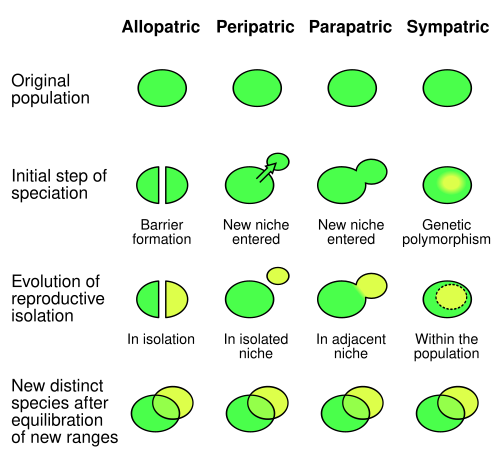
Comparison of allopatric, peripatric, parapatric and sympatric speciation
Parapatric and Sympatric Speciation
In parapatric speciation, populations are not fully isolated but occupy adjacent areas with limited contact. Conversely, sympatric speciation occurs when new species evolve from a single ancestral species while inhabiting the same geographic region. This mode is often driven by ecological niches or genetic changes.
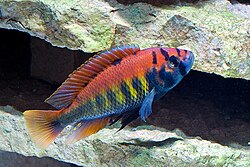
Cichlids such as Haplochromis nyererei diversified by sympatric speciation in the Rift Valley lakes.
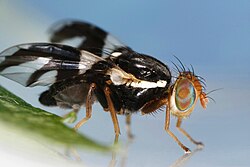
Rhagoletis pomonella, the hawthorn fly, appears to be in the process of sympatric speciation.
Mechanisms of Genetic and Reproductive Isolation
For speciation to be successful, populations must develop reproductive isolation, ensuring they no longer interbreed even if they come into contact. Several mechanisms facilitate this:
- Reinforcement: This process assists speciation by selecting against hybrids, thereby strengthening reproductive barriers.
- Hybridization: New species can emerge through the crossing of different species, provided the resulting hybrid is favored by natural selection and becomes reproductively isolated.
- Polyploidy: This involves a sudden increase in the number of chromosome sets. In plants, a diploid cell may undergo failed meiosis, producing diploid gametes that self-fertilize to create a tetraploid zygote. This results in offspring that are immediately isolated from their parents.
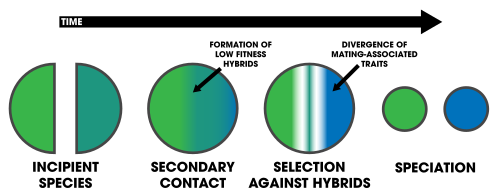
Reinforcement assists speciation by selecting against hybrids.
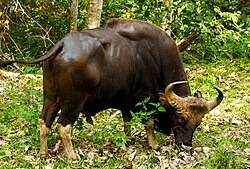
Gaur (Indian bison) can interbreed with domestic cattle.
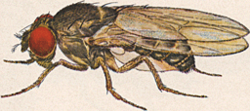
Male Drosophila pseudoobscura
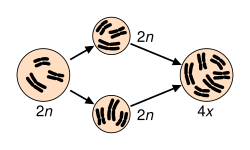
Speciation via polyploidy: A diploid cell undergoes failed meiosis, producing diploid gametes, which self-fertilize to produce a tetraploid zygote. In plants, this can effectively be a new species, reproductively isolated from its parents, and able to reproduce.
Rates of Evolutionary Change
The speed at which speciation occurs is a subject of significant debate. Evolutionary patterns are often viewed through two different lenses:
- Phyletic Gradualism: The theory that evolution occurs through relatively slow, steady changes over vast geological timescales.
- Punctuated Equilibrium: The theory that species experience long periods of morphological stability (stasis), interrupted by rare, relatively rapid bursts of evolutionary change.
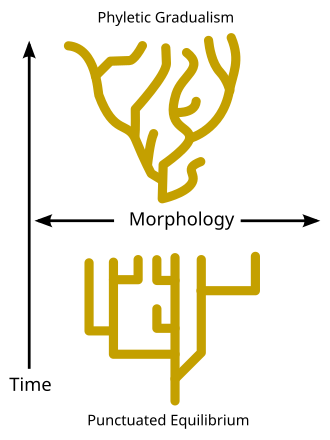
Phyletic gradualism, above, consists of relatively slow change over geological time. Punctuated equilibrium, bottom, consists of morphological stability and rare, relatively rapid bursts of evolutionary change.
Summary of Speciation Modes
| Mode | Geographic Relationship | Primary Driver |
|---|---|---|
| Allopatric | Physically separated | Geographic barriers |
| Peripatric | Small population isolated at edge | Geographic isolation/drift |
| Parapatric | Adjacent populations | Limited gene flow |
| Sympatric | Same geographic area | Ecological or genetic shifts |
Frequently Asked Questions
What is the difference between cladogenesis and anagenesis?
Cladogenesis is the process where a lineage splits into two or more distinct branches, creating new species. Anagenesis is the evolution of a single lineage over time without branching.
How does polyploidy lead to new species?
Polyploidy occurs when an organism has more than two complete sets of chromosomes. This can happen through failed meiosis, resulting in offspring that are immediately reproductively isolated from the parent population, effectively creating a new species instantly.
Can species interbreed?
Yes, some species can interbreed, such as the Gaur (Indian bison) and domestic cattle, though this does not necessarily mean they are the same species.
What is reinforcement in evolution?
Reinforcement is a process that assists speciation by selecting against hybrids. If hybrids are less fit, natural selection favors traits that prevent different populations from mating, thus strengthening reproductive isolation.
What are the two main theories regarding evolutionary rates?
The two main theories are phyletic gradualism, which suggests slow and steady change, and punctuated equilibrium, which suggests long periods of stability interrupted by rapid bursts of change.