Swifts: The Masters of Aerial Life
Swifts are among the most specialized avian species on Earth, designed for a life spent almost entirely in the air. Belonging to the family Apodidae, these highly aerial birds are often mistaken for swallows due to their similar appearance and habits. However, this resemblance is a result of convergent evolution—a process where unrelated species independently evolve similar traits to adapt to similar environments or lifestyles, in this case, catching insects while flying.
The name Apodidae comes from the Greek word ápous, meaning "footless." This refers to their small, weak legs, which are poorly suited for walking but perfect for a bird that rarely touches the ground. This physical trait was so distinct that Middle Age heraldry often depicted the martlet, a stylized swift, without feet entirely.
Key Facts
- Flight Speed: Some species, like the white-throated needletail, can reach speeds of 169 km/h (105 mph).
- Endurance: The common swift can travel at least 200,000 km in a single year.
- Diet: Strictly insectivorous, feeding on flies, ants, bees, wasps, and aerial spiders.
- Taxonomy: Closely related to hummingbirds within the order Apodiformes.
- Unique Ability: Certain swiftlets use echolocation to navigate dark caves.
Taxonomy and Evolutionary History
Swifts are classified in the order Apodiformes, which they share with hummingbirds. While treeswifts appear similar, they are categorized in a separate family called Hemiprocnidae. The evolutionary link between swifts and hummingbirds is supported by the discovery of primitive relatives like Eurotrochilus and the swift-like Jungornithidae.
The Apodiformes diversified during the Eocene epoch. Fossil evidence from temperate Europe, spanning from modern-day France to Denmark, reveals primitive genera such as Scaniacypselus from the Early to Middle Eocene, and the more modern Procypseloides from the Late Eocene to Early Miocene. Another potential ancestor, Primapus, has been identified in Early Eocene deposits in England.
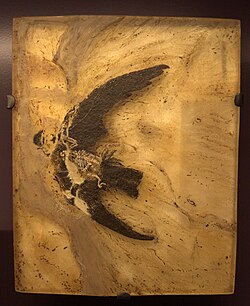
Classification of Species
There are approximately 100 species of swifts, generally divided into two subfamilies:
- Cypseloidinae: Including the tribe Cypseloidini.
- Apodinae: This subfamily is further divided into three tribes: the swiftlets (Collocaliini), the needletails (Chaeturini), and the typical swifts (Apodini).
Physical Characteristics and Flight Mechanics
Swifts are built for extreme efficiency. They typically possess long, swept-back wings shaped like a crescent or boomerang and a short, forked tail. Their size varies significantly, from the tiny pygmy swiftlet (5.4 g, 9 cm long) to the larger purple needletail (184 g, 25 cm long).
Their flight capabilities are powered by a unique skeletal structure. Swiftlets have proportionately longer wingtip bones than most birds, allowing them to adjust the wing's shape and area for better maneuverability. Like hummingbirds, swifts can rotate their wings from the base, enabling them to generate power on both the upstroke and the downstroke. While the downstroke provides the primary lift and thrust, the upstroke contributes roughly 60% of that lift and thrust, enhancing their control in the air.
Distribution and Habitat
Swifts are found on every continent except Antarctica. They are generally absent from the far north, vast deserts, and many remote oceanic islands. Species living in temperate zones are strongly migratory, traveling to the tropics for the winter. To survive unexpected cold snaps, some species enter torpor, a state of decreased physiological activity similar to hibernation.
Behavior and Breeding
The breeding habits of swifts are as specialized as their flight. Many species use saliva to glue their nests to vertical surfaces. The genus Aerodramus relies exclusively on saliva for nest construction. Other species prefer small cavities or holes in walls.
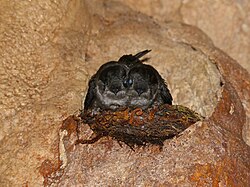
The developmental cycle of a swift is slower than that of similar-sized passerines (perching birds). Eggs hatch after 19 to 23 days, and the young remain in the nest for another six to eight weeks. Interestingly, young swifts often reach a maximum weight that exceeds that of their parents and can survive long periods without food by delaying feather growth.
Diet and Foraging
Swifts are aerial insectivores, catching prey such as dragonflies, aphids, and bees mid-flight using their beaks. Some species, such as the chimney swift, engage in mixed-species foraging flocks alongside swallows.
Human Interaction and Conservation
For over 400 years, the hardened saliva nests of the black-nest and edible-nest swiftlets have been harvested for Chinese cuisine, specifically for bird's nest soup. These nests are rich in calcium, iron, potassium, and magnesium. However, the high commercial value and perceived health benefits of these nests have led to over-harvesting and population declines.
While no swift species has gone extinct since 1600, several are currently listed as vulnerable by BirdLife International, including the American black swift, the chimney swift, and the swiftlets of Atiu, Seychelles, and Mariana.
| Feature | Pygmy Swiftlet (Smallest) | Purple Needletail (Largest) |
|---|---|---|
| Weight | 5.4 g | 184 g |
| Length | 9 cm (3.5 in) | 25 cm (9.8 in) |
Frequently Asked Questions
Are swifts the same as swallows?
No. While they look similar and share similar diets, they are not closely related. Swifts are in the order Apodiformes (related to hummingbirds), while swallows are passerines. Their similarity is due to convergent evolution.
How fast can swifts fly?
Swifts are among the fastest birds in level flight. The white-throated needletail has been reported at speeds up to 169 km/h (105 mph), and the common swift can cruise at 112 km/h (70 mph).
What is bird's nest soup made of?
It is made from the nests of certain swiftlet species, which are constructed from interwoven strands of hardened salivary cement secreted by the birds.
Do all swifts use echolocation?
No. Echolocation is primarily used by cave swiftlets to navigate dark roosting environments, though the three-toed swiftlet has been observed using it at night outside of caves.
How do swifts survive cold weather?
Many temperate species migrate to the tropics. Those that encounter short periods of extreme cold can enter a state of torpor to conserve energy.