Superheavy Elements and the Island of Stability
For decades, nuclear physicists have pursued the elusive island of stability, a theoretical region of the periodic table where superheavy elements—those with very high atomic numbers—might possess unexpectedly long half-lives. While most heavy elements decay almost instantly, calculations from the 1960s suggested that certain nuclides could exist for billions of years, resisting spontaneous fission despite their immense mass.
The potential discovery of these stable elements sparked intense interest due to their theoretical applications. Researchers speculated that such materials could serve as neutron sources in particle accelerators, provide high-neutron-yield fuel for nuclear weapons due to low critical masses, or even power long-term space missions as a highly efficient nuclear fuel.
The Quest for Synthesis
During the 1970s, global laboratories attempted to synthesize elements ranging from atomic number 110 to 127. These efforts primarily utilized fusion-evaporation reactions, a process where a heavy target nuclide is bombarded with accelerated ions in a cyclotron. When these nuclei fuse, the resulting excited system releases energy by evaporating particles, such as protons, neutrons, or alpha particles.
Scientists categorized these reactions into two types: cold fusion, which creates systems with lower excitation energies, and hot fusion, which results in higher excitation energies. Despite these efforts—including attempts to create element 114 using Curium (Cm) and Argon (Ar), or element 126 using Thorium (Th) and Krypton (Kr)—initial searches were unsuccessful. This failure suggested that either the reaction cross sections (the probability of a reaction occurring) were too low or the resulting nuclei were too short-lived for detection.
Parallel searches for these elements in nature also failed, indicating that if superheavy elements exist naturally, their abundance is less than 10 moles per mole of ore.
Mapping the Superheavy Landscape
Despite early setbacks, the synthesis of transactinides (elements heavier than actinium) progressed. Rutherfordium was discovered in 1969, and by 1996, researchers reached Copernicium. Although these elements have short half-lives, their existence proves the influence of closed shells—nuclear configurations that provide stability. Without these shell effects, such elements would succumb to rapid spontaneous fission immediately.
A major milestone occurred in 1998 at the Joint Institute for Nuclear Research in Dubna, Russia. A team led by Yuri Oganessian synthesized Flerovium (element 114). A single atom was detected with a lifetime of 30.4 seconds, decaying via alpha decay rather than fission. This was viewed as a textbook example of the island of stability's characteristics.
Subsequent discoveries up to Oganesson (element 118) have shown half-lives exceeding initial predictions. However, a 2021 study suggests that the stability of Flerovium isotopes is not primarily due to the proton number (Z = 114) but rather the neutron shell closure. Maximum stability is expected at N = 184 neutrons. While current nuclei like Livermorium (Lv) and Tennessine (Ts) only reach N = 177, the trend is clear: as neutron excess increases, stability increases. For instance, an isotope of Copernicium (Cn) with eight additional neutrons exhibits a half-life nearly five orders of magnitude longer than its lighter counterpart.
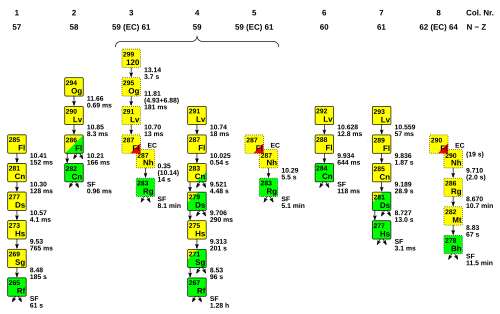
Deformed Nuclei and the Stability Peninsula
While the center of the island of stability is predicted to consist of spherical nuclei, research since 1991 by Zygmunt Patyk and Adam Sobiczewski indicates that some superheavy nuclei are deformed (non-spherical). This change in shape shifts the position of protons and neutrons within the shell, creating new "magic numbers" that provide stability.
In the region of Z = 106–108 and N ≈ 160–164, these deformed nuclei are more resistant to fission and primarily undergo alpha decay. Hassium-270 is believed to be a doubly magic deformed nucleus (Z = 108, N = 162) with a half-life of 9 seconds. This suggests the existence of a stability "peninsula" that acts as an isthmus, linking the region of known stable nuclei to the spherical island of stability near N = 184.
Key Facts
- Island of Stability: A theoretical region where superheavy elements have significantly longer half-lives due to closed nuclear shells.
- Magic Numbers: Specific numbers of protons or neutrons that result in higher nuclear stability.
- Synthesis Method: Superheavy elements are created via cold and hot fusion-evaporation reactions in particle accelerators.
- Neutron Influence: Stability increases as nuclei approach the N = 184 neutron shell closure.
- Nuclear Shape: Stability is found in both spherical nuclei (the "island") and deformed nuclei (the "peninsula").
| Element | Atomic Number | Most Stable Isotope Half-life (Pubs) | Most Stable Isotope Half-life (NUBASE 2020) |
|---|---|---|---|
| Rutherfordium | 104 | 48 min | 2.5 h |
| Seaborgium | 106 | 14 min | 5 min |
| Hassium | 108 | 9.7 s | 16 s |
| Copernicium | 112 | 28 s | 30 s |
| Flerovium | 114 | 1.9 s | 2.1 s |
| Oganesson | 118 | 690 μs | 700 μs |
Frequently Asked Questions
What is the island of stability?
It is a predicted region of the periodic table where superheavy elements with specific "magic numbers" of protons and neutrons are expected to be significantly more stable and longer-lived than other transactinides.
How are superheavy elements created?
They are synthesized in laboratories using fusion-evaporation reactions, where accelerated ions are fired at a heavy target in a cyclotron, causing them to fuse and then release energy by evaporating particles.
What is the difference between cold and hot fusion in this context?
Cold fusion creates compound nuclei with lower excitation energies, while hot fusion creates systems with higher excitation energies, both of which affect the overall yield of the reaction.
Why is the number of neutrons important for stability?
Stability is strongly linked to neutron shell closure. As isotopes approach the predicted magic number of N = 184 neutrons, their half-lives tend to increase significantly.
What are deformed nuclei?
Deformed nuclei are superheavy nuclei that are not perfectly spherical. This deformation can create new regions of relative stability, such as the "peninsula" found around Z = 108 and N = 162.