Understanding Supercooling: When Liquids Defy the Freezing Point
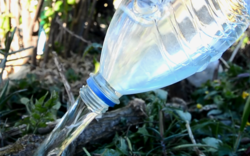
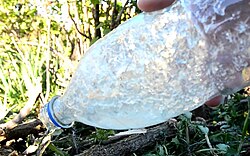
Imagine a bottle of water sitting in a freezing environment. According to the laws of thermodynamics, it should be a solid block of ice. However, upon opening it, the liquid suddenly transforms into ice before your eyes. This striking phenomenon is known as supercooling (or undercooling), a state where a liquid remains in its fluid form even after its temperature has dropped below its standard freezing point.
First described in 1724 by Daniel Gabriel Fahrenheit during his development of the Fahrenheit scale, supercooling challenges our intuitive understanding of phase changes. While we often think of freezing as a fixed event, it is actually a complex process dependent on the presence of specific triggers.
The Science of Delayed Solidification
To understand why a liquid doesn't freeze immediately, we must look at nucleation. In a typical scenario, as a liquid cools, it requires a "seed" or a nucleus—such as a tiny impurity or a microscopic crystal—to act as a structural template. Once this nucleus is present, molecules can begin to arrange themselves into a rigid crystal lattice, turning the liquid into a solid.
If a liquid is exceptionally pure and lacks these nucleation sites, it can bypass the freezing point entirely. The liquid phase can be maintained until it reaches the temperature of homogeneous nucleation, where the molecules themselves spontaneously begin to form a structure without any external help.
Water: From Liquid to Glass
Water provides one of the most fascinating examples of this phenomenon. While pure water normally freezes at 0.0 °C (32 °F), it can be supercooled down to −48.3 °C (−54.9 °F) if it is chemically demineralized or purified via reverse osmosis.
If water is cooled extremely rapidly—at a rate of approximately 10 K/s—it can avoid crystal formation altogether. Instead of becoming ice, it becomes an amorphous solid, commonly known as a glass. This "glassy water" has a glass transition temperature estimated at approximately 136 K (−137 °C). Interestingly, once water has become glassy, it can be heated up to about 150 K (−123 °C) without any ice crystals forming.
Supercooling vs. Freezing-Point Depression
It is important to distinguish supercooling from freezing-point depression. While they both involve lowering the temperature at which ice forms, the mechanisms are different:
- Supercooling: The liquid stays liquid below its freezing point due to a lack of nucleation sites.
- Freezing-point depression: The freezing point itself is lowered because a solute (like salt) has been added to the liquid, interfering with the formation of ice crystals.
Constitutional Supercooling
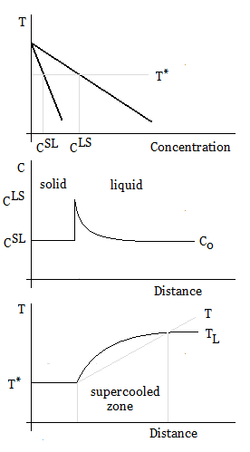
In the context of metallurgy and solidification, a specific type of phenomenon called constitutional supercooling occurs. This happens when the composition of a liquid changes during the solidification process, causing the liquid ahead of the solid-liquid interface to cool below its freezing point.
This can lead to an unstable interface during solidification. To maintain a stable, planar solid front, the velocity of the interface must be kept low. This relationship is governed by the concentration gradient and the diffusion coefficient of the material.
Supercooling in Nature: Survival Strategies
Supercooling is not just a laboratory curiosity; it is a vital survival mechanism used by various organisms to endure extreme cold.
Animals and Insects
Many animals, particularly ectotherms (cold-blooded species) like certain insects, reptiles, and fish, use supercooling to prevent their cells from freezing and rupturing. Some species, such as the winter flounder, produce antifreeze proteins (AFPs). These proteins bind to tiny ice crystals to prevent them from growing. Others use colligative antifreezes, increasing the concentration of solutes in their bodily fluids to lower their freezing point naturally.
Plants
Plants in northern climates often acclimate to winter through supercooling, allowing them to survive temperatures as low as −40 °C. Researchers use infrared thermography to observe this, as it allows them to visualize water droplets crystallizing in extracellular spaces, often beginning in the xylem tissue.
The Ocean Environment
In the oceans around Antarctica, a phenomenon called "pseudo-supercooling" occurs. Because seawater contains salt, its freezing point is naturally lower than pure water. This allows seawater to remain liquid at temperatures below the standard freezing point, which can pose challenges for oceanographic instruments that may suddenly collect ice crystals.
Modern Applications and Innovations
Humanity has harnessed the principles of supercooling to drive innovation across several high-tech fields:
- Organ Preservation: Researchers at Massachusetts General Hospital/Harvard Medical School successfully used supercooling to preserve livers for up to 4 days, significantly extending the window for transplantation.
- Drug Delivery: Scientists are developing liquid-encapsulated drugs that can be triggered to crystallize and release their payload upon a slight environmental change.
- Electronics and Manufacturing: New methods of "soldering without heat" use supercooled liquid metal droplets to repair sensitive electronic devices. Additionally, undercooled metal is being used to print metallic interconnects on delicate surfaces like paper or even rose petals.
- Food Science: By using pulsed electric and oscillating magnetic fields, researchers have successfully prevented ice nucleation in meat (such as chicken, beef, and fish), allowing it to be stored at temperatures like −6.5 °C without suffering from freezer burn.
Key Facts
- Definition: Supercooling is the process of cooling a liquid below its freezing point without it becoming a solid.
- Primary Cause: It is most often caused by the absence of seed crystals or nuclei.
- Water Limit: Pure water can be supercooled down to −48.3 °C (−54.9 °F).
- Glassy State: Rapid cooling can turn water into an amorphous (non-crystalline) solid called glass.
- Biological Use: Animals and plants use supercooling and antifreeze proteins to survive extreme winter temperatures.
Summary of Thermal States in Water
| State/Phenomenon | Approximate Temperature | Description |
|---|---|---|
| Standard Freezing Point | 0.0 °C (273.15 K) | Normal temperature where ice forms. |
| Maximum Supercooling | −48.3 °C (−54.9 °F) | The limit for pure water before homogeneous nucleation. |
| Glass Transition | ~ −137 °C (−215 °F) | The temperature where water becomes an amorphous solid. |
| Plant Survival Limit | −40 °C (−40 °F) | Common temperature threshold for supercooling plants. |
Frequently Asked Questions
What is the difference between supercooling and superheating?
Supercooling is the process of cooling a liquid below its freezing point without it solidifying. Superheating is the opposite: it is the process of heating a liquid above its boiling point without it turning into a gas.
Why does supercooled water freeze so suddenly?
Supercooled water is in a highly unstable state. If it comes into contact with a nucleation site—such as a speck of dust, a vibration, or a seed crystal—the molecules will immediately begin to organize into a crystal structure, causing rapid solidification.
Can all liquids be supercooled?
While many liquids can undergo supercooling, the ease with which it occurs depends on the purity of the liquid and the presence of nucleation sites. The more pure the substance, the more likely it is to achieve a deep supercooled state.
How do antifreeze proteins work in animals?
Antifreeze proteins (AFPs) bind to the surfaces of small ice crystals. This prevents water molecules from attaching to the crystal, thereby stopping the ice from growing and damaging the animal's cells.
Is seawater supercooled?
Technically, the liquid state of seawater at low temperatures is often called "pseudo-supercooling." This is because the salt in the water naturally lowers the freezing point (freezing-point depression), rather than the liquid being in an unstable state due to a lack of nuclei.