Sunshine Recorders: Measuring Solar Duration and Radiation
A sunshine recorder, also known as a heliograph, is a specialized instrument designed to track the amount of sunshine received at a specific location or region over a given period. By capturing the duration of sunlight, these devices provide critical data regarding weather patterns, long-term climate trends, and the ambient temperature of a geographical area.
The data gathered by these instruments is invaluable across several professional sectors. In meteorology and general science, it helps in atmospheric modeling; in agriculture, it assists in crop management; and in tourism, it helps determine the viability of destinations based on sunny weather patterns.
Key Facts
- Sunshine recorders are also referred to as heliographs.
- They measure the duration of sunshine to provide insights into climate and temperature.
- Devices are categorized by whether they use the Sun or a clock as their time-scale.
- Modern versions can measure both global and diffuse radiation.
- Electronic systems have replaced manual interpretation to ensure data precision.
Types of Sunshine Recorders
Sunshine recorders generally fall into two primary categories based on how they track time during the recording process.
Sun-Based Time-Scales
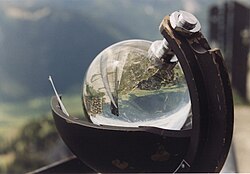
Some recorders utilize the movement of the Sun itself to establish the time-scale for sunshine readings. These instruments typically rely on the Sun's position in the sky to mark the passage of time on the recording medium.
Clock-Based Time-Scales
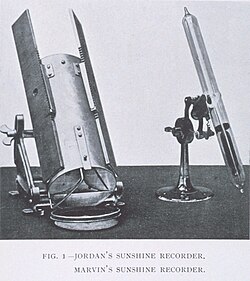
Other recorders employ an internal or external clock to maintain the time-scale. This allows the device to record the exact moments of sunshine independently of the Sun's relative position.
Evolution of Recording Technology
The methodology for capturing solar data has evolved significantly from manual observation to automated digital systems.
Manual Interpretation
Older generations of sunshine recorders required a human observer to read and interpret the physical results. Because this process relied on human judgment, the recorded results could vary between different observers, introducing a margin of error into the data.
Modern Electronic Systems
Contemporary sunshine recorders integrate electronics and computers to produce precise, objective data. By removing the need for a human interpreter, these systems eliminate observer bias. Furthermore, advanced modern recorders have expanded their capabilities to measure global radiation (the total solar radiation received) and diffuse radiation (solar radiation scattered by atmospheric particles).
Summary of Sunshine Recorder Characteristics
| Feature | Older Recorders | Modern Recorders |
|---|---|---|
| Data Interpretation | Human observer | Electronics and computers |
| Consistency | Variable (depends on observer) | High precision and objective |
| Measurement Scope | Sunshine duration | Duration, global, and diffuse radiation |
| Time-Scale Method | Sun-based or Clock-based | Digital/Electronic |
Frequently Asked Questions
What is another name for a sunshine recorder?
A sunshine recorder is also commonly called a heliograph.
What fields benefit from sunshine recorder data?
This information is highly useful in the fields of meteorology, science, agriculture, and tourism.
How do modern recorders differ from older ones?
Modern recorders use computers and electronics for precise data collection, whereas older models required human observers to interpret results, which could lead to inconsistencies.
What is the difference between global and diffuse radiation?
Global radiation refers to the total solar radiation reaching a surface, while diffuse radiation is the portion of solar radiation that has been scattered by the atmosphere before reaching the surface.
What are the two basic ways sunshine recorders track time?
One type uses the Sun itself as the time-scale, while the other uses a clock.