Telegraphy: The Evolution of Long-Distance Communication
Telegraphy is the process of transmitting messages over long distances using symbolic codes known to both the sender and the recipient. Unlike a physical courier or pigeon post, telegraphy relies on the transmission of signals rather than the exchange of a physical object. While ancient civilizations, such as those in China, used sophisticated signaling systems, these were generally limited to predetermined messages. True telegraphy emerged when systems became capable of transmitting arbitrary, flexible text.
Key Facts

- Claude Chappe invented the first widespread optical telegraph in the late 18th century.
- The Morse system became the international standard for electrical telegraphy in 1865.
- Heliographs used mirrors to flash sunlight, proving vital in mountainous terrains like the American Southwest.
- The All Red Line was a strategic British goal to dominate global submarine cable networks.
- Teleprinters removed the need for operators to learn complex codes by using typewriter-like keyboards.
The Era of Optical Telegraphy
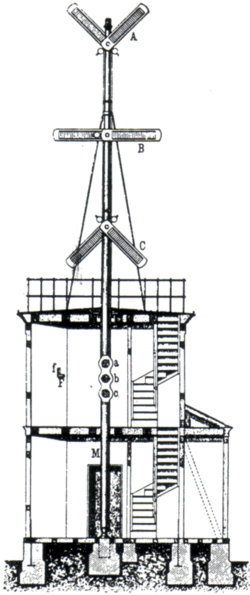
Before electricity, long-distance communication relied on the optical telegraph. This system consisted of a chain of towers or high points where operators used shutters or paddles to signal one another. A specific form of this, using indicator pointers, was known as semaphore.
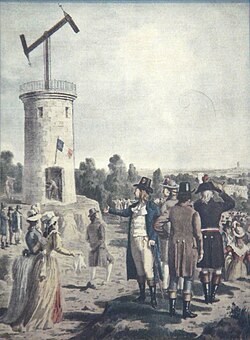
The first successful network was established by Claude Chappe in France starting in 1793. One notable line between Paris and Lille spanned 230 kilometers and was used for military dispatches during the wars between France and Austria. Despite its utility, optical systems were limited by daylight and weather, often averaging only two words per minute.
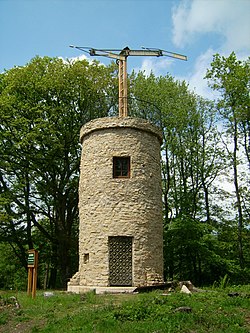
Other nations developed similar systems, including Abraham Niclas Edelcrantz in Sweden and a Prussian system in the 1830s. France continued to use coastal semaphore stations for ship-to-shore communication as late as 1895.
The Rise of the Electrical Telegraph
![Marconi watching associates raising the kite (a "Levitor" by B.F.S. Baden-Powell[57]) used to lift the antenna at St. John's, Newfoundland, December 1901](/images/c9/b9/c9b91c22a87237265c3b3532ff08f57f5208af884573522abc214b4c4f16922b.jpg)
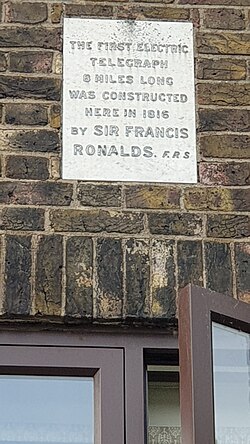
The transition to electrical systems began in the early 19th century. Early experiments included electrostatic deflections and electrochemical bubbles. In 1816, Sir Francis Ronalds constructed an experimental system using an electrostatic generator, though the British Admiralty initially rejected it in favor of their existing optical network.
Railway Telegraphy
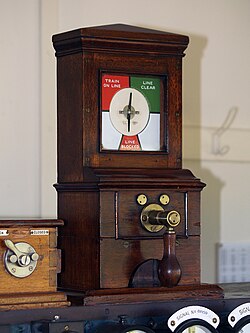
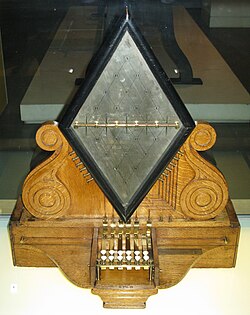
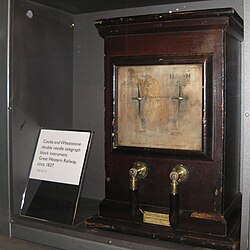
In Britain, the electric telegraph found its first major application in railway management to prevent accidents and coordinate traffic. In 1837, Cooke and Wheatstone patented a system that was demonstrated between Euston station and Camden Town. By July 1839, the first permanent railway telegraph was completed on the Great Western Railway using a four-needle system.
The Morse Standard
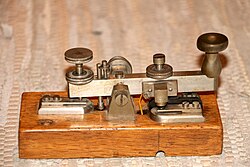
While Britain focused on needle systems, Samuel Morse developed a different approach in the United States. The Morse system eventually became the global standard in 1865, utilizing a modified version of the code developed in Germany in 1848.
Specialized Signaling: Heliographs and Facsimiles
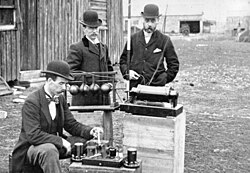
A heliograph is a telegraph that transmits Morse code by flashing sunlight with a mirror. Proposed by Gauss in 1821 and refined by Mance in 1869, it became a critical military tool. It was used by the French during the siege of Paris (using kerosene lamps at night) and by the British military in colonial wars.
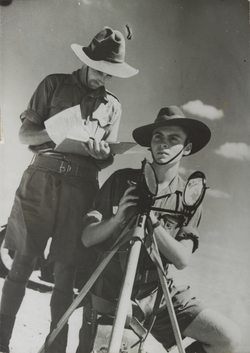
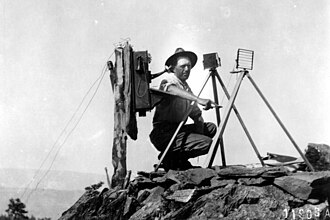
In the United States, General Nelson A. Miles used heliographs to communicate across the vast, mountainous terrain of Arizona and New Mexico during the Apache Wars, where electric lines were impractical. This technology remained in use by Australian forces as late as 1942 during the Western Desert Campaign of World War II.
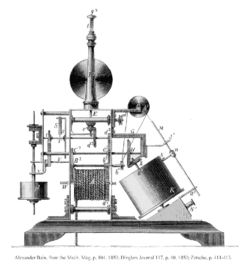
Parallel to these developments, other forms of distant writing emerged, such as Alexander Bain's facsimile machine in 1850, which laid the groundwork for image transmission.
Teleprinters and Automated Transmission
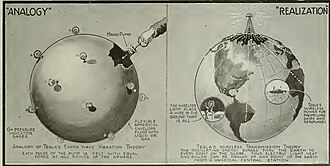
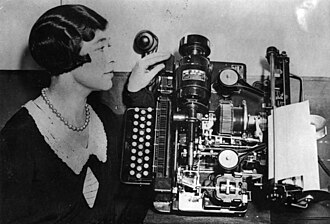
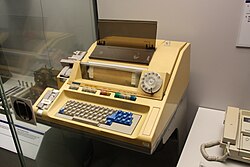
The teleprinter revolutionized the industry by allowing users to type messages on a keyboard and receive them as printed text, eliminating the need for specialized training in Morse code. This evolved from early printing telegraphs, such as those developed by House and Hughes.
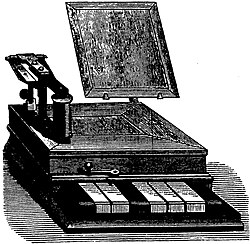
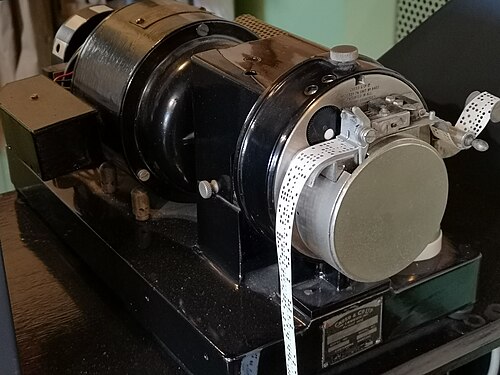
To increase efficiency, automated punched-tape transmission was introduced. A system developed by Wheatstone in 1858 used bipolar encoding (both positive and negative polarity voltages), which allowed for duplex communication—sending and receiving simultaneously—at speeds of up to 400 words per minute.
Global Connectivity and Submarine Cables
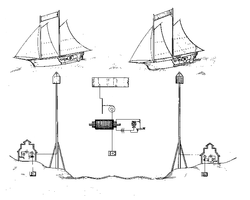
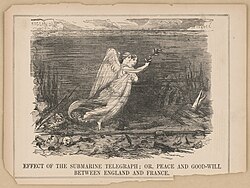
The expansion of telegraphy led to the creation of massive undersea networks. While an overland line to India was connected in 1866, it was unreliable, leading to a submarine cable in 1870. Australia was linked to the world via a cable at Darwin in October 1872.
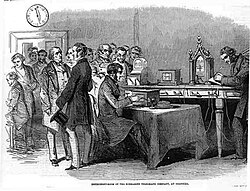
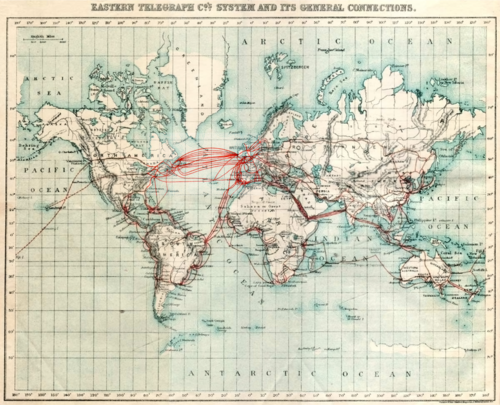
Britain dominated this infrastructure through a strategic initiative known as the All Red Line. By 1892, British companies operated two-thirds of the world's cables, providing a massive strategic advantage during World War I, as Britain could quickly sever Germany's global communications.
The Decline of Telegraphy
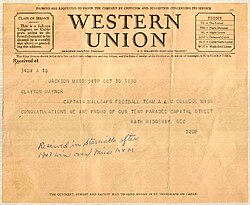
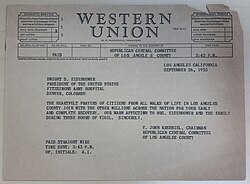
The dominance of the telegraph began to wane during the Great Depression of the 1930s. While teleprinters remained essential for news agency feeds until the 1990s, the rise of the internet and digital data transmission eventually rendered the traditional telegraph obsolete. Companies like Western Union survived the transition by pivoting to profitable services such as wire transfers of money.
| Technology | Medium | Key Feature | Primary Limitation |
|---|---|---|---|
| Optical (Chappe) | Visual/Light | Towers and Semaphores | Weather and Daylight |
| Electric (Morse) | Conducting Wires | Dot-and-Dash Code | Required Trained Operators |
| Heliograph | Mirrors/Sunlight | Portable/Wireless | Required Clear Skies |
| Teleprinter | Electrical/Digital | Keyboard and Printout | Required Physical Infrastructure |
Frequently Asked Questions
What is the difference between a telegraph and a signaling system?
A true telegraph can transmit arbitrary text messages using a symbolic code. Simple signaling systems, like those used in ancient China, could only send a few fixed, predetermined messages.
Why was the Morse system adopted as the international standard?
The Morse system was highly efficient and flexible. It was formally adopted as the international standard in 1865, utilizing a modified version of the code developed in Germany in 1848.
How did the 'All Red Line' benefit Great Britain?
The All Red Line was a network of submarine cables owned and operated by British companies. This gave Britain control over global communications and the ability to cut enemy cables during conflicts, such as World War I.
What was the purpose of bipolar encoding in tape transmission?
Bipolar encoding used both positive and negative polarity voltages, which allowed for duplex communication, meaning messages could be sent and received on the same line simultaneously.
How did the heliograph work in the field?
The heliograph used a moveable mirror to reflect sunlight in flashes, typically using Morse code. It was especially effective in mountainous regions with clear air where laying wires was impossible.