Sudan Flag History: From the Mahdist War to the Modern Republic
The flags of Sudan serve as a visual timeline of the nation's complex journey through religious revolution, colonial administration, and the pursuit of national identity. From the stark black banners of the 19th century to the vibrant Pan-Arab colors of today, each design reflects the political and social shifts of the Sudanese people.
The Mahdist Era (1881–1899)
The origins of Sudanese vexillology—the study of flags—can be traced back to the Mahdist War. In 1881, Muhammad Ahmad, the self-proclaimed Mahdi, appointed Abdallahi ibn Muhammad as one of his four caliphs. To aid in the recruitment of Baggara Arabs and other western tribes, the Mahdi provided Abdallahi with a black flag.
While other caliphs utilized different colors, the black standard became a defining symbol of the Mahdist Army. This historical connection remains significant today, as the black stripe in the current national flag is a direct reference to this era.
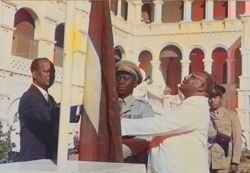
Anglo-Egyptian Sudan (1899–1956)
Following the Mahdist period, Sudan was managed as a condominium—a joint administration—by the United Kingdom and Egypt. During this time, the territory lacked a unique national flag. Instead, the flags of Egypt and the United Kingdom were flown together, with the British flag given precedence.
Specific rank flags did exist, such as the one for the British Governor General. This flag featured the Union Flag with a white disk; since Sudan had no official coat of arms at the time, the disk simply bore the text "GOVERNOR GENERAL OF THE SUDAN" surrounded by a laurel wreath. Interestingly, during the 1955 Afro-Asian Conference, Sudan was represented by a simple white flag with "SUDAN" written in red capital letters.
The First Republic (1956–1969)
Upon gaining independence on January 1, 1956, the Republic of Sudan adopted its first official national flag. Designed by the poet Macki Sufi, this flag was a horizontal tricolour of blue, yellow, and green.
The colors were chosen specifically for their neutrality among political parties and ethnic groups, representing the natural landscape: blue for the River Nile, yellow for the Sahara Desert, and green for the country's farmlands. This flag remained in use until 1970, though it resurfaced as a symbol during the 2018–2019 Sudanese protests.
The Modern Era and Pan-Arabism (1969–Present)
A coup d'état in May 1969 led to the establishment of the Democratic Republic of Sudan. In 1970, following a design competition, a new flag created by artist Abdel Rahman Ahmed Al-Jali was adopted. This design shifted toward Pan-Arab colors—red, white, black, and green—which symbolize Arab unity and independence.
The current flag follows the pattern of the Arab Liberation Colors, featuring a horizontal triband of red, white, and black, with a green triangle positioned at the hoist.

Symbolism of the Current Flag
- Red: Represents the struggle for independence and the sacrifices of the nation's martyrs.
- White: Symbolizes light, optimism, and the White Flag League, a nationalist group that opposed colonial rule in 1924.
- Black: Represents the land of Sudan (which means "land of the black people" in Arabic) and the black flags of the Mahdist Revolution.
- Green: Symbolizes Islam, agriculture, and the prosperity of the land.
Key Facts
- Independence Date: January 1, 1956.
- First Designer: Macki Sufi (1956 tricolour).
- Current Designer: Abdel Rahman Ahmed Al-Jali (1970 Pan-Arab design).
- Core Symbolism: The current flag blends Islamic identity, Arab unity, and historical revolutionary struggles.
- Historical Continuity: The black stripe in the current flag honors the 19th-century Mahdist banners.
| Era | Period | Primary Colors | Key Symbolism |
|---|---|---|---|
| Mahdist Sudan | 1881–1899 | Black | Religious and tribal recruitment |
| First Republic | 1956–1970 | Blue, Yellow, Green | Nile, Sahara, and Farmlands |
| Modern Republic | 1970–Present | Red, White, Black, Green | Pan-Arabism, Islam, and Independence |
Frequently Asked Questions
What do the colors of the current Sudanese flag represent?
Red represents the struggle for independence and martyrs; white symbolizes optimism and the White Flag League; black represents the name "Sudan" and the Mahdist Revolution; and green represents Islam and agriculture.
Who designed the first flag of independent Sudan?
The blue-yellow-green tricolour adopted in 1956 was designed by the poet Macki Sufi.
Why was the 1956 flag replaced in 1970?
Following a coup in 1969 and the renaming of the country to the Democratic Republic of Sudan, a new flag based on Pan-Arab colors was adopted to emphasize Arab unity.
Did Sudan have a flag during the Anglo-Egyptian condominium?
No, the condominium did not have its own national flag; instead, the flags of the United Kingdom and Egypt were flown together.
What is the significance of the black color in Sudanese flags?
Black has a dual significance: it refers to the meaning of the word "Sudan" (land of the black people) and honors the black standards used during the Mahdist War in the late 19th century.